
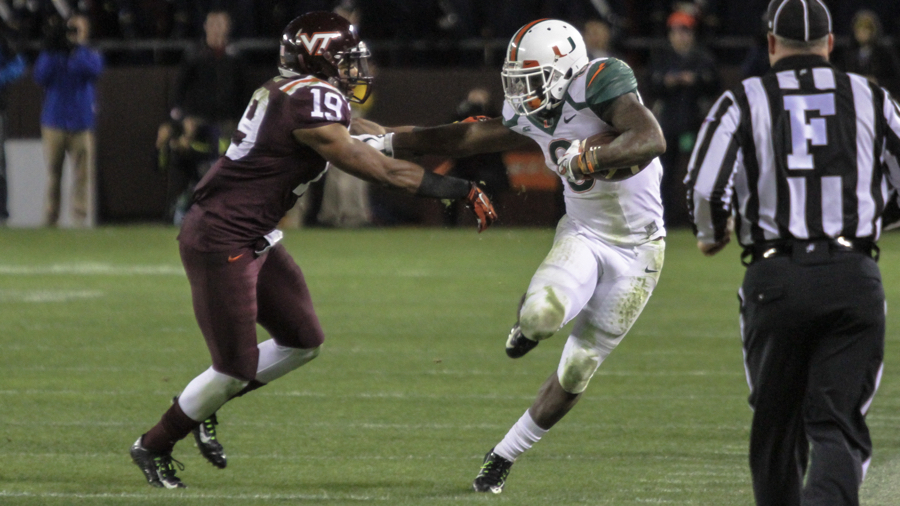
Well, that was ugly. There's no way around it. But it wasn't as ugly as it could have been. Miami beat us in the first half. Handily. We beat ourselves in the second half. Should we have lost the game? Probably. That badly? Not quite. It seems like a broken record, but I think we were only a couple plays away from at least making this more respectable. By no means do I think we deserved to win the game, but it shouldn't have been as bad as it was. Any time we created chances for ourselves we seemed to make mistakes to eliminate those chances right away. Acknowledging our struggles so far, we need all the help we can get and cannot afford to squader the opportunities we do create.
These missed opportunities affect us for far more than just the play during which the occur. A mistake that costs us on one play has a cascading effect that troubles us much further down the road, whether it be that particular series, that possession, or the entire game. Our first possession is a great example. An unnecessary penalty by Bucky Hodges on our first punt return led us to start at our own 13-yard-line instead of a very favorable position nearly right at midfield after a great return by Greg Stroman. I'm not saying we would have scored a TD right away and the game ends completely different, but we have a better chance at getting some points, and the field position game changes entirely even if we still end up punting the ball.
Before I delve into the offense and defense, I want to give a quick shoutout to our special teams play. I think overall we played very well on special teams. It was nice to finally see some good returns on punts (outside of Hodges' penalty) and kickoffs that helped our offense by shortening the field. Additionally, our coverage on punts was generally pretty good, and we blocked an extra point! Obviously the short punt into the wind by A.J. Hughes hurt us, but overall it was good to see some solid play by those who ride bus 3 (special teams).
There was no question of Miami's strategy to attack our defense in this game. Their objective was to funnel everything through their backfield. With large offensive linemen and incredibly skilled running backs, Miami dialed up a heavy dose of zone blocking to move the ball on the ground. A few play-action passes allowed them to go over the top when needed. What hurt us the most were the cutbacks on the runs, and the involvement of the running backs in the passing game. Miami was not afraid to run out of spread formations, ensuring our defense was stretched thin to give Duke Johnson and Gus Edwards plenty of lanes to cut back against the grain.
On this 3rd-and-1 run, you'll see all of our defense slant to the top of the screen, with no one filling the backside for cutback support. Ken Ekanem (No. 4) seems to be automatically crashing regardless of what the offense does, telling me that some sort of cue (probably the alignment of the offset end) was dictating his play. If this is the case, I would have thought there'd be some sort of backside fill. Maybe there is (Kendall Fuller - No. 11, or Kyshoen Jarrett - No. 34), but it's slow to arrive for a 3rd-and-1 situation. Duke Johnson (No. 8 - Miami) runs into his own blocker slowing his momentum, otherwise he would probably would have gained much more than just the first down.
Another example of this comes towards the end of the game. It appears there has been an adjustment to where, instead of Ekanem slanting hard, he loops upfield and the outside linebacker (Derek Di Nardo - No. 41) crashes down the line. This creates an opportunity for Ekanem to make a play in the backfield, but he gets too far upfield, effectively creating another cutback lane for Duke.
We see this another time on Gus Edwards' (No. 7 - Miami) long touchdown run. Over-pursuit by our defense, and a slip by Kendall Fuller, leads to the long touchdown run. Both Dadi Nicolas (No. 90) and Jarrett are scraping down the line, but get caught too far inward. I think there's a legitimate case to make for Jarrett being held by Miami's WR No. 3 here. It was a very short hold, but stopped Jarrett completely nonetheless and should have been called.
When Miami's running backs weren't handed the ball by QB Brad Kaaya (No. 15), they ran routes out of the backfield so he could throw it to them. If part 1a of Miami's strategy was to run the ball with their RBs, part 1b was to have them catch it down the field. I think Miami wanted to attack our interior linebackers, especially Andrew Motuapuaka. Motuapuaka, who made his first start, was put in a tough position having to handle Duke Johnson all night. With so much emphasis on Miami's running attack, it was easy for our defense to get sucked in with a play-action fake, and then get beat over top. This play halfway through the first quarter is a good example.
In this case, Andrew Motuapuaka (No. 54) starts off in pretty good coverage. He knows he's matched up with Gus Edwards, and scrapes along to run with Edwards out of the backfield. Detrick Bonner (No. 8) and Jarrett both are sucked in by the play fake, and scramble to recover. Although Motuapuaka starts in decent position, Edwards' speed creates enough separation for Kaaya to drop the pass in. Thankfully Kaaya does not recognize Bonner coming in on the fake, otherwise he has an easy throw over the middle to Phillip Dorsett for the touchdown.
In another example, Deon Clarke (No. 40) is matched up with Johnson coming out of the backfield running a simple out and in route. Although Kaaya missed the throw, Clarke was out of position and Johnson was open. Don't get me wrong, I'm not criticizing the play of our linebackers in this case. Miami's running backs present matchup problems that they took advantage of with our defense. Covering Johnson or Edwards coming out of the backfield is no easy task for a linebacker, and Miami knows this.
If it's tough for a linebacker to cover either of Miami's RBs, you can bet it is even harder for a defensive end. Twice in this game we saw a play in which a DE was tasked with covering the RB underneath. Before we go screaming about why that would ever occur, keep in mind that same sort of coverage led to an interception vs. Pitt last week. We see that as an example here on 3rd down late in the first quarter.
The Hokies are in man coverage with a safety over the top (Cover 1). Pre-snap, we show a blitz with our 6 interior players. While Motuapuaka and Clarke blitz, Ekanem and Nicolas take two steps up field and then drop into the underneath zones. Again, last week this resulted in an interception. In fact, Ekanem is in the exact same position to intercept the ball that Nicolas was last week if Kaaya hits the underneath crosser. The difference between last week and this week though is Johnson out of the backfield. If Miami's offensive coordinator saw that film last week and dialed this play up for this week... then a tip of the hat to him. Kaaya stands in the pocket just long enough to give Johnson time to get around Nicolas, and floats a prayer up that Johnson can run under. You can't fault Nicolas too much here, it's a tough position to be in.
The EXACT same setup by both teams resulted in Miami's touchdown immediately prior to the half. The setup is identical. Miami has the ball on the right hash, trips to the left and one to the right with the RB to Kaaya's right. The trips all run vertical routes, the solo WR drags across, and the RB releases out of the backfield. We're in cover 1 man, with 6 guys at the line of scrimmage. Again we show blitz, but then the DEs drop off. So again, we have Nicolas in coverage with Johnson. I really don't like to question Coach Foster's calls, but this one has me puzzled. As I've mentioned, we certainly have seen success before with this call, but I don't see the reasoning behind using this defense with Miami having no timeouts and :09 seconds left in the half. Bud's got to want to have this one back. I'm not sure what we have to gain here versus what we have to lose. If you're going to have two players in underneath coverage anyway, why make the switch between the LBs and DEs? If you're going to bring the LBs on a blitz, why not bring the house? It seems like an in-between scenario that doesn't lead to much upside and leaves us susceptible to a big downside in this scenario, a la a Miami touchdown right before half.
Our defense clearly did not have a good first half. However, whatever the defensive coaches told our team/adjusted did wonders for the beginning of the second half. After each of our first two turnovers, the defense did a great job buckling down and getting the ball back. It wasn't until after our third turnover that the defense started to yield; I'm sure it was somewhat demoralizing to see the offense cough the ball up so quickly like that.
From an offensive standpoint, we also did not have a good first half. Again, I yield to French when it comes to blocking schemes and the performance of the offensive line, but we've got to get better there. The bubble routes we attempted from a passing perspective worked to extend the running game outside. I know a lot of people (including the announcers) were critical of this approach, but I think it was a pretty good strategy, at least in the first half. We're not the type of offensive team that can dictate to the defense what we do. Its sad to say, but right now, we have to take what the defense gives us. Last week versus Pitt, it was the outsides and underneath. This week versus Miami, it was the bubble routes. Lets look at this play late in the first quarter. A simple way to analyze this is from a basic mathematical point of view. To the top of the screen, there are 2 Miami defenders. Across from them there are 3 Hokie WRs (well, 2 WRs and a TE). In other sports, you would refer to this as "having numbers" in basketball or an "odd-man rush" in hockey. The point is, we outnumber them. To have a blocker for each defender and one of your better athletes with the ball in space is pretty much the goal of any offensive strategy. That's why I'm okay with this approach, because it was there throughout the game. In this specific example, yes Michael Brewer makes a bad throw and the blocks aren't completed executed correctly, but the foundation was there, so I can't fault Loeffler for trying to take advantage of it.
We see this again early in the second quarter. We have Miami outnumbered at the bottom, and we hit Hodges with a quick pass. The blocks by the Isaiah Ford (No. 1) and Josh Stanford (No. 5) are good, and Bucky gets upfield. Yes I think Stanford has a good block, having his hand on the outside of the DB is what gets him in trouble. He's positioned his body pretty well, and I really don't think he gained much advantage by the "hold". Tough call to make, but having your hand on the outside of the DB makes a good block look more like a hold, which the officials cued in on.
This next example is one that puzzles me though. At the beginning of the clip, if you take the same math approach as above, you'll see 2 defenders and 2 WRs to the top, and 3 defenders and 3 WRs to the bottom. But, Miami shows blitz, creating a man advantage at the bottom. The initial design of this play appears to be a quick screen to the top regardless of the matchups. I think there has to be some sort of check that allows Brewer to change it to throwing to the bottom if the matchup appears more favorable though. It's a tough ask of an offensive lineman to get out to block a charging DB in time for a quick screen. I think we would have had much more success throwing to the bottom of the field if we check to it at the line of scrimmage.
This bubble approach was also created using the 3 players split wide as blockers for the RB out of the backfield. In this clip, we have 3 WR split to the top, with our TE and RB also to the right of the center. For how much of an unbalanced look we are presenting, Miami is not doing a whole lot to overload one side of their defense. As such, when Brewer hits Joel Caleb coming out of the backfield, we have a everyone except the safety blocked, and Caleb picks up a nice little gain before the fumble. I want to emphasize this is a really well executed play outside of the fumble. We have 4 great downfield blocks by the WRs and TEs. It is completely overshadowed by the fumble, but this is what Miami was giving us all night, and we were able to take advantage of it.
I think Loeffler was trying to use the bubble passes to set up a pump-and-go down the sideline for a big gainer. This is a good idea if Miami is jumping the bubble route, but to this point I don't think Miami really was pressuring the bubble that hard. I think sticking with hitting the bubble route quickly was our best bet, especially as we got close to the end zone as in this play.
Not only do we have Miami outnumbered to the top of the screen, but one of the defenders blitzes, so we have two blockers with Hodges running the bubble. However in this case, Ford is actually running a go route so that Brewer can fake to Hodges and hopefully hit Ford down the sideline. Byrn is caught in some sort of awkward middle ground, faking a block on a non-existent defender. He doesn't see it, but looking inside to pick off whichever defender scraped across would help Hodges immensely. Based on the defense Miami lined up in though, I think Brewer needs to nix the fake and hit Hodges immediately. I think the technique of the DB shows he's not going to bite because he has deep responsibility, so the pump fake won't excite him. What I don't know though, is what sort of flexibility Brewer has here. Does he have a pre-snap call to nix the fake? I just don't know.
Switching gears a bit, I wanted to show clips from the later in the second quarter when we were backed up into our own end zone. I think this series of three plays were a huge turning point in the game, and our inability to move the ball coupled with a poor punt by Hughes really tilted things in Miami's favor. Our first play call was a flood route into the boundary.
Hodges clears down the sideline for an out route by Malleck, Rogers peels into the flat and Stanford runs a shallow drag from the backside. Rogers gets eaten up by the DE, so I think Brewer is looking to try and hit Malleck. Based on where the defender is when the ball goes out of bounds, Malleck may not have been open. However, I think the read here has to be underneath first. With Rogers locked up by the DE, Brewer needs to find Stanford over the middle. It appears that he looks at Stanford, but I think at that point he's actually looking at the blitzing defender. He needs to realize the defender is blitzing right from where Stanford is running to, so he has an easy dump off pass. A keen observer will point out how last week I referred to a backside drag route as the 3rd or 4th option that shouldn't be considered. Even if that is that case here, Stanford has a route that is run at a shorter depth and straight across the field rather than drifting further from the line of scrimmage. I think the read has got to be the shorter routes first knowing that being near the goal line Brewer will not have the time to go downfield.
I think part of what makes Brewer feel he needs to rush is his poor footwork on this play. This drop back has to be quicker, cleaner and sharper. After the play fake, he sort of pitter patter steps to gather his feet as if he were going to look for a long throw down field. In this situation though, he is not going to have time for that. He needs to make his fake, and get his feet set immediately to recognize the defense and be ready to throw right away.
This second down play call baffles me. Like seriously. We run a two receiver switch and sit route, with a rollout by Brewer to his non-throwing side (to his left). That's creating an incredibly tough throw for Brewer close to his own end zone. The key to throwing when you roll opposite of your throwing arm side is getting depth, then moving forward towards the line of scrimmage as you throw to get some momentum behind the ball. That's really hard to do when you're almost running out of your own end zone after getting the snap. He appears to have Ford open sitting at the first down line, but he has no easy way to get the ball to him. I'm glad he threw it away, but how do you not call a run play here? Last week, we were backed up into our own end zone and we ran the ball 3 times (remember, Marshawn was out). This time, we throw the ball three times. Granted, the 3rd down call was a good play call based on the situation, (smash route, the corner receiver was open and Brewer overthrew him), but I really thought we'd run the ball on second down.
I know Brewer's arm strength has been questioned in the past, and I think we saw some examples of it during this game. Getting the ball out quickly and with some velocity is not his selling point, and I think we all recognize that. His accuracy and game management was what we were all sold on, even if that hasn't turned out to be the case in every game so far. With Mark Leal, we do see a bit stronger arm. On his touchdown throw, Leal didn't have the best footwork, but was able to make up for it with his arm strength. He threw it pretty flat footed, but still got it there. Unfortunately, just a few plays earlier he threw one low on a very similar route to the TD.
Is Leal the answer? I don't know, Miami was playing some soft defense with the game well in the bag. Will it hurt to find out? No, I don't think so. It's easy to think the grass is greener on the other side, but to really know, you have to cross the fence. I don't think we have much to lose by making a QB change, since nothing else seems to be working. I'm not trying to put all the fault on Brewer though, because there's plenty of areas where everyone can improve. However, a shuffle can bring some different talents to the table. Just keep in mind, it will also bring a different set of challenges too. I'm all for mixing things up to find out what works, but lets not look at a mixup as if there is one-change-fix-all move for the coaches to make. We have to get better all around.
As a side note, I know last week a bunch of you asked what I thought we needed to do execute better, and what I thought of Beamer/Loeffler etc. Those sorts of questions are tough to answer. It's easy to look at the film and explain why things didn't work. The film is right there in front of you, and most everything you need to know is there. As far as describing the how to improve, that's a whole different animal. This is why coaches get paid a lot of money, and get fired when they aren't successful. Discovering that "how to get better" thing is not simple. I can't try and speculate on that because in all honestly, I know nothing about that. I'm not a coach. I put my trust in our coaches, and believe that they are trying to help the team be successful to the best of their abilities. To question their abilities? That's why the athletic director gets paid so much. I'll leave it up to him.
I won't leave you with a complete non-answer though. So what do I think we need to do? Up-tempo. Faster cadence. Just like we did when we opened the second half. Why do I think that? I watch a lot of Oregon Ducks games.

Comments
I think the Leal ship has sailed long ago. I was a proponent of getting Leal more involved last year when we were basically out of the running for an ACC championship and Logan Thomas was struggling. However, the coaching staff refused to even give Leal any remotely meaningful snaps in preparation for this year or in the event that he had to go in (see the UCLA bowl game).
At this point though, it would be much more useful to get Motley involved and see the extent of his ability. At least he'll still be on the team in the future. Getting Leal in there would be meaningless at this point, because the potential of this season is a lowly birth at the Geico Bowl or something. I think it would be more useful to continue on with anyone else for the rest of this season in order to be productive.
Giving Leal the ball would not be completely useless, because it would allow the rest of the offense to learn to play together with a pocket passer, and maybe gain some confidence. But I agree that Motley is probably the better choice.
you play the best guy. Brewer has another year of eligibility. Perhaps we need to come to grips that he is better than Motley?
If thats the case, we're in a world of trouble.
Brewer is the 93rd ranked passer in FBS this year. 93rd. If we don't have anyone on our roster better than that, we're in for some long, long, loooooong years ahead of us.
I think we do. But, they are being redshirted this year.
You'd think that if it were even close, then Motley would have gotten the mop up duties behind Brewer, instead of Leal. I don't think it is close.
I meant anyone except Leal should get snaps at this point (either Motley or Brewer). Also, burning a redshirt on someone this late in the season wouldn't be worth it.
great write-up as usual. A question for you film disectors. It appeared through my maroon and orange colored glasses that Miami was getting away with A LOT of holding. That hold of Jarrett you mention above on one of Johnson's TD runs was right at the point of containment and you would think that multiple refs would have had a clear view of it. What is your opinion on the amount of holding the U was getting away with? Was it typical?
Officials miss calls regardless of the color of the jersey. Contrary to what Notre Dame fans think, officials don't have it out for any particular team. Sometimes they just aren't that good.
of course! I was at the game, I did not get a chance to see it with replays, etc. My question was for those like French and Jeff who had looked at the game in detail, whether or not they thought the U was getting more breaks there than usual.
I think we often see where missed calls hurt us more. When Dadi got a penalty for a personal foul, that was after he was tackled by the offensive lineman. Should have been a holding penalty but instead it went the other way. On the other hand, I'm sure there were several penalties we got away with too. The thing is that you can't concern yourself with whether the other team is catching breaks. The performance on the field is what dictates the outcome of the game, not the zebras. Whether they got more breaks or not, it's just part of the human element of the game. Everybody will have a different opinion on what they see. For instance, Marshawn, after reviewing game film, still thinks he was down on his fumble. I disagree, but that's where two people see two different things. After having a thread regarding whether we were cheated from a win in the Pitt game due to the play clock confusion, seeing a comment regarding the officials and whether they missed calls in a blowout made me feel the need to comment on it.
Thank you. We have far too many problems with our offensive & defensive performances in the Miami game to once again go down the path of - 'the officials don't like us'. It's just very unnecessary.
Officials miss calls all the time. It is hard as heck to officiate a football game. I've yet to hear a losing team claim that the officials were too lenient on them and/or too harsh on the winners.
The officials are like the weather -- both teams have to play in the same circumstances, and both teams have to figure out how to make it work for them rather than against them. Particularly holding -- the CW says the officials could call a holding penalty every play if they wanted to. No one wants to see that. You just have to hope that it will even out over time, although it may not even out during one game.
My son told me a great quote the other day, although I don't recall the attribution. If you hear someone say they could do a better job than "that ref," ask him, "Which of the seven positions would you like to try? Back judge? Head linesman?" The type who think they could do better than the zebras on the field typically don't know enough about it to know which official has which responsibility.
Your son is one of my favorite people.
It's an interesting point, but in reviewing the film, nothing really stood out to me that much. Outside of the one I mentioned, (which again I think was marginal but still a hold, but also not an excuse for the defensive play there) I didn't see anything that bad really. I guess the majority of the plays seemed doomed anyway, so what's a hold or two at that point?
Worth mentioning that that offensive PI call on Notre Dame was 100% correct as well. Just sayin (not necessarily to you, but more in general).
As an official, I think I'll chime in here. The umpire (who conveniently has an arrow coming out of his face) is looking right where he's supposed to be. That's 100% his key - the center and guards. In this case, this is the side judge's call. His key is the outside receiver, and whenever that player can "threaten or be threatened," he needs to be the one with a flag on the ground if a foul occurs. Since there is no one in his zone (deep and wide) to take his attention, I'm not sure why he abandons his key. On top of that, the head linesman is responsible for the spot and the tackle. However, the runner is close enough to the block that he should pick up on that hold pretty easily. The final line of defense, so to speak, is the back judge. However, he is looking play-side and his key is the second man in to the passing strength (so either a WR or a TE, in this case the H-back to the left), so you really can't fault him for not being on top of things when the runner cuts back.
Keep in mind, physical proximity doesn't always mean a certain official has the call, and you shouldn't expect him to. Still, I'd be very much interested to hear what was going through the side judge's head on this play.
thanks for the great reply - I see why you're nearing 10,000 TLs! I learned something from your response ... I really enjoy learning and being entertained when I come to TKP.
Duke Johnson is a great RB, but give Bud Foster one off-season, he will figure Duke out.
wooh...woooh....wooohhh... let's be clear here: Duke Johnson is a true-Junior. He's draft eligible.
We are in full support of Duke Johnson "taking it to the next level." All Hokies support Duke Johnson in his professional career.
Supposedly his mom is talking him into staying for his senior year. I wonder how much the Boosters are paying for her to say that. Cause Duke Johnson might be the first first round RB since David Wilson.
Duke is good, but Gurley and Abdullah will be drafted before him.
I don't see Gurley or Abdullah with his catching skills out of the backfield or the special teams play. Gurley also might get hit from the getting in trouble. I had never heard of Abdullah before this year, Duke has been good every year of his career. But you have a very valid point.
Gurley won't take any hit for this situation. NFL execs know it is a stupid rule and aren't going to hold it against him. Now if he was failing drug tests, that's a different story. Regardless, Duke is fast and strong, and I see him doing well in the league, but I don't think he is among the top 3 backs in the nation right now.
We can agree to disagree.
Todd Gurley 100-yd KO RET TD during his freshman year.
Todd Gurley 73-yd receiving TD last year against Florida.
Todd Gurley 100-yd (actually 104, but college) KO RET TD. That was this year.
I sound like a Georgia homer, but the skills you don't see Gurley having? They're there.
I think that if anything keeps Gurley from being a first round pick it is concerns about his ability to stay healthy (not that I agree or disagree with those concerns).
Duke is actually the 8th rated back on this list. That seems low to me.
http://walterfootball.com/draft2015RB.php
I could buy Gurley and Yeldon above him.
Gordon plays behind the best offensive line in the country. I never believe in Wisconsin running backs (see: Dayne, Ron). I think they're generally overrated.
Mike Davis at USCe? Uhh, maybe. Haven't seen him play much lately. I would go Duke.
Abdullah? Maybe. He's good. I think he isn't as good as Duke, but whatever.
I would have Johnson at fourth at the lowest.
I predict Duke Johnson will gain zero rushing yard against VT next season.
Duke Johnson is so good that the ACC has declared him the leader of the Coastal division....ahead of his entire team.
Another excellent post btw, and very much appreciated.
This quote stood out to me most and explains so much of why I can't help but question our current coaching situation.
Now maybe it'd be too irrational to dump your starting QB after a single poor performance, but given our current situation there just seems to be more positives than negatives for making a change.
In no way am I convinced that a back up will come in and go Andrew Luck for us, but sometimes you do get that magical element that some guys have under the bright lights. We've all seen third string QB after thoughts come out of nowhere, and out perform when given the opportunity. Openness to change can also keep guys engaged and competing, knowing their opportunity could come. Loeffler admitted as much at the beginning of this season that perhaps he should have better prepared Leal to be game ready. If nothing else, galvanize the fan base and say hey we're trying to compete, or here's something new to come see at the next game. And as Jeff pointed out, a different skill set could maybe end up being more compatible with the elements on this team; who knows?
The lack of transparency from the coaching staff is concerning. We almost never receive any exposure to back up QBs even when the game is out of reach; which I find really weird. If someone else is hurt and can't play, I don't think it's too much to ask to be privy to such information, rather than have us speculate and heap unnecessary insult at maybe our only available QB.
And then we have the illogical moves like bringing in Leal into a game that is out of hand, in a season that is pretty much a bust. So if he plays really well and gets the start, he gets us to our 6th win, and then we'll be back to the drawing board again next year. It doesn't make any sense. Leal has 4 games left in his career and we should be developing other guys (Motley) at this point. Even if Motley doesn't win the job next year, I'd prefer to have a back up with REAL game experience; but better, we'd all know what we're getting if the starter isn't performing well.
Which I can understand if it were just one poor performance, but we're in the midst of a series of poor performances by Brewer right now
I definitely agree that it's pretty strange how unwilling CFB seems to be to put in a backup QB when the game is out of hand (in either teams' favor). It was certainly the same way when I was playing back in 07-09. Not sure why it is, but gaining some first hand experience never hurt anybody. I'd like to see the backups get in more when it is appropriate, so that we can be more confident in discussions like these about how the backups may play.
Was driving to work this morning and Duke Johnson ran past me...
My co-worker asked what was so funny after I read this. Thank you fine sir.
He was trying to catch up to David Wilson.
Good one.
Key word: trying
He stiff armed you outta the left lane.
Did he stiff-arm your car?
On that bubble screen to Bucky in the redzone, notice how important it is to be accurate with that pass. It's easy to notice inaccuracy on a 20 yard out, but if this ball is in front of Bucky and encourages him to build momentum instead of losing it, he beats Perryman to the corner and scores easily.
This was always my bugaboo with LT. Great arm but was frequently inaccurate on bubble screens and drags to the detriment of his receivers momentum.
Yup. Sixty-yard deep ball? No problem. Ten-yard screen? Uh oh ...
Jeff, my dude, great write up.
What you said re: the bubble screens is exactly why I don't fault Scott for the short comings of the offense -- at least certainly for the play-calling. The numbers were there for the screen game for the taking, and as in any west-coast offense, if the high percentage pass is there, then why not take it for easy yards? I'd do it every day! We did it with success when Tyrod was there, so I'm all for it nowadays too.
What I would blame Loeffler for though, is if he didn't have the right personnel in the formation for a screen game -- ie: not sure I'd want Mars Williams running the screen that Caleb did and fumbled. I'd blame him too if he didn't give Brewer a check-down on the one screen that was blown up near the side lines that you highlighted (2 WR vs 2 DB -- he should've checked out to the other side of the field). Bottom line, we're not executing, and at least from what I can tell, it's not due majorly to the play-calling.
I, too, find it disturbing when people who know football a lot better than I do seem to say the bubble screen is the problem, without explaining what they mean by that. Having read this post I am convinced that, if Loeffler is to be faulted for his play calling (jury still out), it's not just because he called bubble screens.
But here's the other thing I saw in these clips of the "offense"
1. Good play, reasonably well executed, Brewer missed a short pass.
2. Successful play. Good.
3. Perfect set-up for a screen to the left. Brewer throws right without ever looking left.
4. Successful play. Good except for the fumble.
5. (watch the replay at 0:16) Willie Byrn ALL ALONE at the 1st down marker. Brewer throws behind LOS.
6. Josh Standford open. Brewer throws the ball away.
7. Three receiver pattern, three receivers open. Brewer throws the ball away.
I've said it before, I'll say it again: we were sold Brewer not because he was strong, not because he was fast, not because he was gifted, but because he was a great decision maker. Which he isn't.
It seems to me there a little confirmation bias going on here.
5. Maybe I'm missing it, but I can't see the 1st down marker, let alone somebody open.
6. Stanford is open, but a) he may not have been visible and b) that's a tough throw given where the DL are.
7. As pointed out in the article, this play call puts Brewer in tough position. I also don't see THREE receivers open...I see only Ford open, but a LB is in position to cross in front of him. Brewer would have to throw across his body without the depth to be able to set himself. This one has a higher likelihood of disaster than success if he takes a shot at Ford, IMO.
The play runs twice in that clip. The replay starts at about 0:16. You see Byrn drift out into space looking for someone to block. He apparently doesn't see the linebacker, but realizes he's all alone. So he runs to the marker and makes himself a target. I watched it a few more times, and perhaps I am being unfair. Brewer was under a little pressure, and I don't think Byrn had looked back yet when he threw the ball. If Brewer had been able to buy a second or two and then throw... but maybe that is too much to ask at game speed.
And yeah, confirmation bias is a problem. But I think my overall point is valid.
In response to your list I wanted to point out some things.
3. Pre-snap read misjudgement. Needs to recognize that.
5. Willie Byrn is not running a route on this play. Like Jeff pointed out this was the play where they wanted to finally use the bubble as the bait and take a deep shot. From pre-snap alignment, you can see it is not the correct time for the deep pass, but the bubble is there. Willie needs to recognize that the corner was taken deep, and immediately turn inside looking for scraping defenders. This play would be much more successful this way.
6. Josh is open, but it was a flood concept. Josh is one of his last reads coming from the backside. In this situation though, Brewer should see blitz from the mike backer and see this as his hot route.
7. Isaiah was open, but this play call just doesn't make sense. Like Jeff said, when rolling to your non-throwing side, the QB is supposed to get depth and attack the LOS to get velocity on the throw. Because we are at our own goalline, Brewer cannot do this which is what makes this such a questionable play call.
I was unfair on 5 (as I have also noted above). I did not notice until I had watched it a few more times that Brewer was under just enough pressure that he couldn't wait for Byrn to turn around. (You can see the pressure on Brewer in the first half of the clip and Byrn in the second, but you never get to see the two of them together.) So to make that throw he would have to either buy a little time in the pocket or throw the ball at Byrn's back and hope for the best.
The only problem I have with the bubble screens is that there aren't any extra blockers out there. We are leaving our receiver out there to beat a defender one on one and they usually spend so much time dancing that more defensive help arrives.
If you watch other teams run screen (ECU) they either have the receiver take off up field about 4 yards and have him come back around to the inside or they just have the receiver come towards the QB which allows blockers to get setup. When the receiver starts off up field and comes back he leaves his defender 7+ yards up field and he allows time for some OLine blockers to arrive.
That's just my observation on the bubble screens.
What you are describing is a tunnel screen. Both of these screens are effective in their own way.
First the bubble. The general idea is that you have numbers. The bubble screen is usually ran towards trips. The #1 WR will block the corner. The #2 will block the safety or OLB. WR #2 blocks with his butt to the sideline. WR #1 can take the corner with his butt to the play (creating an alley between WR 1 and 2, or butt to sideline where the WR #3 can run between the alley created between his block and the sideline.
The tunnel screen: WR 1 will generally take 1 or 2 steps up field, to allow his blockers to set up, then tunnel back down the LOS towards the QB. The WR catches the ball on the run and because of the Defensive line rushing up field and the blocks downfield, a tunnel is created for the WR to run downfield when he catches the ball.
Both can be successful. Hope this helps!
This is very helpful. But both of these seem like plays that should be run when the receivers are given a lot of cushion. It seems like something that the QB should audible into rather than something the OC calls and it is run no matter what.
The bubble is designed for when you have the numbers, and they are giving you cushion. Usually the bubble is good for 4-10 yards. You run this play enough and they have to respect it, opening up over the top. Lefty tried to bait them into a bubble and go where the bubble is ran, and the WR1 fakes the block and instead runs a go route. This is a good play, however, was ran when the corner had deep responsibility so had no reason to bite on the bubble.
The bubble can also be combo-ed with a run play. A lot of times the QB can have the option to hand the ball off to the running back or throw the bubble. It's basically a read option play in which the QB can read the guy on WR3 and the numbers the defense present. If OLB stays with WR3, hand the ball off. If OLB crashes the run, throw it out to the bubble and let him make a play in space. Like Lefty says its an extension of the run game.
Edit: I added some images to help illustrate my point. There has been a lot of criticism of the bubble screens, but it's a common wrinkle in a lot of today's high scoring offenses.

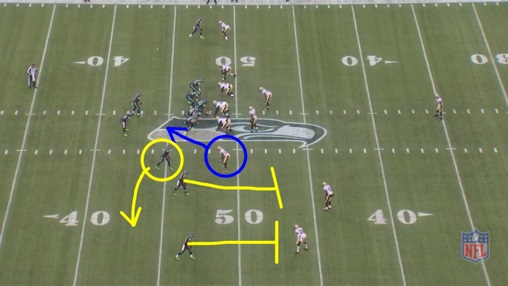
If you play a skill position, you must be able to win your 1 on 1 battle. When our numbers are 3 on 2 to one side with a deep safety in the middle, that's often when we see a bubble screen. There's nothing wrong with that play because you have 2 receivers who should tie up the defenders so the person receiving the pass can get up field at least 7-10 yards. I'm not 100% sure on the terminology, but it sounds like you're talking more of a tunnel screen or a jailbreak screen depending on who is blocking for the receiver. That's different than the bubble screen.
"Play calling" has a lot of different meanings. Loeffler has the right plays in his playbook. He often identifies the right subset of plays will best be utilized against a specific defense: game planning. Any individual play may or may not work depending on execution.
But getting in a flow, calling plays that build off each other, that keep the defense on their heels. That is the art of it. When Foster is good, he is great at calling the right blitz/coverage at the exact right moment. He feels which guy has the right matchup or which offensive player might be vulnerable. It's very ephemeral.
I haven't seen Loeffler get into this flow very often. The OSU game had good flow on the successful drives. He was in a good flow in the first half vs. UNC. He was in good flow early against GT last year. But there is very little consistency in his playcalling.
I think for Loefler, plays 6-10 in a drive tend to be a sweet spot for him. It's getting beyond play 3 that has been a challenge for our offense.
Agreed, but you have to execute plays to ensure they can build-off of each other. If the OL isn't blocking or your WR's aren't catching, I can't see how anyone would reasonably expect any subset to work at all.
There aren't many (or really any) plays that you can plan around this. In years past we had the "oh sh!t" play where TT, LT3, etc would scramble and get positive yards, but I don't think that was actually in the playbook as much as it looked like it should have been.
Yeah, we got far more out of Tyrod's "Oh sh!t" button than we could ever expect to get out of anyone else. And for all the heat LT3 took over his career, his frame and his arm got us out of a whole lot of jams.
Thanks for the write-up, i enjoy reading your work. in particular, your naming the name and the jersey number when looking at the film help immensely, as i dont have everyone's number memorized. Your insight is great, keep up the good work!
Yes. I love French's write-ups, and I know it's my own fault for not knowing the linemen's numbers, but I literally have to keep the roster open in another tab to follow along. Mea culpa but I appreciate the crutch.
Not at Virginia Tech!
:)
I'd disagree..... but yeah, you've got a point. Moorehead comes to mind for the first part and Newsome for the second, to top the respective lists.
Seriously though, another great write up. Between you and French this site is invaluable to Tech Fans, especially in times like these. I wasn't too high on Lefty after Thursday, but I think that you and French's review both kind of absolved him from a playcalling perspective. There was the occiaisonal "WTF call was that?" but for the most part it was "This was a good call but the OL (him) messed this up, or the QB (you) messed this up." When your OL and your QB are this consistently...not good...its going to make every playcall look like a bad one.
That said, one thing I think we really can critisize SL for is his QB development. He's the QB coach, he's this alleged QB whisperer, and he has this line of Tom Brady's an the like that he's supposedly groomed into who they are today - or at least contributed to their growth...So, why do both of our QBs continue to have such basic footwork, mechanics, etc. problems? Three and five step drops, making reads, getting rid of the ball is basic stuff right? Even rolling out and throwing properly when you roll to your non throwing side like you talk about is a little more advanced, but probably shouldn't be this challenging at this point...right?
I don't know, perhaps I'm over-simplifying. It wouldn't be the first time.
I'm not disagreeing, but remember he hasn't had a full offseason with Brewer. I don't know how much fundamentals can be drilled during the season, but hopefully he'll get a chance to work his magic during the spring.
Although a lack of basic fundamentals seems to be a common theme for us. I remember a few years back it being admitted that our OL didn't understand the correct aiming point for a cut block, and Newsome assuming they would already have been taught that.
It's certainly a valid point. I would hope that SL highlighted some of the footwork stuff when the reviewed the film. I would point out though that Brewer's footwork isn't too terrible overall (or so I've seen in the past two films). I highlighted that one there because it got him in trouble, but he does have other times where his footwork is good.
[In fact, one play I didn't bring up but had thought about was a 3rd down pass that was tipped at the LOS. Although it was tipped, Brewer took a nice, quick 5 step drop and took a hop or two into his throw in order to get some pace on the ball. I think he was trying to hit a WR running a stop route and really would have had to slung it in there to complete it. His extra hops allowed him to throw it a bit harder, just got tipped at the line.]
I think with the roll out he didn't have enough space to roll correctly because he would have had to drop out of the back of the endzone. As far as the drops go, from what I've heard is that Brewer has never really done much under center. If that's the case, then he's a bit less experienced with a 3-5 step drop with a play fake. I'm sure they go over footwork for a period or so in practice, it just doesn't always carry over every play. Hopefully a good offseason/spring can help to clean a lot of that up.
In regards to SL being this great QB coach or whatever, here's my take on it. You can't squeeze blood out of a turnip, meaning you can't get something out of something that isn't there. Tom Brady I think we can all agree on, is a rare talent. SL had something to work with and even then he only instilled the foundation in Brady, he didn't turn him into a three time SB champ.
Also, after it's all said and done Brewer is only three months and eight games into our play book and he also has a confidence issue going on, on top of normal banged up football injuries. If we would've lost to tOSU I don't think we'd be having this "OMG fire everybody, bench the QB" conversations that we're having here these past couple of days. I know, I know we didn't lose, but even a blind squirrel finds a nut every once in awhile. We'll be fine, we'll get bowl eligable this year, and this group of seniors will not want to be the group that loses to LOLUVA. Granted, after the tOSU game I was all like "Why not us" but since then, it's more like
How long must someone who has played QB their whole life be in a system and how many games must they start before "properly setting your feet before you throw the ball" ceases to be an unreasonable request? Especially for someone coached by an alleged expert in the field?
Much like the OL, this is the concern with Brewer - it's not highly complex stuff that he's failing to do. It's not really systemic, and It's not high concept. He's failing to do very basic "Quarterback" stuff, here. I think, I'm not expert myself, but that's some of what I'm getting from the film reviews at this point.
Have you ever tried to set your feet and throw with a rush on and you've been hit and you're still not 100% sure of what you're seeing in front of you because you've only repped that particular play a dozen times or so?
I'm gonna assume the answer here is "no."
Much like with the rest of our young guys, time and reps will heal just about all wounds in most cases. No different with an inexperienced QB. If he had been a 2 year starter, I'd be very much concerned. 3 months and 8 games into his career, not so much.
No need for an off-season. Bud already knows how to handle Duke Johnson or any other great running back. It's a matter of getting his guys prepared and ready to execute at 100%. It's like playing against GT's offense. If every single guy on defense does exactly what his job is, then GT's offense won't succeed. But as soon as one part breaks down, then the flood gates are open. Same with guys like Duke...if everyone executes their coverage and tackling assignments, then Duke won't have nearly as impressive of a game. But the D-line got man-handled and the LBs were frequently out of position or tackling poorly.
EDIT: This was in response to comment 205193. Not sure what happened when trying to "reply".
Agreed.
Williams being out was a real kick in the pants as far as tackling Duke Johnson is concerned.
Jeff,
Great article. I agree about your observations of what we could on Offense wrt to speeding it up, etc... My Brother in law played for Oregon, thus I see a lot of Oregon games by default, and have a bit of a rooting interest in them. When my BIL watches VT games, especially this past one, he says the same thing you said about speeding up. Like a lot of us, he noted how much better we did when we sped up the tempo and ran the same 2-3 plays on that drive. He was miffed that our OC didn't continue that pace/use it as the base. Basically, Oregon doesn't have a huge complex offense; they have a smaller grouping of plays that they run very well and fast. The speed at which they run them, causes opposing Defenses to get tired and make mistakes. Obviously, we don't have quite the athletes that Oregon has, but we have proven to be effective with pace.
As an aside, Oregon's Freshman RB is a savage. That guy is the same size as MW, but runs stronger and is faster; he's nasty. I still think MW would be a lot more powerful if he ran lower and more behind his pads. It looks like he stands straight up upon contact, instead of trying to get lower.
Completely agree. The athletes Oregon has allows them to be so successful with the offense they run, but we've seen some success when we've run it too. Even if it is something that just catches defenses off-guard, when we can catch them off-guard we can score! I would like to see us integrate it more, especially on, say, a random drive early in the second quarter or something...
Am I the only one that wants to see us run a Stanford-Oregon combination? The power running game of Stanford with the pace of Oregon. Every 14 seconds, the defense is getting smashed. That'd be fun.
Whose defense do we get to run?
Bud's, duh. Oh, and Les Miles' insane 4th quarter decision making as well.
As to the Leal question, the real decision is this: do we plan on having Brewer start next year? If Brewer is not going to start next year, then yes, mix it up and see what Leal can do. But if, as of today, Brewer is still the man for next year (and I suspect that is the case), then leave Brewer in and get him to (hopefully) improve.
Great write up Jeff, great addition to TKP. I hate being overly critical of Brewer, but I've noticed something that's hurting these bubble screens. Bubble screens are designed to get athletes the ball in space quickly. The bubble route involves the receiver retreating a yard or two so that he has momentum towards the LOS by the time he catches the ball. Too many times Brewer is throwing the ball to the receiver's back shoulder. Watch again and consider the time the receivers have to take to adjust for this, which allows for corners to fight off their blocks, and for LBs to pursue. If Brewer starts hitting these guys in stride, this is a much more successful play.
Agreed. Completely. You look at the one to Caleb, which Brewer leads perfectly, and then compare them to a few others where you see the receivers have to change their path/turn their body. Because it is a play where you're catching behind the LOS, you definitely don't want to waste any time or movement since flow is coming to you quick. A poorly thrown ball on a bubble can kill the whole play, whereas a nicely led ball can help catapult the receiver up field. If we are going to continue to see this in our offensive attack, I would really like to see a bit better accuracy so the receivers can catch the ball in stride. Good call out.
Also, it's important to throw the ball forward, where a drop is an incomplete pass rather than a fumble. Two good reasons to keep it in front of the receiver rather than throwing it at him or behind him.