
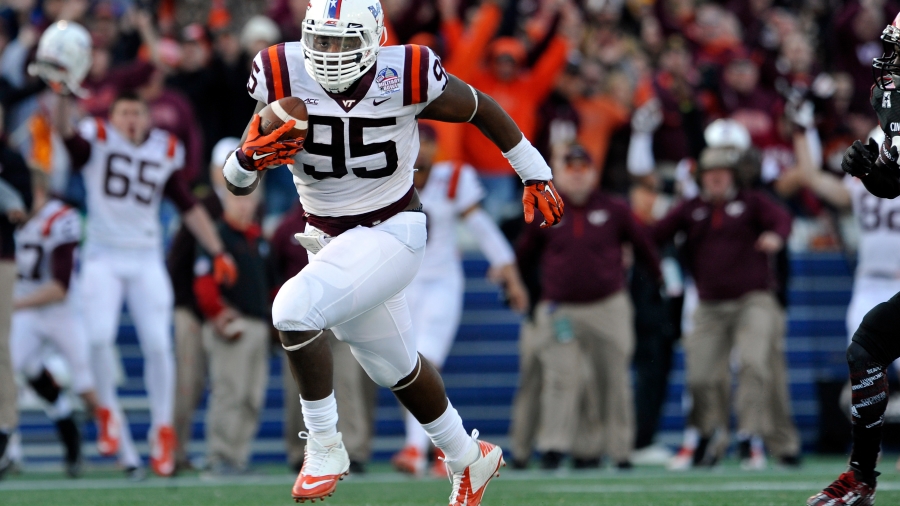
With Frank Beamer absent from Virginia Tech's sidelines for the first time since 1989, it was inevitable that some things would be very different for the Hokies during the Military Bowl.
Yet even with Shane Beamer stepping in for his dad on the field at Navy-Marine Corps Stadium, the team delivered a performance evocative of Frank's glory days with excellence in all three phases of the game.
"7-6 isn't what our fans wanted, nor us as coaches, but the toughness and resiliency that our guys have shown, ignoring the outside noise throughout the season, for them to come out and play the way they did today, I couldn't be happier for a group of kids," Shane said after the game.
It did feel a little bizarre to see Shane reading a statement from Frank (who had already departed for the airport) immediately after the game ended, but the sentiment he expressed through his son is one that speaks to the good feelings the team's 33-17 win over Cincinnati engendered in the whole staff.
"I've had many proud moments in my time at Virginia Tech, but this is one of my proudest," Frank said via Shane.
Wins in bowl games are hardly impactful for the state of any program, but it's hard to shake the feeling that this could be a sort of tipping point for the team after a frustrating 2014.
The Hokies showed offensive versatility, defensive aggressiveness and special teams competence, a trio of attributes not seen since the Ohio State win that could be very promising if the squad can display them again in 2015.
But the elder Beamer made it clear that it wasn't just his team's performance that resembled Hokies squads of old. Even though he could barely speak in the press box, the rest of his staff says his demeanor remained the same.
"He made sure to let me know to run it in the second half, especially when the quarterback went out, just 'make sure we run the ball here, Scot,'" said offensive coordinator Scot Loeffler. "There were a few grunts and groans on some plays as well, but he's awesome."
Beamer's values clearly haven't changed, even as the rest of college football has, but the bowl game did provide a few glimpses of the kind of team Frank wants to field as his career enters the home stretch.
Ford's Throw
Even as Frank wanted to keep things simple with the running game, Loeffler wasn't afraid to mix things up.
He flashed that creativity early, reaching deep into the playbook on Tech's third drive of the game.
The Hokies' first two offensive outings produced a three play drive that gained just three yards, and another three play drive that ended in a Michael Brewer interception.
Cincinnati scored a touchdown on their second drive of the day to go up 7-0, and it seemed like it would be the start of another long afternoon for the offense.
But then Loeffler shook things up. Brewer hit receiver Isaiah Ford on a 15 yard pass to open the drive, and a roughing the passer penalty by the Bearcats pushed Tech to Cincy's 34-yard line.
Loeffler called for a Bucky Hodges wildcat run, netting two yards, and then dialed up a play the Hokies have been practicing for months without ever deploying.
The Hokies faked a reverse to Ford, and sent Brewer running deep downfield on a very unusual gadget play. Ford never thought he'd ever get a chance to try it out.
"In practice, my hands were really cold, so I wasn't throwing it as well, but when he called it, I got excited," Ford said.
Ford uncorked a 30-yard bomb down the field in his quarterback's direction in an interesting role reversal, with one thought stuck in his mind.
"'Just don't get Brewer killed, that's the only thing that was going through my head,'" Ford said.
But he did more than just prevent Brewer's demise, he completed the pass, giving Tech the ball at Cincinnati's two-yard line.
Brewer says being on the receiving end of a long pass was a little different for him, but it wasn't an entirely new experience.
"I had a catch back at Texas Tech, but that was definitely my longest catch," Brewer said. "It was a great call from Coach Loeffler and it worked perfectly."
Ford has some prior experience throwing the ball too.
He played quarterback every year leading up to high school, and even threw a touchdown pass during his senior year at Jacksonville, Fla.'s Trinity Christian Academy. That provided the impetus for Loeffler to install the play.
"I remember telling Coach Lefty about it, and he said 'we might have to put that in,'" Ford said.
It's a good thing he did. The creative play call energized the whole offense, and gave an early spark to a unit that was off to a thoroughly sluggish start.
But the next big play of the day came courtesy of the defense.
Clarke's Forced Fumble
One aspect of the team that looked very much like Tech's teams of old was the Hokies' dominant pass rush, and their intensity on that front created one of the more memorable plays in the program's bowl game history.
On the Bearcats' first drive of the second half, quarterback Gunner Kiel was attempting to help Cincinnati answer a Ryan Malleck touchdown that put the Hokies up 20-10.
He helped the team pick up one first down, but on the fifth play of the drive, linebacker Deon Clarke derailed those hopes and changed the whole complexion of the game in the process.
Clarke barrelled through Cincy's offensive line to deliver a big hit on Kiel, jarring the ball free.
"At the beginning, coach called a blitz. Love blitzes," Clarke said. "The defensive line opened a big gap for me and I came through and did what I had to do."
Defensive tackle Nigel Williams looked up, found the ball right in front of him and somehow managed to scoop it up while staying on his feet.
"First thing was, 'got to get the ball.' I was trying to get the ball and not fall as I get it," Williams said.
Williams rumbled 26 yards down the field, but Cincinnati running back Rod Moore punched the ball loose on the team's 15-yard line.
"The running back ran me down and got the fumble, but I trusted the guys behind me to pick it up and finish the play," Williams said.
That's exactly what they did, as cornerback Greg Stroman was able to grab the ball and take it the rest of the way for the score.
"I was running after to go block and it came loose and I was in the right place at the right time," Stroman said. "They were ripping at the ball, and I was trying to get in there, and my teammates helped push me in."
Williams was frustrated about not being able to get the big score himself, but it still evoked fond memories of his high school days.
"I played a little tight end in high school, had a few returns, so I had a little flashback when I picked the ball up," Williams said. "I would've liked to finish the play, but I'm glad that we got a touchdown off of it."
The play was also a vindicating one for Clarke.
He'd been filling in on the kickoff team during the bowl game, but right before the second half started, he pleaded with Shane for one play off.
"Last year, I used to always play kickoff, every down. This year, they just put me on it for the last game," Clarke said. "I forgot how kickoff was, I was winded a little bit, so I asked (safety Der'Woun) Greene to come in because he was my backup."
Shane granted him some time on the sidelines, with one condition.
"I said 'if I'm taking you off kickoff, you better make a play on defense,' and he backed it up," Beamer said. "That was a huge play, it swung the momentum."
There's no doubt about that. Not only did Clarke's hit knock Kiel out of the game, but it helped give Tech a commanding 27-10 lead.
It was a testament to the way the defense played all year. Defensive coordinator Bud Foster never shied away from bringing pressure, no matter the circumstances, and that helped the Hokies accrue the fourth most sacks in the nation with 48.0.
This offseason, the program will lose four players (Chase Williams, Derek Di Nardo, Detrick Bonner and Kyshoen Jarrett) that produced 10.5 of those sacks.
The rest? They'll be back for more.
A Look at 2015
While the bowl win itself was encouraging for the program, it was some of the changes the team showed off during the game that are truly exciting.
"We talked about it in the whole bowl week preparation, the month leading up for it, this game was really just important to springboard us into the offseason," Brewer said.
Unlike the team's demoralizing beatdown at the hands of the UCLA Bruins in last year's Sun Bowl, there were a number of positive signs that could bode well for the coming season in this postseason matchup.
The first is one that's been evident for the last few weeks: J.C. Coleman is alive and well.
"I'm super proud of J.C.," Loeffler said. "That guy's a true Virginia Tech guy inside and out."
His 157 yards against the Bearcats set a Tech bowl game record and earned him MVP honors on the day, but his excellence over the team's last four games could have a real impact on the team going forward.
Tech certainly has plenty of options at running back going into the new season, but that doesn't mean there's any certainty about how much each back will actually play.
Marshawn Williams and Shai McKenzie are both nursing notoriously nefarious ACL tears (with McKenzie healing from his second tear in two years) and it's no sure bet they'll be ready for spring practice. It could hardly be considering a surprise if at least one of them ends up redshirting.
Trey Edmunds will likely contribute more next season, and he did get his first work since October against Cincinnati while turning four carries into 11 yards, but he's essentially been out of commission all year. He had a healthy redshirt freshman campaign in 2013 until the final game of the regular season, yet his lingering injury issues in 2014 have to make coaches concerned about his durability going forward.
But Coleman's emergence over the back half of the season, capped off with a dominating performance against the Bearcats, changes the equation.
He's proven that the team won't have to rush Williams or McKenzie back before they're ready and that they won't have to put the full rushing load on Edmunds.
"I feel like I can be a great running back here," Coleman said. "I'm ready to go to work in the offseason, and everyone knows how hard I work."
His hard work over the last few games has certainly been noted, but the offensive line's improved play is also worth getting excited about.
"The offensive line was awesome today," Coleman said. "Coach Searels got those guys going."
Stacy Searels' group really seemed to find its footing just as Coleman got more involved in the run game, and that's a pairing that will return mostly intact in 2015.
The unit loses David Wang, Caleb Farris and Laurence Gibson, but the squad got a quick look at how the shuffling might go next season when Wang went out midway through the game.
"It only figured the one guy we said we couldn't get hurt was center," Loeffler said. "But I think our kids rallied together, they've rallied together all year long."
The injury forced Farris to move to center, Augie Conte to move inside to guard from tackle, and Wade Hansen to rejoin the starters.
While Farris may be leaving, Conte and even Hansen could be big parts of next year's line, as tackle Jonathan McLaughlin returns from injury as well.
At the skill positions, the team loses promising receiver Josh Stanford and graduating senior Willie Byrn, but the bowl game may have provided answer about one potential replacement on the depth chart.
With Deon Newsome suspended, Loeffler turned to Stroman for an added dose of speed, and he made a real difference on offense.
"We had to bring Stroman over to the other side to help us with the jet sweep game," Loeffler said.
He only had two runs for 13 yards and one catch for six yards, but the former high school quarterback could add some much needed depth at position. Loeffler joked about "recruiting" him for offense after the game, but it's still unclear how much that will carry over into 2015.
"He jokes here and there, I'm not sure how it'll go," Stroman said. "I just do what I'm asked and play football."
But Stroman's also been asked to contribute on special teams, and he continued to excel in that area, returning three punts for a total of 30 yards.
He's been a marked improvement over last year's punt returners, and that's made all the difference in a special teams unit that's been awful the last few years.
"Greg's a talented guy, but I think he surprised us with his speed and big play ability throughout this month," Shane said. "He's a guy that seemed to make plays in practice throughout the month of December, he's a talented punt returner."
Stroman got some help in the return game from Der'Woun Greene against the Bearcats as well. Greene's time on the kickoff team netted two returns for a total of 73 yards, including his 46-yard dash right before halftime that set up a Joey Slye field goal.
Speaking of Slye, he had his finest performance as a Hokie against the Bearcats. He set a career high with a 45-yard kick in the second quarter and promptly broke it with that 49-yard boot just before the half. He'll be just a sophomore and should enter the spring entrenched as the starting kicker after a reasonably successful year, going 20 of 28 overall.
Now that this difficult 2014 is finally at an end, it would seem that that's exactly where the staff's focus is: March.
"Normally when you go through the kind of adversity we went through, it makes you tougher, makes you stronger, it gets you ready for good things down the road, and that's the objective, is 2015," Loeffler said.
It's easy to get carried away after a big bowl win, and even easier to put stock in the "just wait til next year" mantra of the staff with the amount of youth on the team, but (for once) it just might be worth buying what they're selling.
"We've got a lot of work ahead of us, but the pieces of the puzzle are starting to fall together," Loeffler said.

Comments
Summary of this article:
Good article. Looking forward to next year. I agree, next year (and the year after for that matter) could be something special. That OSU game in Lane is gonna be AWESOME!
BTW: Any updates on Sam's fractured elbow?
No official update, but my gut feeling is that he should be good to go for spring practice. By all accounts it wasn't anything major, so a 6-8 week healing period (maybe 10-12 including PT), seems about right. I'd be very, very surprised if he wasn't full-go for spring practice.
Next year is going to be super interesting especially at quarterback. With more competition with the red shirts coming off and a longer off-season for Brewer, our quarterback play next year HAS to be better. Really hope the line can improve drastically and our offense could be a force.
Based on what I saw defensively, Stroman will stay at corner. Lock. Write it down now. He is going to be ace in man coverage, especially when he gets strong enough to press. Nobody is getting away from him.
Holding out hope Stroman becomes our next great DB-Returner, a la prime-Hosley. I feel like it has also been a couple of years since we have had that DB that was a threat to house every INT he came up with.
What are your thoughts on him Macho-ing it and being a 3-way contributor?
Slim, and only because Ford, Cam, Bucky, Kline (?) will already be prime targets and we should consider limiting hits that a starting DB takes if he is already returning kicks
I agree with you, but I'd also like to see a Stroman for Heisman campaign. /sarc...?
It really sucks that you basically have to be a QB or RB to have a real shot at Heisman.
Stroman wouldn't be catching passes as much as he would be running reverses
I noticed him in on several snaps and did notice him seemingly doing a very good job.
It's nice to see we saw the same thing. Makes me feel all warm and fuzzy about my burgeoning football knowledge.
"Wins in bowl games are hardly impactful for the state of any program, but it's hard to shake the feeling that this could be a sort of tipping point for the team after a frustrating 2014."
This is a statement that drives me crazy as a fan. Yes, to the football team in general it is not significantly impactful (I guess) but as a fan the bad taste in my mouth when loosing the last game of the season lingers almost the entire offseason. A bowl win should be viewed as way more important from a national perspective since its on national TV and a lot of loyal fans make these trips every year. Economically I am more inclined to up my Hokie Club contribution and buy VT merchandise and start making plans for next year. With a final loss its a stagnating down feeling that lasts longer than most since there is no redeeming game for 8 months. Making the bowl game as important or more than any other game should be paramount because it is the mindset of winning bowl games at all cost that will be required if VT ever makes the playoff and possibly beyond. Just my 2 cents...Imma hang up and listen.
Nice healthy dose of positivity. Hopefully this excitement pours over in the recruiting area. I think in 2015 we begin to see these 7 point or less losses turn into wins. Loeffler will hopefully get more of what he needs to make this offense consistent and some size upfront will help the running game. All in all Im content
Maybe I read this on TKP somewhere before: "Lose by a lot, lose by a little, win by a little then win by a lot". The progression of a great team... Maybe oversimplified but interesting nonetheless!
I brought that up back in the fire Loeffler threads, wondering which year of that rebuilding process we were in.
It isn't a Horse original, but I don't remember where I got it from.
Pretty sure it's Charlie Strong's words about rebuilding Texas
Great article, Alex. Really well done.
seconded
Nice article Alex and I agree, there are a lot of positives the last 2 games. I would like to point out something else (not that Hokie Fans don't know this) but last night I watched the OU vs Clemson game and those boys from OU just flat out quit half way through the 3rd quarter. I can honestly say, our boys never quit the entire season, even when things got ugly like the Miami game. They played hard until the last second went off the clock. That's HOKIE FOOTBAL, never quit!!
Let me note something here because there's no real good place for it.
Note the last kickoff to finish the last drive of the half.
Kickoff is received at the 3.
Traditionally this is a ball to be let run into the end zone for a touchback in years past. Starts on the 25.
All year I have been defending Beamer for having guys run the ball out even though we get tackled just short of the 20.
There's no real statistical difference in scoring by starting your series at the 17 or the 25.
In front of the 35 and the scoring percentage goes in a steep upward curve.
We've been getting some good runbacks on deep kicks that are starting to payoff with all this runback practice.
46 yards in the last series of the half sets up a long 3 points for Sly. This is the numbers game Frank is playing. The guys needed all those runbacks to learn how to practice blocking and not fouling at game speed.
We had 3 kick returns Saturday averaging 24.3 yards. longest was 46 yds (starting position VT49) then 27 got us to the VT36 and one for a loss.
Punts.
41yds fair catch
40 yds no runback
50 yds no runback
one for 33 yds that went OOB.
32 downed at the 50
That's a 39.2 yard average but no yards in return.
Yes, one went out of bounds and one was downed after a short kick but, look at the 3 in the first half, 130 yards and no return. That's a top notch stat. The one for 50 in the air leads me to believe some wind came up.
Anyway, this is a fine example of why Hughes has been a little shorter with punts. They were looking for hang time. It sacrifices some distance for time aloft. Forces the other team to fair catch or have poor runbacks by allowing your gunners time to get there.
And we had some guys get there.
Yes, you have. And all year I've been thinking about it. And all year I've been screaming at the return guys to just take a knee. This approach just feels wrong to me. I know you posted some numbers at least once, and I'm a numbers guy, but something is missing here.
You almost seem to be saying, "yes, we lost a million yards during the season, but all that practice allowed the return team to make two great plays in the bowl game." I know I'm not being fair to your argument, but I gotta tell ya, the frustration outweighs the logic sometimes.
There has to be a way to strike a balance between running the ball out when there's a legit chance of doing something special, while taking the knee when that chance just isn't there. I don't expect the return man to see into the future, but as a group I think they need to do much, much better. Maybe just getting better football players back there will make your approach effective enough that I can get over my mental block.
Yeah, I see that frustration and am able to fight past it. It doesn't feel natural to not go for the yardage you know you can get by taking that knee. You see a guy tackled at the 19 and there's a whit stripe between him and where the ball would be if he took the touchback.
With these guys so young, I expect more better next year. It just takes a long time to ramp up. But this type of thing is what we expect of Frank on special teams, do something different to try and make it work.
It didn't really hurt us in the regular season with a couple possible exceptions, it's the times it helped, in the clutch, in the bowl game to change momentum going into the half and tying the game.
Can't wait until Stroman or the kick return guy takes it to the house.
Stroman is really starting to get some long ones together with only one or 2 left that can tackle him.
I generally am in favor of returning the kicks. Can't change the game with a knee on the ground. However, I was not impressed at all with Knowles this year. My view was either make a change in personnel or take the knee because we just weren't producing.
We and everyone else have always fielded kickoffs inside the five yard line and run them back. #1 rule of kickoff return is to catch the ball. #2 rule is don't run backwards, especially into the endzone. Nobody has had an issue with kicks being returned from the 5, the 3 or even the 1. The perfect play on a kickoff is to kick to the 5 and a tackle at the 10-15 yard line. Why? Because nobody lets the ball roll into the endzone.
The issue that I and many other fans have had with the KO return team this year, is the return man blindly running out of the endzone when the coverage team is already to the 25, even 20 yard line when he catches the ball. There's not even a chance of breaking a big return in most of those situations, so we're throwing away yards.
Sure the chances that our offense scores may not go up that much when we start at the 15-18 instead of the 25, but Beamerball relies on field position to put our team in favorable situations. You take every yard you can get. If our offense doesn't score, those are 5-10 more yards tacked onto the ensuing punt. A punt that could wind up across the opponent's "magical 35-yard-line-scoring-chance-boundary" because of that 10 yard bonus.
Also this concept of getting better at KO returns because we ran so many out of the endzone that we eventually got better at it loses some credibility when you consider that the biggest improvement to our KO return results was removing Knowles from the unit.
Yup, those are exactly the sort of conventional wisdom things that upset me:
"Never let the ball touch the field."
"Never, ever run backward with a football."
"Football is a game of inches."
How can Frank Beamer not be coaching these kids to know at least as much as I know? But I think that's Egbert's point: a lot of what we know from conventional wisdom is wrong. Either it was always wrong, or it was correct once but no more, or it is correct at some levels but not others. Egbert says "take the touchback" is one of those rules that looks correct but isn't. Apparently Coach Beamer has reached the same conclusion, because apparently he's not telling the kids to take a knee when in doubt.
I've never returned a kickoff or a punt, so I don't know what the field looks like at the moment when the return man must focus on catching the ball -- I don't know to what extent it's possible to know at that instant whether the return is likely to reach the 15, the 25, or the 35. I guess I just see our return game as an area where there is quite a lot of room for improvement, and I want to see better results. I don't know what Coach Beamer has to do to improve it -- whether it's more about personnel or coaching or strategy or what. But I hope it gets better next year.
What always irked me was how we consistently would start (seemingly) inside the 15, and the other team would get the ball at the 40, 50 or worse. It was painful to watch. Granted the defense was usually able to limit points, but it didn't help that punt swapping always seemed to keep the ball on our end of the field.
Is this poor offensive production? Is this part of the game plan, high-hangtime, risk-reward mentality? I don't know. "IMO"
Sorry, but this is fundamentally incorrect.
First, it is extremely rare for a returner to let the ball bounce on the 3. Nobody has advocated that we do that. The returns that I and others have questioned are those where the kick went into the endzone.
Second, there is a significant statistical difference between starting on the 17 and starting on the 25. It is about 0.8 expected points.
There have been 17 kicks this season returned from within the end zone. The average starting field position on those 17 returns was the 21 yard line. That includes 3 returns beyond the 25 (58, 29, 29) and 14 that fell short of the 25.
The expected point difference for those (on average, not the sum) is about 0.55 points. 17 * 0.55 is 9.35 expected points. By returning those kicks, VT likely cost itself a touchdown and a field goal over the course of the season.
For an average team, bringing the ball out is roughly a break even proposition. For VT, with the 108th best return team averaging 19.0 yards per return, we should have taken the yardage.
There are obvious exceptions to this (late in the game when trailing, etc). Also, all this might change if Der'Woun is more successful returning the ball next year than our team was this year. But with the team we fielded for most of the year, bringing the ball out of the end zone was a mistake.
Yo bravo for this
Very nice break down (leg to ya) however, the point is to teach this incredibly young team how to bring the ball out.
Also as I look at the chart included there, the mean between about 77 yards and 90 doesn't appear to be much of a difference at all. But for the sake of discussion, let's ignore that and go with your numbers. (The difference between a starting position of the 21 or the 25 is .55? I don't see that somehow.)
The telling is to see if that difference improves next year, and to consider in the outliers where an excellent return makes a difference in a game.
To me, the loss of the 9.5 points throughout the season spread into an expectation of a difference of .8 of a point once or twice a game is next to nothing.
Then, let's consider it's benefits when it works, such as in the bowl game. This is the essence of Beamerball, an unexpected game changer such as the blocked punt for TD vs UVA.
Greene's kick return at a clutch point going into the half that allowed for Sly's FG was worth much more than all the games where we could expect an additional .8 points in any other game.
But back to my earlier point. Ignore the mean line he has there. He's comparing starting position from endzone to endzone. We're not. Look at just between 75 yds out and 85 yards out. It's scattered and up and down but the mean between these distance is nearly a horizontal line. The leap up is at about 75 yards out.
Maybe I am missing something, but this data looks almost linear to me. There are tiny variations here and there, but it seems to mostly say that each yard of field position is about equal in its effect on scoring. I'm not a statistician though, so maybe I'm just not seeing everything.
From about 75 yd to go until 0, it is about linear. But consider the points beyond 75, ignoring the trend line. Even with the variation, it looks like there are about two regions where the data are almost a step function. From 90-100, the expectation value is negative, i.e. the offense is more likely to turn it over and lose points than it is to score. Then from 75-90 or so, it's also flat at a small positive fraction, which is Egbert's point. Over a range of values, there is no discernible difference in the expected points scored. So if we've got it at the 17 or the 25, the overall effect on the drive is the same.
I am not reading that the same way you are, I think. I agree it looks like a step function below a certain point. However, if that's the case 25 and 17
are clearlykinda look like they are on different steps, with expected points being roughly 1 for starting on the 25 and 0.2 for starting on the 17. The point where it takes the next step is right around2125... Frankly, I think the linear approximation is as useful as the stepwise function, and both seem to indicate that we should not have been bringing the ball out of the endzone.With respect to the momentum argument, anything within 5 yards of the 25 probably doesn't effect momentum. We had exactly 1 positive momentum return out of the endzone (against Miami, when the game was close to out of hand) and 10 returns that failed to reach the 20. We had 3 plays that were at least 10 yards short of the 25, which I would argue give the defense momentum. In the 4th Quarter against Pitt with 13 minutes to go we ran one out of the endzone and got to the 9 yard line. (We were down 21-9, so this falls into the category of the exceptions I mentioned, but still was terrible for momentum.)
EDIT: I see what you are saying... If we read it as a step function, it is not as clear where the break happens...
You're right. This season was abnormally bad when it came to return yardage. It would be much more reasonable to assume that we would average something more like the 23 yard line when returning kicks out of the endzone. In that case, the potential reward is worth the risk. In our case this year, I'm shocked that the personnel wasn't changed sooner when it became apparent that we were starting inside the 20 entirely too often, usually because the return man had a bad case of lateral running.
Yes, there is a sudden jump up, somewhere in the range of 74-76 yards out, but there's also a dip back down somewhere between like 73-75, so I'm sort of lumping that all together in that generalization. It's not clear exactly where all the points are. If you do a running average with a window of 10 yards or so, it winds up being basically flat from somewhere around 73/74 out to about 90. Without the raw data, it's impossible to make a conclusive argument either way, but there is definitely a flat segment starting somewhere around touchback range down to 90 or so.
Ok I think I see what you're saying now. I think it would be easier for most to see this if you could isolate that data and give it its own trendline. I did notice the sharp up and down turns at the tails of the data, indicating how devastating getting the ball inside your own five can be, and also how advantageous it is to start inside the redzone. I also agree with bringing the idea of bringing the ball out of the endzone on kick-offs. You can't bust a big return by taking a knee.
Trust me, I hated seeing us run the ball out of the endzone just to get tackled on the 15. But Egbert is right. You can't put a number on momentum. A single big play can blow a game wide open versus a point or so based in a season long average field position to points ratio. Any stats guy will tell you that coaches don't go for it on 4th down nearly often enough. They are probably right to a very small degree. However, what the numbers don't show is how the variables change when the philosophy changes. Beamerball has always been about owning the emotional momentum changing plays in a game. Back to this year though, there had to be better returners on the roster than Knowles.
I've never met a stats guy who believes in momentum, either. I'm not sure how you can mix the two arguments, unless you're going to establish a quantifiable measure of momentum.
That's easy: it's the product of mass and velocity. *slides glasses back up nose*
(Edits: if you write a nerdy joke, spell check)
I almost made that joke preemptively. But I said a stats guy, not an engineer.
f(x)=0 when knee is on the ground
This is a great point.
Actually, this isn't valid. f(x) = 0 is for the kick off play itself. Since knee on the ground (in the end zone, since that's the point of this discussion) means the team starts at the 25, we would have (using the fit line, from the chart)....
f(25) = 0.9 when knee is on ground. If the ball is returned to the 20, then we have f(20) = 0.3
If a team returns 20 balls from the end zone, taking a knee has a cumulative value of 20*0.9 = 18 so an expected value of 18 additional points on the season. If they take it out and average getting to the 20, the have an expected value of 20*0.3 = 6 points. That gives us an net benefit of 12 points, which in this season, could have easily been 2 additional wins.
Edited to correct arithmetic mistakes
In this case, f(x) was intended to be a function of momentum, which equals zero when you take a knee and kill the possibility of a game changing play. I will say this again, because I truly believe it:
Rarely, if ever, is a couple of points from a mythical field position formula going to change the outcome of an entire game. However, one kick for a touchdown can completely turn the tide. This year, we were horrible at it. But, you can't get better with a knee on the ground.
Well, then I'd say f(x) = 0 is wrong. A team may not gain momentum from taking a knee, but they don't lose any either. If you were to say f'(x)=0 then you are correct.
With regard to "Relating yards to points is a ridiculous correlation." No one is relating yards to points (although, there's a strong correlation to number of yards gained in a game and points scored as well as number of yards gained to points scored on a possession). What's being "related" is starting position in terms of distance from the end zone. Do you not believe that if a team starts 20 yards from the end zone, on 100 occasions, they will score points than if they start 100 possessions 80 yards from the end zone? The average for each of these scenarios is the "expected value" for starting a drive that distance from the end zone. The analysis present does this same comparison, only it refines the process to allow for the estimation of the expected points any distance from the end zone.
With regard to your "couple of points" making a difference comment.... For any single prediction, an analytic model is virtually guaranteed to be wrong. In this case it's wrong for any single out come other than 0, 3, 6 or 7 points, since we're talking football scoring. Over the course of multiple "events" is where the predictions become true (as in what's the average number of points for the events). There will be possessions where a team scores 3 points. Others, where they score 6 and others where they score 7. For a large number, they will score 0. A prediction of 1, essentially means that the team is likely to score one FG in 3 possessions, when starting that distance from the end zone or score one TD in 7 possessions.
In the end, believe what you want, but over the course of a season, it can make a meaningful difference for a team (what if VT had scored 1 more FG and 1 more TD this season, simply based on taking a knee, when the ball is 5 yds into the end zone?)
The joke was that the equation for momentum is mass x velocity. My response was then that the result of that equation is zero if there is no opportunity to make a play (with knee on the ground). If velocity is the variable, then the derivative simply leaves you with mass (the constant or otherwise known as the slope of the momentum equation) and I don't even think Knowles weighs 0 pounds. So, I would say f'(x) = 180 lbs +/- a few lbs (convert to kilograms at your leisure).
I'm just saying that there are infinitely more variables that go into the outcome of the game other than whether a drive starts on the 18 or 25 yard line. giving every starting yard line a projected/expected scoring outcome is ridiculous when we are talking about less than the length of the sticks.
I'm sticking with my opinion that it is worth the risk of bringing it out of the endzone. However, when we are repeatedly unproductive like this year, then something does need to change. We didn't have an average starting field position less than the 25 because we chose to bring it out of the endzone, we had that field position because we sucked at bringing it out of the endzone. When that becomes apparent, then a personnel change is needed. But I can't think that the talent on the team is ever so bad that you just say take a knee because we can't return it to the 25 anyway.
This thread is ridiculous. Mass x Velocity is a simplification of the momentum equation. More generically, momentum is the time derivative of the product of position and mass. If you make assumptions all willy-nilly, and assume that mass is a constant, you miss what's really happening: Knowles is gaining mass as he runs. It slows him down, which costs us yardage, but at no expense to momentum. Geez, where's the moderator?
Relativity, it'll get after ya
Knowles has been decelerating while accelerating and gaining mass while burning calories. I think we have found the cause for the hokie slump and Gentry needs to be notified immediately.
I'm just sitting back waiting for these @$$holes to GET BACK ON TOPIC. /sarc
I love reading this stuff. You guys make the offseason bearable.
I read it a little different... f(x)=0 to ME is saying..hey..you aint gonna house one if you don't try.....
Hence, my comment about it being correct for the play. The statistical analysis that was being used was for starting position for a possession, not for a single play.
That's the point isn't it. Momentum swings most definitely exist. We have all seen them. But, there is no way to wrap it into numbers. So, we can make pretty charts and discuss odds, but the momentum is always going to be an x-factor that, if not at least admitted to exist, will bite the statistician in the ass.
Actually, momentum swings can certainly be represented in the analysis. It takes an analysis that's far more complex than the one that was done to create the chart that's been posted in this thread.
It probably could be noted in a very complex simulation. However, the cause for such a swing is dependent on emotion, adrenaline, and timing. I think you could spend a lot of time studying the effects and come away with one conclusion: big plays create/kill momentum (sometimes).
Consistently being tackled short of the 20 puts mo on the other side.
I don't see getting tackled short of the 20 as being much of a momentum killer as the kickoff already occurs mostly when the other team has scored. That has a larger impact than getting tackled at the 19.
As opposed to a runback that gets out to the 40 has a better chance of keeping the spirits up on a team that was just scored upon.
There are those kick offs that start each half of a game......
From the games that I watch, stopping the opponent short of the 20 definitely fires up the covering team. Since VT had that happen to them a lot (& every time Knowles returned the kick), I don't see how you can argue for it. From the stats listed earlier, 1 out of 17 returns from the end zone went past the 29 & only 3 past the 25.. The 14 that didn't had an average starting position at the 16.5 yard line. Are you seriously arguing that starting that deep in a hole, on a consistent basis was worth one return of 58 yards?
Yes, because that one return, in a bowl game, with 30 secs left in the half allowed the score to be tied on the last play going into the half.
The other times had no perceptible impact on the game.
This one had a very perceptible impact on an important game.
Well, when he puts it that way 1 out of 17 maybe there is "no perceptible impact" because we haven't been able to perceive it? It's easy to say "I don't see the benefit of going outside" if you've never gone outside. Just a thought, devil's advocate and all that.
I would put it: what's the benefit of going outside, if you are rarely capable of doing so & when you fail, to make it outside you get a jolt of 1,000 volts.
If the return by Greene was part of this discussion, I might see your point. He caught the ball at the 3 and returned it 46. Of course he has to return it when he can't down it to get to the 25. Newsome had it vs Miami. Possession ended in marshawns fumble at the 3.
The return by Greene counts because part of the point is that all those returns are training for each future return. Blocking for a guy coming out of the endzone is the same as a return starting from the 5.
Nope. Bringing the ball out to the 15, from 5 yds deep had ZERO impact on that play, unless you are saying that all of those failures caused FB to remove Knowles from the return team.
Even if it did help, those 3 points didn't benefit that game more than poor returns from deep in the end zone cause us to lose as many as 2 other games.
My stance is that the cumulative impact of repeated runbacks is that the team benefits from the practice just as if all those hours spent in practice would have benefitted them while the lack of a few yards had no real negative impact.
The result of this practice allowed for improved team performance, which includes personnel changes by the coaches. Can we agree that the team would benefit from kickoff runback practice above and beyond NCAA limits?
Hopefully we'll see improvements on the average and mean next year and more explosive plays, hopefully culminating with actual points.
The entire point being to improve the averaged achieved score per drive following an opponents score and the beginning of the half in which we receive. This would have a definate "momentum" impact.
I can't identify 2 other games where losing a portion of a point, on average, would have made an impact.
Funny that teams that are much better in the kick return game don't ascribe to this theory. Case in point: I'd wager that Todd gurley took a touchback more times than all VT returners, this season. Part of a good return game is to know when to take the chance, not just do it regardless of kick hang time or depth into the end zone.
Pretty sure that if we had Gurley as a returner then Beamer wouldn't use the same return strategy as he does for the current personnel. .
Because they are already good at it and do not need all that extra practice.
I suspect that once VT special teams become adept at returning kickoffs, there will be more selectivity to it.
At the beginning of the season and most of last year, if we HAD to run it out we would have essentially 0 chance of making a big play.
Towards the end of the season we have a small chance of making a big play. Once we get to the subjective decent chance to make a big play, is suspect we'll stop running it out as a matter of course. Until than, my point is, there is a very small chance of it actually hurting.
The stats I point out are for all of NCAA. I also contend that with this offense later in the year, whether we got the ball at the 17 or 25 didn't make a single bit of difference.
I say, keep me running it out until we see marked improvement, Frank. The reevaluate.
That return was from the 3 and not part of this discussion. Of course you should return a ball from the 3.
The single long return from the end zone happened in the 2nd half of the Miami game.
But my point is that without taking all those runs out of the endzone, the runback from the 3 is not as effective due to a lack of practice and experience.
Frank talked about the abysmal STeams performance in the Alabama game last year and attributed it to individual performance and there was not much he could do about it as the STeams by necessity were 50% freshmen.
The problem was lack of individual and team skill. this is a change he made to combat that. Run them all out and use these as practice sessions so that kickoff and punt runbacks would eventually become a strong point rather than a weak one because he could get them as far as trained so they were able to consistently get the starting point where it had minimal negative impact.
Now, maybe the guy he had doing the runbacks was the weak point but, you could see the number of penalties on the runbacks fall and the blocking get better. This culminates in 46 yd runbacks because this practice does not only apply to kicks into the endzone.
The training and experience blocking also applies to kickoffs where the receiver isn't staring into the face of a killer that gets there immediately after the ball.
"Light shines on the Mole People!" When I look at that chart I see what the original author apparently intended -- a roughly linear relationship between field position and expected points scored. Now that I understand your finer point, I see your argument. But it makes me wonder: do you know what sample size we're looking at? I hope we're not structuring this whole debate around 10-20 data points!?
I believe the data is from one season (of NFL) football. You could question whether NFL data is relevant; I'd say it is. I will make this point, then move on. The data show relatively large differences between 1yd increment starting points with > 75 yds to the end zone. That is what our set of observations shows. But do we really believe that the 'true' probability of scoring increases by starting, for example on the 12 rather than the 13 (as is the case with several data points in that range)? If I'm making predictions based on this data I'm using the trend line.
Does it make sense for the function to be non -linear near the goal line? Yes. Is a step function with a sharp break at 75 yds a plausible data generating function, given that actually playing football is generating the data? Probably not. A lot more observations would likely bear that out.
I'm an economist. I'm comfortable with that kind of ambiguity. Engineers and pure stats folk probably would not be.
Sample size is far too small to choose the handful of points between 21 & 25 and attempt to draw a conclusion. The regression line is as tight as any data that I've ever seen (I've been doing statistical analysis & creating predictive models like the line one the graph, for over 20 years, so I've seen 1,000's of data plots). I'm not sure that I completely agree with the .55 pt difference in expectatio between 21 and 25 (leading to the conclusion of a lost TD + FG), I would definitely say that you could conclude that the difference of a TD or 2 FG is what was lost. Which could have won VT a game or even two.
Relating yards to points is a ridiculous correlation. Its like saying a missed free throw in the first half of a basketball game cost you the game when you lose by one point. So many other decisions happen throughout the game that can make five yards of starting field position vanish.
Edit: deleted double post
Anyone care to replicate this plot with data from the Virginia Tech 2014 football season?
Not me, I'm just asking.
I think it would decrease the data points but, let me add I love this whole discussion.
In my opinion it goes back to the root of whether CFB works to modernize his game.
I am still excited about 2015, but a few things concerned me; twice we took ourselves out of first and goal situations because of stupid penalties inside the 5 yard line: one holding, one unecessary block in the back. Those netted field goals (if I remember correctly). It hardly mattered because of how far out in front we were and the fact that the team was down to their 3rd sting QB and had wasted two drives going with wildcat packages rather than let the kid throw (which he eventually did with some success). Gotta round off those edges next year.
EDIT: I guess that block in the back was lucky because it pushed us out of a TD that would not have counted, so I guess there is that
For the record, I think that TD would have stood. The officials didn't rule it a fumble, so we can only assume they would have called it a TD if they hadn't flagged the block in the back. With the available camera angles and how close it was, I think we would've gotten a call of "play stands" when they reviewed it.
"Are you sure?"
- Danny Coale
Ha. In this case I'm pretty confident. On those types of plays, unless the guy's a full yard short or you have a camera right down the line, that isn't getting overturned whichever way the officials call it on the field.
Had the play resulted in a fumble, Cincy could have declined the penalty.
Agree 100%
While we are on the subject of special teams, help me with our kickoff philosophy. Do we intentionally kick it short to try and get the opponents drive started inside the 25 yard line or do we not have the leg strength to kick it to or out of the end zone?
I can't find it now, but I'm pretty sure it is intentional. When the rule changed bringing touchbacks out to the 25, Frank said something about how there was an opportunity there to get after the return man and win the field position battle. Hasn't really worked out that way, though.
I miss Jared Develli booming them out of the endzone regularly
Watching that video of the fumble return for TD again, because I've always got time for Beamerball.
Deon Clark hits like a freight train, but, and yes, I'm going to criticize him now.... he blocks like a Marcus Davis.
I kid of course... he only wanted to celebrate after that huge hit and I can understand that. But he had an opportunity to block out 15 and give Stroman a walk into the end-zone. Instead he's all like
Ekanem on the other hand, sized up the situation and helped move the scrum across the goal line.
And Kendall Fuller, all 190 pounds of him, dropped 309 pound Cinci OL Eric Lefeld before he could get a hand on Stroman.
And of course Stroman, streaking down the field to gather up the loose ball and take it home, he did more than his part.
Deon just got lucky and found a hole to get a free hit on the QB. He's going to have to tighten up his game.
Actually, if I put 2 and 2 together here, I understand that Clark's move to sack was not luck.
I think I read some where that they had a designed play on that.
Foster and his DL coach have been working on a few things. One was that if the OL can design blocking plays, why cannot the DL?
The DL blocked to open a hole for Clark like the OL blocks to open a hole for an RB. Apparently it periodically works.
If the DL can open a hole and have a LB waiting for the runner to come through or open it to sent a delayed blitzed through to the passed, would that not be brilliant and within the genius of Foster?
I was joking. Yeah, it was a well designed blitz. And Deon just killed his assignment.
I think 2015 will be a pretty good year if Frank can ever regain control of the locker room.