
Seems like one of the biggest topics of discussion in this early offseason has been about Michael Brewer. I've not got any hard data to back this up, but it seems like TKP members (at least the active commenters) are split close to right down the middle on Brewdog.
Full disclosure: I'm pro-Brewer. He won me over with his moxy in the Ohio State game. and held my loyalty by the way he kept peeling himself off the turf and continuing the fight, like his scoop and score on a fumble. But I also wanted to take a look at how the young man did by the numbers in 2014, factoring out any emotional lean due to Brewer's heart and competitiveness. In general what I want to look at is, did Brewer develop over the course of the season, and was the development sufficient for him to have any leg up in the QB competition come spring practice?
If there was a knock on Brewer early in the year, it was (everyone say it with me now)... INTERCEPTIONS. Through week five, Michael had tossed ten picks, putting him on pace for a 24 interception season. After the Western Michigan game, if Scot Loeffler had one mission as a QB coach, it was to get Brewer to stop throwing picks. And how did that particular mission fare? Here's a look at Brewer's interceptions by game:
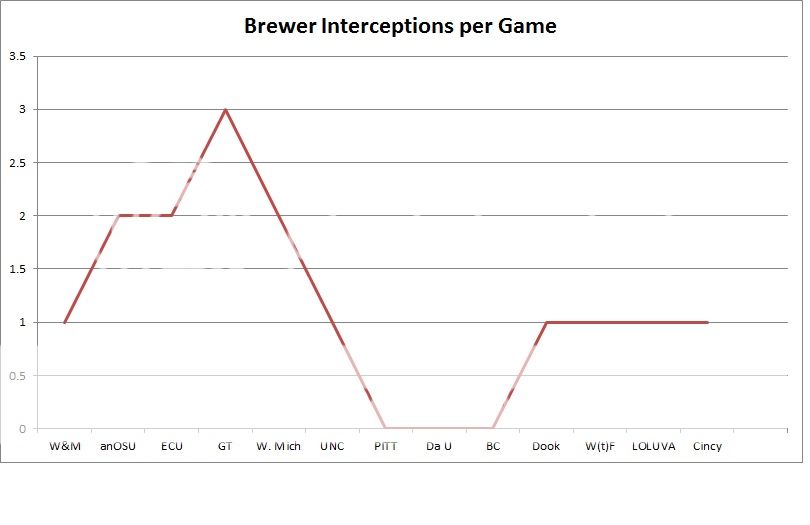
Looking at raw numbers:
- Games 1-5: 2.000 INT/Game
- Games 6-13: 0.625 INT/Game
The knee-jerk is mission accomplished. Yes, Brewer still threw some picks down the stretch, but it was at a very manageable rate. However, just celebrating a steep drop-off in INTs would be myopic. How was the rest of Brewer's game affected by the focus to rope in his interceptions? Was there a significant decline in his effectiveness as a QB once his INTs dropped? Here's a look at his INTs/Game against his passer rating:
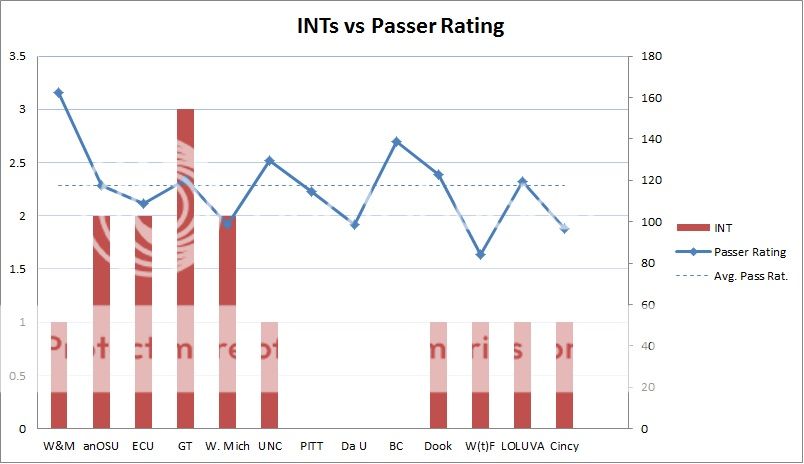
Here I've converted Brewer's INTs to a bar graph, while the line graph represents his passer rating in each contest, in the hopes that this makes it a little easier to read. The dotted line represents Brewer's season average passer rating. I chose passer rating rather than ESPN's QBR because QBR focuses on all around QB contribution to the outcome of a game, and here I'm more focused on how the attempt to reign in interceptions affected Brewer's passing game. (Plus I'm skeptical of the QBR since ESPN refuses to divulge the formula.)
Looking at this reveals the following:
- There was not a significant drop-off in passer rating after Brewer started focusing on reducing INTs.
- Both Brewer's best and worst games as a passer against FBS competition came after he'd gotten INTs under control.
- Brewer is a way more consistent QB than I originally gave him credit for.
In regards to that last point, Brewer was pretty much right on his season average passer rating in five of the thirteen games he played. On a whim, I compared ther standard deviation in Brewer's game-to-game passer rating to that of Heisman winner Marcus Mariota. Feeling it was unfair to compare Brewer to a Heisman winner, I also included an "average" quarterback. I arbitrarily selected the QB ranked 50th in passer rating, Northern Illinois' Drew Hare. The results:
| Brewer | Mariota | Drew Hare | |
|---|---|---|---|
| Passer Rating | 117.35 | 184.35 | 136.33 |
| Standard Deviation | 20.31 | 36.94 | 38.24 |
| STDEV as % of PR | 17.47% | 19.64% | 27.03% |
Apologies if that's hard to read. The bottom line (literally) is that Michael Brewer displayed Heisman-level consistency from game to game, and that's the only time "Heisman-level" and "Michael Brewer" can be used in the same sentence. Brewer was consistent, but he was also a consistently subaverage passer. Part of the reason why is because Brewer's YPA is a paltry 6.1. Another reason is, although he did do a pretty great job corralling his INTs, his 18:15 TD:INT ratio put a dent in his passer rating.
Finally, speaking of that TD:INT ratio, here's one more round of graphy goodness before we adjourn:
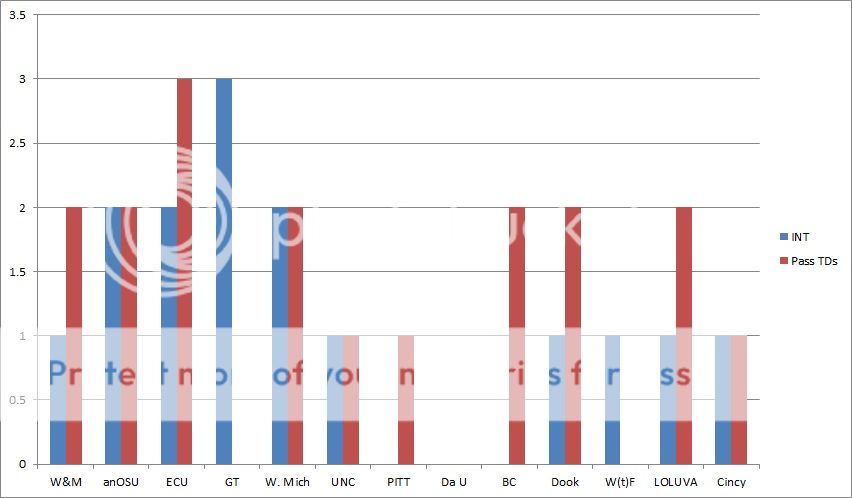
In games 1-5, Brewer threw more TDs than INTs once, against ECU. In games 6-13, he managed that feat four times.
So there you have it. All the info on Michael Brewer's performance I can cram into Excel. And what have we learned today? Mostly that Brewer is a consistent QB with definite limitations who improved in terms of throwing picks over the course of the season without taking a big hit in passer efficiency. Even if he maintains this improved TD:INT ratio, we won't see a dramatic improvement in his passer efficiency unless his yards per attempt and completion percentage takes a big boost. (If his 0.625 INT/game average down the stretch had held all season, his passer rating would still have only been 120.52, all else holding equal.)
The question is, is the Michael Brewer we saw down the stretch good enough to have any sort of advantage or coach favor when spring practice begins? Based on the numbers above, I'm not sure there's a definite answer either way.

Comments
I'm not sure QB Rating is an effective measure of performance drop-off. QB Rating is lowered when you throw picks, so when he reduced his interception total, his rating should have improved (assuming the rest of his performance stayed the same). The fact that it didn't means that after improving his interception rate, he reduced his performance in other areas to offset the lower turnover ratio.
Yds/game, TDs/game and yds/attempt might be more enlightening if you've got them.
I tried to address this by showing what the effect would have been had he consistently thrown INTs at the 0.625/game rate all season. It would have only boosted his PR by like three points, which surprised me. So getting the INTs under control wouldn't have had a huge boost to PR because his his YPA was really holding him back.
I still maintain passer rating is the way to go because it lumps everything into one rating. It includes all the things you asked for in one number.
I did post TDs/game in the very last graph tho.
Huh, so his yds/attempt didn't drop when he reined in the picks? I sort of just assumed that it did, because the offense really stagnated sometime around then.
Something else that might be neat to look at is attempts/game - if that plummeted, then we know that the drop in picks was likely a playcalling adjustment instead of anything the player did.
Nice plots, btw. I love this stuff.
I'll have to crunch the numbers on yds/attempt across each game, but I know there wasn't a dropoff in attempts/game.
Unfortunately the spreadsheet I used to make this is on my computer at work, so it'll be tomorrow before I can post any additional hard data.Actually, I'll just leave this here. Improvisation FTW!
Not sure how well that shows up, but from that I get:
YPA Games 1-5: 6.48
YPA Games 6-13: 5.69
Yes, we see a dropoff, and his two worst games in terms of YPA come after the adjustment. However, two of his four best games in terms of YPA also came after the adjustment. In general we see a smaller drop in YPA coupled by a significantly larger drop in INT/game, with no discernible reduction in ceiling.
The bad games against Wake, Miami and the Military Bowl that are dragging his YPA down might be attributable to his adjustment to reduce INTs, or to something else. Not enough to predict accurately here.
Hate to do this -- but I presume for attempts, the statistic includes balls that are purposefully thrown away to avoid a sack.
Do you have a way to know how many of those there were, and whether that number increased by any statistically notable way to correspond with the drop in INTs?
I'll look into that, but I don't know if throwaways are recorded as anything other than an incomplete pass. Good question. I'll look into that.
This is the best I've been able to come up with.
Hokiesports.com game log specifies who a pass is attempted to on most incomplete passes. Sometimes, though, it just says "Brewer, M pass incomplete." I also notice a lot of these coincide with a defender being credited for a QB hurry. So if was accept these entries where no receiver is listed as an intentional throwaway (regardless of whether or not a QB hurry is awarded on the play) we get this:
I'm not really satisfied with this answer because I'm not even confident about the data I'm using. But if we can just accept them as valid for the sake of argument we see this.
THROWAWAYS PER GAME
Games 1-5: 2.8
Games 2-13: 2.25
Season long: 2.5
Standard Deviation: 2.4
Basically, the adjustment to INTs had zero effect on throwaways, and there was no discernible trend to the number of throwaways over the duration of the season.
One notable thing: Brewer's best passer rating against FBS competition came in the game he had by far the most throwaways. (BC, 138.71 passer rating, 8 throwaways)
I looked at the numbers myself, and there really is no discernible pattern between pre and post Western Michigan. He was roughly ~5-6 yd/s attempt against ECU and an OSU, while over 7 against GT. He was ~6 yds against UNC and Pitt (higher against UNC, but they're terrible), and alternated between stinkers and decent showings the rest of the way... I'm going to see if I can normalize for defenses and find a trend.
Yeah, see above. I edited.
Here's some of what you were asking about in chart form.
His lowest number of attempts was 20 against Da U and was surrounded by the games in which he had the second and third highest number of attempts on the year, 45 against Pitt and 48 against BC. This coincides with the 3 game stretch in which he didn't throw any Ints.
One thing to keep in mind with Brewer's attempts per game is that it doesn't always truly reflect the number of passing plays that are called by the coordinator/checked to at the line.
In the Miami game Brewer had 20 passing attempts and there were 22 or 23 total passing plays for him in that game (20 attempts +3 rushes, 2 of which were sacks). The number of attempts in this game is also skewed another way because Mark Leal played late in the game. Leal had 8 pass attempts and 1 rush attempt in that game taking the number of passing play in the game to 30-32.
In the dOOk game sacks and scrambles make a very large difference in the number of passing plays that were called compared to attempts. Brewer had 14 rushing attempts which includes 6 sacks , this puts the number of plays called as passes in that game in the range of 29-37, instead of the 23 passes that were attempted by Brewer.
Nice post, IH!
I think the biggest detriment with Brewer's effectiveness and the success of our offense is that YPA. There were a lot of pass yards not actualized this year, either by not being completed or not even being attempted. We had opportunities for a ton of big plays this year.
I'm pretty sure we all could come up with a couple examples per game where Brewer made some really bad throws to open receivers.
Likewise, we could find plenty of examples where he missed even seeing or attempting a pass to guys crossing the middle.
Question then is, how much of this is on Brewer, how much on an O-line that was generally horrible at handling anything other than a straight rush with no twists or stunts, and how much was on the edict to stop throwing INT's, thus making him to think twice before he made a throw (and therefore lose the window the receiver was open)?
He was playing loose against OSU. He made two huge throws for completions that we all were cringing over mid-attempt, one over the middle across his body, and one doink while running for his life between 3 defenders to Sam Rogers doing Sam Rogers things.
These are the types of passes that cost us several turnovers in games after that.
Just no easy answer. Yeah, you'd love for him to be 3 inches taller so he could see better across the middle. You'd love for him to get back the gunslinger attitude, because he plays with a lot more confidence. But you don't want to stupid INT's that cost us so many times.
If you asked me today who I want to start next year, it's Brewer.
But I am completely in favor of an open competition at the position next Spring. I think we've got a bunch of good prospects at the position, and no matter who wins, we're going to see much better production under center next year, be it Brewer or one of the other guys.
6.1 isn't gonna cut it. That means basically everything is a screen or to the flat. No vertical threat at all. The question is, how do we fix that? And the answer is the O line. It's hard enough for Brewer to see targets over the middle. Asking him to do that with a pocket that collapses after 3 seconds is impossible. So we either improve pass pro exponentially or roll the pocket to get Brewer a clearer view downfileld...which also takes away half the field from the passing game.
Excellent post first off. I love the effort and I'm sure your employer did not. I think the screens did hurt his numbers significantly, but not because we ran them, because we ran them poorly. If we were busting more for 20+, all the numbers would be drastically better. Two things your number confirmed that I already sort of believed:
1. Brewer is consistent. You know what you will get with him.
2. If he doesn't throw at least one pick, we are screwed anyway. So we should grade his INT #s on a curve.
I think vision is only part of the problem. Brewer's deep ball is inconsistent at best. He doesn't have the arm strength to get deep vertical passes out quickly. He also has a tendency of running backwards instead of stepping up in the pocket to avoid pressure, which certainly doesn't help.
It might be interesting to look at the rushing totals in comparison to his passing successes, as most people would probably think that at Virginia Tech we should be setting up the pass by using the run. Due to our lack of success running the ball, the passing game may have struggled since coverages would not have to respect the Play Action as much.
Funny you should mention that. One thing I had looked at was the relationship between team yards per carry and Brewer's passer rating. My thinking was like yours: successful running game begets better passing performance. But in 2014 at least, the opposite held true.
VT averaged over 4 yards per carry against FBS competition three times in 2014: W. Mich (6.55), UVA (4.95) and Cincy (4.75). Against UVA Brewer had a passer rating very slightly higher than season average, while against W. Mich and Cincy his passer rating was under 100. Meanwhile his best passer rating all season against FBS competition (BC, 138.71) came in the game with our second worst YPC (2.4).
Problem with looking at this game by game, though, is I'm cherry picking in a season when the run game struggled in general. (Sound familiar?) To a certain extent, Brewer might have done well in games with less run support because he had to for us to have any shot to win (rise to the occasion, so to speak) and we may have had running success in games he struggled because Lefty was forced to stick with the run on a day Brewer was struggling.
If we can get the run game fixed, in eager to see if Brewer improves because of it.
Yards per carry minus Logan in 2013 was 3.6
Yards per carry minus Brewer in 2014 was 4.5.
He also had three lost fumbles which I think led the team. What does the TD/Turnover comparison look like?
Love the guy's heart but I think the competition will be completely open in the spring.
Brewer's the guy, the competition will be for #2 unless someone really blows Lefty away. He's said a couple times now that he's really excited about having some continuity at the QB spot and being able to work with one guy two seasons in a row.
You don't bench a senior who was a first year starter and expect better results with a younger guy who will also be a first-year starter. Considering he never even went through spring practice and won the starting job after not playing football for a year or so, I think Brewer did a heck of a job. A full offseason of strength and conditioning work, spring ball, summer workouts and fall camp will be awesome for him.
I've heard Lefty say that as well but that was prior to their recruitment of Lawson and the post-season assessment from Babcock.
That said, if Brewer is the guy, then lets hope spring and summer do in fact work wonders.
Lawson isn't college-ready right now. Even if he was, he'll be enrolling over the summer. Asking a kid to fix his footwork, adjust to the speed of the college game, learn a complex offense and then steal the job away from a senior who's the returning starter all over the course of about 3 weeks is asking one heck of a lot. The added work, coupled with the extra experience of his fellow skill players and the likely athletic upgrades up front should start paying dividends sooner rather than later.
I do agree with you, if the starting position is to be stolen, it's likely not Lawson who steals it. If Andrew Ford or Chris Durkin go full beast mode in spring I could maybe see them wrestling the top spot away from Brewer. But Lawson would have to be game ready from day one on campus.. The likelihood of that with the number of QBs ahead of him is slim.
I would give you ten legs for this if I could. I never thought to extract Brewer's carries from the rushing totals. The tailbacks showed marked improvement from 2013 to 2014. Good catch.
The question becomes, how much responsibility does Brewer shoulder for yardage lost, and how much is shared by the O line? Brewer is a pro style QB. He'll never be much of a running threat. Therefore yardage lost to sacks will hurt him more than it hurt Tyrod or Logan.
Then again, to maintain a grip on his starting spot, it's up to Brewer to prove that he makes up for the yardage lost to sacks by being that much better of a passer.
Really, really good catch.
thanks and thanks for putting in all the effort
Here's the breakdown (my apologies in advance for any issues with formatting):
Game #Attempts Yards Y/A
1 30 251 8.36
2 36 199 5.52
3 56 298 5.32
4 39 297 7.61
5 32 178 5.56
6 27 186 6.88
220 1409 6.404
7 45 265 5.88
8 20 80 4
9 48 345 7.18
10 23 138 6
11 18 126 7
12 33 235 7.12
13 24 94 3.91
211 1283 6.08
Despite an extra game included in the second half of the season brewer had 9 less attempts and about 120 less yards. The Yards/Att dropped a bit over .3, which doesn't really equate to a whole lot of yardage if you are throwing the ball 20-30 times per game.
Nice breakdown, made even better by the inclusion of "anOSU," "W(t)F," and "LOLUVA."
I'm down with the lingo.
Brewer will be good next year ,if we can field any semblance of a competent O line. Despite his physical limitations he is a warrior and has the heart of a lion. We need more like him!
Brevity is the soul of wit...
You got it dude. The success of Brewer absolutely depends on the offensive line. Brewer is a game manager QB. No more, no less.
And we all know from real life, that good managers effectively delegate to the competent staff that surrounds them.
The success of any quarterback depends on the o-line. See the last two seasons from Payton Manning and Jameis Winston: last year they lit the world on fire, this year they worked behind a line that got shuffled several times and did not play as well.
Tyrod Taylor didn't have a great offensive line when the Hokies won the ACC and the Orange Bowl after the '08 season.
We won the ACC with 4 losses. Weak 2008 ACC makes that a weak argument.
Yes, but think of what he would be if he wasn't running for his life on half the plays. I also acknowledge that Tyrod is an elite quarterback where brewer is a steady player that can return to his aggressive mentality when he has time to see the field.
So here's something I threw together:
I wanted to see if maybe by normalizing against that defense's avg allowed completion %, passing yds/game and yds/attempt, some sort of pattern would emerge. Above 1 means you're doing better than the average team against that D. Below 1 means you're worse. Sadly, no pattern emerges, although it does shine a light on just how bad we were a few times...
My god, Brewer played his nuts off against Boston College. It's a damn shame he couldn't get the W in that one.
his ints went down towards the end of the season yes, but so did his attempts at throwing the ball down field.
Well, his yds/att didn't really drop so I'm not sure you can really make the case for that. They were always pretty low.
The data shows a drop in YPA, but not a titanic one. Games 1-5, he had two games above his season average YPA and three below it. Games 6-13 he had three above the season average and five below it. His level of play did not take a major hit after correcting his INTs.
What about his total yes as a percent of total offense? I think our run game definitely has an impact. Personally, I want the best QB to play. I think Brewer has leadership intangibles and if he can improve his physical health he will be the starter.
One other comment on which I know most will disagree with me. It is not realistic to hold a pocket for more than 3-3.5 seconds for a vertical threat. In order for our vertical threat to be a threat at least 4 things have to happen.
1. Correct Route combination against the coverage
2. Correct read of coverage by Qb
3 3 sec of protection/called rollout yo move the pocket if necessary
4 proper throw/and catch
I think it's reasonable to say that a pocket should start to collapse after 3-3.5 seconds. Brewer is already on the ground after 3 seconds. That's where the improvement needs to happen.
I agree, but would qualify number 3 a bit.
How many times over the past several years have we seen the QB make a hurried looking pass and therefore incompletion to open receivers, even though replay showed a good pocket?
And how many times have we seen the absolutely laughable pass pro where a 4 man rush against 5 or more blockers still gets 2 guys running clean to our QB?
Until our QBs can feel confident they will have time to work their progressions, it's not going to matter that occasionally they get sacked for holding the ball too long, or from blown assignments or superior play by a DL. If the QB can feel comfortable that he's going to get an average of 3.5 clean seconds back there, his play is going to get better.
This has been our achilles heel for far too long. This is a big reason I think we saw LT3 regress, and Brewer have a rough season after starting out better. I don't care how hard-core you are -- eventually you start anticipating getting hit.
Next year is where Searels gets judged, more so than Loeffler in my opinion. He's got good guys in the system. He's got good recruits coming in. We should see a better line opening the season, and barring injury, a line that gets better as the season progresses. This will translate to better QB & RB play.
If the last few weeks of the season & the bowl game are any indication, we may be in good shape.
Correct. Interceptions down, sacks up. Instead of serving up INT's, he held onto the ball for sacks on top of sacks. Can't he learn to throw the ball away occasionally??
Leg for you. INTs vs sacks was the one relationship I hadn't really considered. So after crunching the numbers:
You are onto something...but only for two games. There was a sharp spike in sacks against Duke and Wake Forest. Those two games might be a case of Brewer holding the ball too long, or it might have been a case of the O line allowing pressure to get to Brewer too quickly for him to make a throw. I don't recall off the top of my head, and have no desire to rewatch the Wake debacle to find out.
However, your contention that reduction in interceptions was correlated with a general increase in sacks is inaccurate beyond the two outliers. In general, the number of sacks Brewer took ranged from 1-3 per game across FBS opponents.
In a related matter, does anyone know about what point in the season Hanson started seeing significant playing time? Did it coincide with Duke/Wake?
McLaughlin was injured in the BC game, so IIRC at that point Hansen came in.
Aaaaaaaaaaaand we have our outliers explained.
In part. Hansen got eaten up in pass pro a few times, to be sure, so that could explain the increase. WF threw some delayed blitzes straight up the middle, I think. RBs failed to pick up blocks there. But some of this is definitely due to McGlock's injury.
Not saying it's Hansen's fault. Him coming in shifted the line IIRC. Things were significantly different for the two games that are far outside the mean. As soon as the new look of the line started to gel, we returned to baseline.
Yep, definitely agree.
W(t)F
I see what you did there!
In addition to the o-line issues Brewer also had a lack of consistent running game to help him until the end of the season when JC went all muscle hamstery, makes it tough to qb with all those hindrances. I am sure the qb battle will be interesting this spring and summer...
muscle hamstery?
 /
/
I think that the job is Brewer's to lose. Unless someone comes in an completely blows the doors off I think he gets the start. Plus we all have to remember that Brewer only had fall camp and practices with Loeffler and Gentry. I'm excited to see where he's at after a full spring practice and a full offseason with S&C. I can't wait to see the spring game. Of course we are always seemingly pumped for the spring game and it does little to answer anything and more to bring about new questions IMO. But I'm still excited.
Brewer will always have limited vision down the field due to this height, and will miss some open receivers. I am not sure he has the arm strength to get the ball to the receivers fast enough on a slant route to keep defenders from jumping the route for 6. We need to make our WR players more dynamic - I see so many teams getting it out quickly to a quick guy in stride who makes a guy miss and goes for 10+, while we loft it out to a covered Bucky and watch him drag a guy for 3. We need him to throw the deep jump balls to Bucky and I Ford in bounds so they can catch them. We get those worked out with better line blocking and we will be a lot more dynamic. Combine that with a better clock in his head and stepping up instead of back in the pocket and we can have a top 40-50 offense with Brewer. Those are too many ifs not to have an open competition, but the leadership and tuffness he showed should give him a leg up in the Spring. I think he'll he'll improve and start next year unless someone else really steps up - which I'm hoping for. Not because Id on't like Brewer - I do - but because that means we have someone even better.
Next year, I hope for something better than 2014 Brewer.
If that is 2015 Brewer, then I'm down with that.