

As a TKP reader, and therefore Virginia Tech Hokies fanatic, EVERY play of every game has you captivated and your emotional state hangs on every pass, every tackle, every penalty, every little detail of every game. But of course not all plays are as big as others and as your memory of the mundane fades you're left with last memories of the truly game-changing plays of every season. Here we use analytics to count down the biggest, most game-changing plays in the past 10 years of Virginia Tech football...
In each installment of this series I'll bring you two plays: one play devastating to the Hokies' chance to win, and one dominating play in Virginia Tech's favor. They will count down in order of how much each play affected the odds of Tech's victory.
For details on the method, see Virginia Tech's Top 10 Plays of the Last Ten Years: No. 10.
The Countdown
Most Devastating:
10. Boise State 9/6/2010 - Kellen Moore pass complete to Austin Pettis for 13 yards for a TOUCHDOWN
Most Dominating:
10. Boston College 12/1/2007 - Sean Glennon pass complete to Eddie Royal for 24 yards for a TOUCHDOWN
The 9th-most Devastating Play: Miami 11/4/2006 - Tyrone Moss rush for 50 yards for a TOUCHDOWN
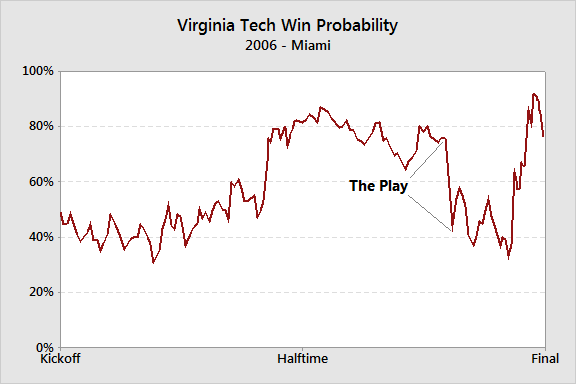
When Virginia Tech faced Miami in 2006, the Hokies were still in the process of asserting its dominance over the ACC and doing so against Miami — a team trying to show that it was still nationally relevant — would be a huge step. The Sean Glennon and Brandon Ore led offense wasn't prolific, but it was good enough given that Bud Foster had the defense dialed in, as usual, that season.
The Hokies entered halftime pitching a 10-0 shutout. While not high-scoring, the game was well within control. On their first drive in the second half, Miami needed points badly enough that the team attempted a 55-yard field goal that incredibly was successful, making it a one-score game. However, the Hurricanes still had not shown an ability to move the ball and the game felt within control. Neither team was able to move the ball on the next three series, and halfway through the third quarter Miami found itself at midfield on 3rd-and-2.
Hoping for a drive-sustaining first down, Miami called for a rush by Tyrone Moss. Unfortunately for the Hokies, Moss did much more than move the sticks: Initially he appears to gain just enough for the first down before running into traffic, but then he inexplicably pops out of the other side of the crowd. The Hokies entire secondary had entered the fray already, leaving no one to stop Moss from sprinting across open field to the end zone, bringing the game to a 10-10 tie.
Despite the gut punch of a touchdown by Tyrone Moss, a Brandon Ore response with just a minute and a half to go gave the game back to the Hokies, 17-10.
The 9th-most Dominating Play: North Carolina 10/29/2009 - T.J. Yates pass intercepted by Rashad Carmichael at the North Carolina 10, returned for 5 yards to the North Carolina 5
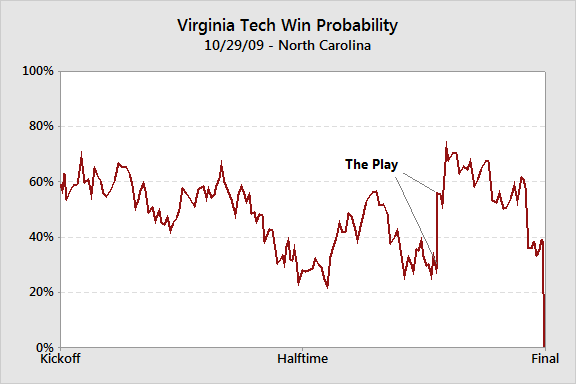
Playing at home and hoping to avoid an upset by the visiting Tar Heels, the No. 13 Hokies found themselves playing catchup for much of the game. North Carolina had scored first, and VT had responded to make it a 7-7 game. Then they fell behind again 7-14, and could only respond with a field goal to make it 10-14. The game was now in the fourth quarter, and the Hokies would be kicking off to a Tar Heels team ready to drain the clock and cling to the lead in their upset bid.
On the first play from scrimmage at their own 20-yard line, Rashad Carmichael breathed life back into the hopes of the fans in Lane Stadium. Immediately following the snap, the pocket collapses as Yates fakes an inside handoff; he then makes a poor choice in trying to complete a screen pass to a receiver far too close to Carmichael. Rashad shakes his block and snatches the interception a full 10 yards behind the line of scrimmage, flipping the tables from a 4-point deficit on defense to possession a mere 5 yards from the end zone.
Three plays later Tyrod Taylor would rush for the touchdown and lead, but unfortunately a pair of late UNC field goals ultimately took the win back and gave the Tar Heels the upset they were seeking.

Comments
I gotta give it to ya Joel, those were a couple of curve balls you threw us today. I wasn't expecting plays that still led to opposite outcomes. The statistics behind them are fascinating
Just wait...there will be at least one game that includes a Top 10 devastating AND dominating play!
brb. I gotta go prep myself for a heart attack...
has to be Miami 2011 - the Lamar Miller TD that dang near gave me a heart attack, and Logan doing his thing...
Second place (at least in recent memory) probably belongs to the FSU game in 2012. Take a late, 1-point lead with just over 2:00 to go, FSU has a long field, then a long TD with 0:40 on the clock. Sigh...
I'm hoping there will be a top 10 most devastating play by our own team. Maybe fake punt against duke 2014?
More likely the fake punt against Michigan.
Michigan was the better opponent, but our chance of winning went from probable to highly unlikely with the failed (and inexplicable) fake punt attempt against duke. Less than 4 minutes to go, up by one with our Defense on a roll and we gave it to them almost in field goal range with their kicker who had missed only one kick all season (a 51 yarder against us earlier in the game).
If I put numbers on it, I would guess that the duke play sent us from a 75% chance of winning to a 10% chance; due to amount of time left, duke's field goal kicker and the inability of either team's offense to move the ball in the second half.
Honestly all the fake against Michigan did was give them the ball at their 40 rather than maybe the 1 or 20 yard line. The game was already tied. It definitely had an impact, but not one that was totally game altering like the Duke game could have been.
I'm just glad we were able to pull off the win in both games...
Yep. Miller scoring on a 2nd & goal from the 30(!) took Miami from down 3 to up 4. LT3 with the TD on a 4th down play under a minute remaining could be #1 dominating. The Nebraska ending was more unbelievable, but since it was spread between 2 plays (the Coale long catch & the Dyrell TD), it's not one huge % swing on one play.
Looks like it is the UNC game above. That last play looked pretty devastating.
Also, those uniforms we were wearing against UNC that year were awesome.
I thought so too but there are 2 data points there. The first drop is the RMFW fumble. The final drop is their field goal as time expired. I have to think that Knowles long TD catch against GT in 2012 is probably on the list.
No comment on whether specific plays will appear, but I did remove things like field goals as time expires from the list. They are just too obvious and not that much fun to recall.
It's the singularity event.
I'll submit my guess as Cincinnati 2012 ... Corey Fuller TD with 1:49 left to go up 4 points and then Cincinnati scored a TD with 13 seconds left to retake the lead.
Exum played his nuts off in the game.
mmm hmm
Interesting twist, adding plays that changed the game, but not the final outcome. Those kind of plays are often overlooked as most people will only remember the final score. For example, I had forgotten about the INT against UNC, but remember clearly the Ryan Williams fumble at the end of the game deep in our end to gift wrap the game for them, which could be included as a devastating play.
OT: I wish we would go back to those orange uniforms.
Ouch. I still remember that fumble.
I was like 'WTF was that?!'
But then I remember how the team immediately surrounded RMFW and how impressed I was at the solidarity=lesson.
I think if we made the same list subjectively, whether we consciously decided to or not we would immediate subset based on whether we won or lost. I don't think anyone (myself included) would even consider devastating plays where we ultimately won, or dominating plays where we ultimately lost.
That night was the epitome of the term "stealing a game."
Agree with everyone, I thought it was strange a bit for the curve ball here. So I'm guessing that the plays are determined by the biggest "spike" in the graph and not necessarily ones that changed the outcome.
It's entirely a number analysis without consideration of the effect on the outcome. Just what plays caused the biggest swing in win probability.
That is correct - it's just the magnitude of the rise or fall in odds of winning from that play alone, regardless of what happens after. Believe me, at some point in the series you're going to go on a roller coaster!
This is a really interesting way to look at important plays. This type of conversation always focuses on plays that factor into the final outcome. By looking at large swings in in-game win probability we get an entirely different conversation, and some plays that would otherwise be forgotten such as the two above.
This makes me wonder though if certain huge plays would be at a statistical disadvantage in trying to make the conversation. Like Danny Coale's catch vs Nebraska. We were still trailing after that catch was made, so I would bet a play that basically just flipped the field wouldn't really spike our win percentage. Or maybe I'm wrong and I don't understand what formula is used to determine win percentage.
Either way, interesting way to frame the conversation.
Your probability of winning when you're down 5 at your own 16 with 1:15 or whatever remaining is likely pretty low. I'd bet that going from that to being on their 3 yard line is a pretty big spike in probability. Sure, you haven't scored yet, but you have four downs to move 3 yards which has to be a fairly high probability situation...unless you're a typical hokie offense
You are correct - those factors play into it, so it's almost like you get partial credit for the points before you actually have them. Think of it this way: suppose we were down by 2 when that play happened, and there was even less time on the clock so we could kill the entire clock before a field goal attempt. Although we don't actually have the points yet, the model would show a high odds of winning.
Of course it's not perfect and no model is, but I think it produces a pretty solid list. I won't comment on whether that play or any other specific plays will appear though but love seeing people's guesses.
Or Seattle with a sure win in the Superbowl...
I have no #source, but I believe the win percentage formula is just based on historical data, filtered to match the specific scenario. For a given down and distance, with that scoreboard, with that time left, how often do teams end up winning the game? (also, looks like they might account for home team advantage as well)
Correct - I can't share the exact model, but you're covering the important stuff.
Why can't you share the exact model?
It was provided by Matt Mills of Football Study Hall and is his/their intellectual property. He allowed me to use it but I agreed I wouldn't share the actual model.
Just to get an idea of how much work you have to put into this series, do you have to manually enter each individual play to populate the graph?
The technical details: I found an R script that pulls play by play data from ESPN and used it to get most of the data. But it turned out to be terrible, so I've spent hours correcting errors, then more manually inserting a few games or periods of games that didn't pull at all. I would say something like 20 hours to get the data and make it (mostly) correct.
After that, I switch to Minitab from Excel and then things are pretty easy. A macro made the graph for every game during that period, and I just made copies to highlight specific plays here. I may share the dataset at some point but would want to document things really well and would like some kind of protection to try to force people to credit myself and The Key Play if they use it for anything public.
I read your book!
Wait... is there a TKP book?
Have you considered trying to sell this style of analysis to an NFL team?
It's readily available to NFL teams, and I have a day job! The NFL is much more advanced than college with analytics.
Still, you should think about trademarking joelestrametrics.
Time for me to lawyer up!
Oh please. Tesla gives makes all their patents free to anyone and you can't share a data set?
True story, I thought Elon Musk was a cologne for two years.
That's Tesla's choice, and regardless of legal issues if someone says they'll give me something of value but I can't share it then I will respect the deal.
For what it's worth I can share the data, just not the model that converts it to win probabilities.
Not to mention that if they had you sign something like an NDA you could be sued for it.
I didn't ask for the model - I realize that you didn't create the model, you mentioned that upthread.
I'm talking about the data set, like when I said "share a data set" in my post, since you seemed to be hung up on getting credit for it.
Good for Tesla - they get lots of press for opening up all of their patents.
I put a ton of unpaid work into creating a dataset of value, and want to ponder how much I want to try to force proper credit be given by anyone using it publicly before I just give it away. I would argue giving away your IP for free to anyone anonymously and asking them to cite the source when publishing results from it is much closer to the Tesla end of things than most people.
A bigger reason it hasn't been shared is that I need to document it well first. Wanting to include some protection asking for citation is a secondary reason.
I love this! I agree with earlier comment; it would be interesting to see the odds jump created by Danny Coale's catch against Nebraska just as a reference to the other plays we are seeing in this series.
What is crazy, is that the 9th most devastating play is about a 30% drop. That means we have got some really devastating plays left in this series. I don't know if I can take it, but I will, because I have to.
Also, it would be really cool if at the end of this series, you looked through your data and posted your own top ten lists. Call it "adjusted", subjectively of course, but still based on the data. Factor in things like, did it effect the final outcome? Was it late in the season with championship implications? Did the formula miss something (like maybe Coale's catch against Nebraska, not sure haven't seen the data)? etc.
Thanks for this great series!
I'm also curious what actual last second game clenchers look like on the probability graph. BC '07 or GT '10, as an example of devastating and dominating, respectively. Those games had plays at the wire that decided the outcome of the game, but depending on what the probability graph looked like immediately prior those plays, the jump up or down might not have been sufficient to make the list.
I plead the fifth.
I was just thinking out loud (thinking in text?) anyway. You've piqued my curiosity with this.
I believe that this series will go very far to prove my theory that the big highlight worthy, momentum swinging plays are not the ones that win you the game. It's the 2.01 yd gain on 3rd and 2 in the 3rd qtr, or that one indiscrete 3 and out that determines the outcome of the game.
Kind of like the 4th and 2 that FSU had against us a few years back when they were ranked #1 and we were up on them by a few points with time running out in the fourth? We get the ball back and we can run out the clock, they had no timeouts left. We hit the running back in the backfield but didn't wrap him up and he was able to get off of the tackle and squirt forward for 3 yards. They went on to score and win the game. DANGNABIT!
Anyone that is against the Maroon/Orange/Maroon combo is nuts...those are some sexy unis.
That is all.
That's an orange effect combo I could get behind all day long.
Me too. Reminds me of these:
I would love to see the maroon on top and the orange on bottom.
This:


plus this:
Plus these pants:
Hate the pants. Now, make them match the orange of the jersey trim, and maybe. Our current orange pants are way too loud and look oversaturated on TV.
And I want those lids as our standard.
That helmet does look sick. I have never been a fan of the shoulder stripe kits, but i think that combo would be sick
Those two weeks in 2009 absolutely sucked. I think we were ranked #4 heading in to ATL and lost to GT and the very next Thursday night that game against UNC happened. It was another year where we lost a few games we shouldn't have, but it ended nicely with beating, soundly I might add, Lane Kiffen and Tennessee in the Peach Bowl.
Which also resulted in a glorious set of jerseys I might add:
Yeah, those are great.
Maroon Lid +
*insert jersey here*+
Maroon pants
definitely seems the way to go
Best memory of that UT game was that we effectively ended their QB's career by knocking him out of the game. I believe his name was Crompton? It's been a while, but that was a fun game
Our '99 defense made a living out of knocking opposing quarterbacks out of the game. IIRC, the Sugar Bowl was the first game that season where the opposing starting QB didn't leave the game, either due to injury or ineffectiveness. Just thought I'd throw a fun stat out there.
Actually, I think that the Clemson QB (Streeter?) survived through the game, although Corey Moore did his best to kill him late in that game. I also seem to recall that he broke his collar bone very early in the game the next week. We weakened it up.
Was it this play?

Jonathan Crompton was his name and he graduated and went on to play backup QB for a handful of NFL and CFL teams.
Late in the game, one of the Hopkins brothers basically suplexed Crompton because he was fighting for yardage after the initial contact. I heard so many Vol fans bitch and moan about that play because it wound up sending Crompton to the hospital after the game.
Vol fans whine, bitch, and moan about something not going their way?!?! I've never heard of such a thing!
/sarc
First time for everything!
#amirite
Would be interesting to see how much the winning percentage increased in the 3rd quarter of the National Championship game for us. Can't imagine one play would have jumped a huge percentage but the whole quarter had to be a hell of a swing.
Fuck Matt Ryan
I love and loathe this series.
I love all the awesome plays that we did well, and man, can't wait to see more like them in the coming years when we break out again.
We're also treading very close to reopening old wounds that have been repressed for a reason.