
Will the Virginia Tech team that takes the field against Miami come out dominant, or splash cold water on Hokie Nation's renewed hopes for a winning season?
From the Football Study Hall advanced statistical profile of Virginia Tech, the Hokies have exhibited the following behavior in the first half of the season:
- The offense is among the worst in the country — ranked 114th — in first quarter S&P+, but ranks very well in other quarters: 20th, 37th, and 33rd. It would be great to have the offense come out firing on Saturday. Miami's defense is rated 108th in the first quarter.
- The offense is solo tackled 53.1% of the time, compared to 74% nationally — ranking nearly last in the country. Translation: Hokies are not getting into space when they have the ball.
- This is simply putting numbers behind the obvious, but when Virginia Tech has won this year it has been convincing with the team's performance rating at the 84th, 91st, and 97th percentiles of all college football games this season. None of the losses have broken 50%.
Where the Season Stands
Virginia Tech is currently 3-3. The actual and predicted score difference and odds of winning each game are:
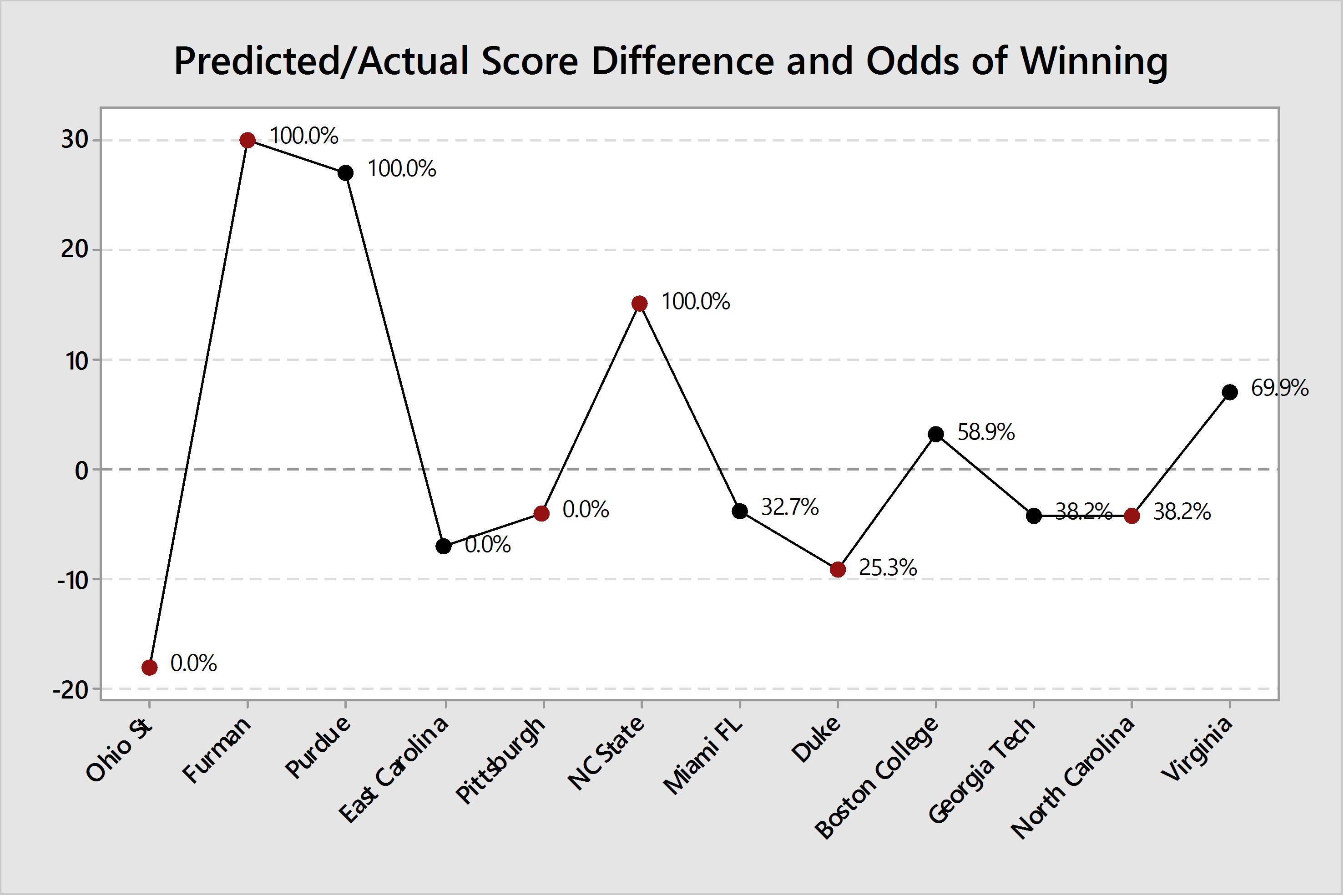
The convincing win against the Wolfpack, combined with Boston College competing against Wake Forest in a game of futility that any fan base other than the Hokies can rightfully mock, has Virginia Tech now favored in two remaining games. Unfortunately one of those is against the Eagles, in which the historical odds put Tech's chances at 0%. I still see you though UVA.
The odds of each possible regular season win total are now:

Rankings and Computer Predictions
The computer rankings and predictions for each team:
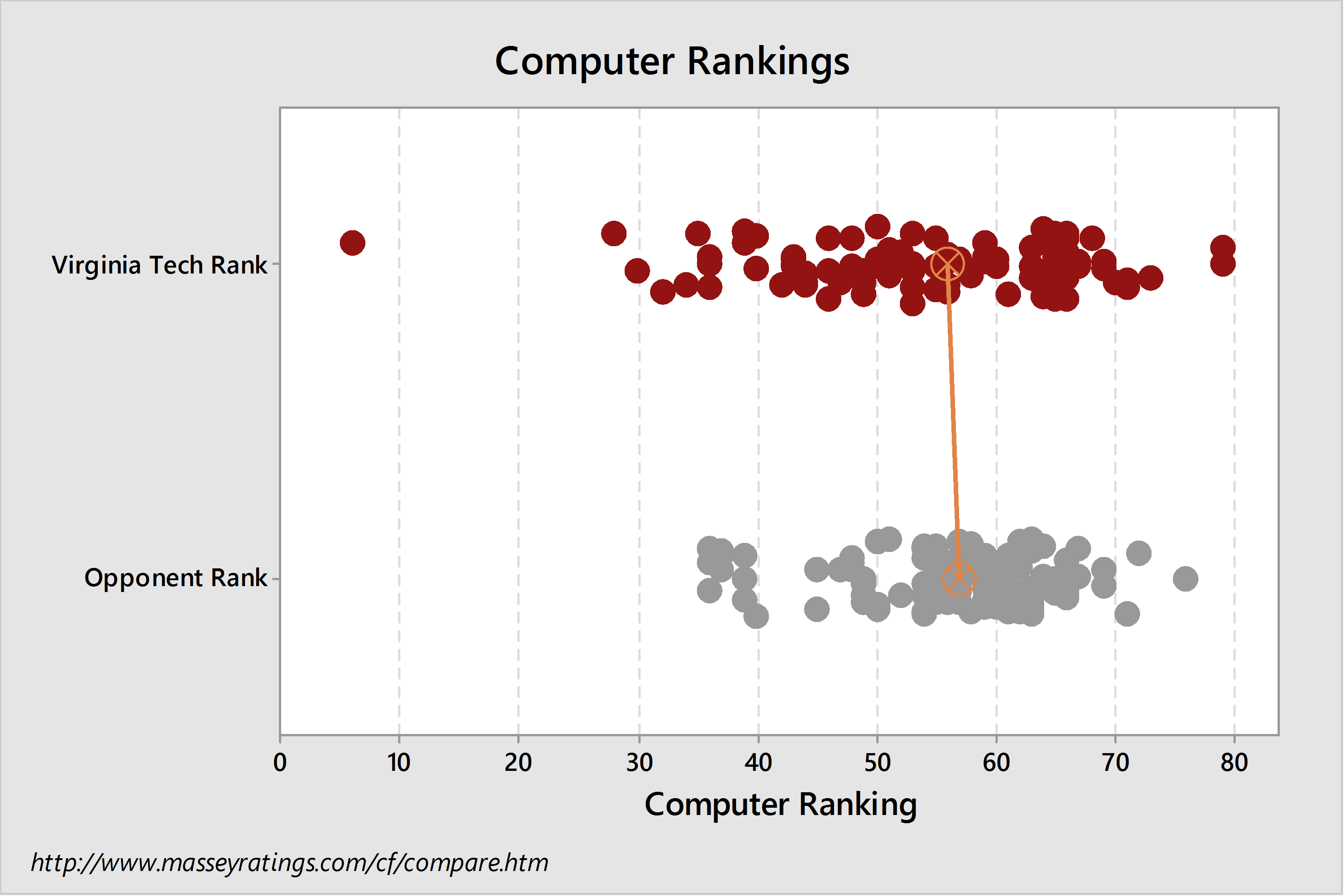

The outlier on Virginia Tech's rankings is real and comes courtesy of TrueSkill, the second-least accurate rating system to this point according to Massey's Ratings Comparison. According to TrueSkill, the Hokies are the No. 6 team in the country and well, just because a rating system is objective and computer-driven doesn't make it good. The odds of a 6-point underdog winning are: 32.7%.
Next is a look at any overall offensive or defensive advantages:

These two teams are very evenly-rated, with Miami maintaining a moderate advantage between the offenses and Virginia Tech between the defenses. Each offense is rated higher than the opposing defense.
When Virginia Tech Has the Ball
Here is an explanation of S&P+ ratings, and FEI ratings. All statistics are now opponent-adjusted.
Who has the advantage in the passing and rushing game when the Tech offense has the ball?
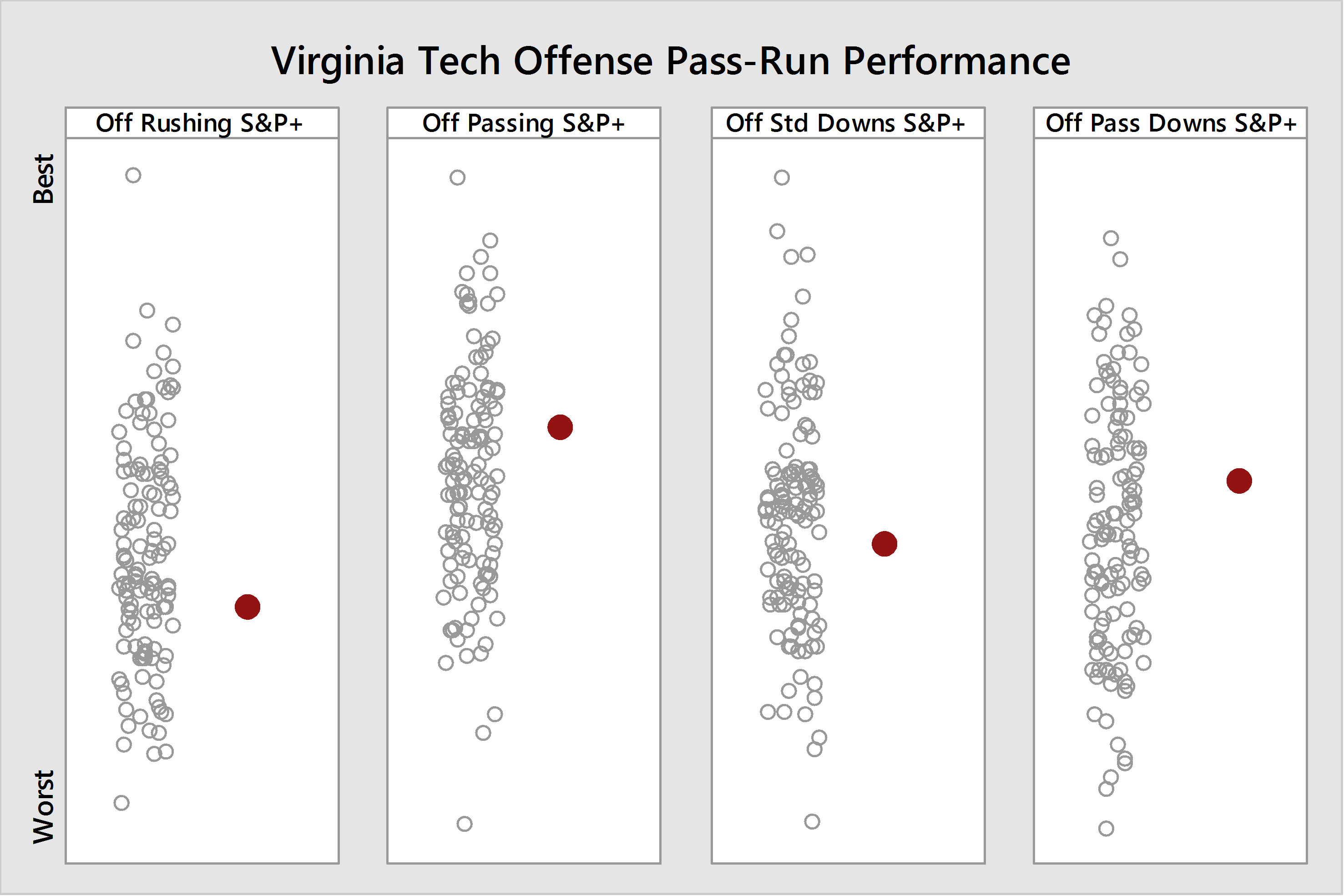

The Miami defense has not been particularly effective thus far, and Scot Loeffler should be able to balance the run and pass games as neither will be at a disadvantage.
When Miami Has the Ball
Again, examine pass-run comparisons first:


The ratings don't suggest a gashing on the ground like the Hokies experienced in 2014, but they didn't prior to that game either. Ultimately, the Hurricanes also enjoy advantages in both rushing and passing, and Virginia Tech has been awful defending explosive rushing plays. One strong point is in passing downs — it seems that Miami is less effective relative to Tech's defense when in obvious passing situations.
Who To Watch Out For
Who will fans not need to watch for in 2015? Duke Johnson. There's that. Otherwise:
- Quarterback Brad Kaaya is confident and protects the ball. He's thrown only one interception this season. The offense relies on his passing game and is not generally run-heavy.
- All defensive backs, who combine to rank No. 1 in the country in Havoc Rate — an opponent-adjusted statistic that indicates how often they record a turnover or pass breakup.
Statistical Key to the Game
Miami has gained an astounding 10.2 points per game in turnover luck and has a defense that is very aggressive in trying to create turnovers. Otherwise the team is not nearly as dynamic on either side of the ball as one might believe. Even a tie in the turnover battle probably gets Virginia Tech the win, and winning the turnover battles would almost guarantee it. So in my opinion, turnover difference is the key to the game.
Statistical Prediction
Statistically, Virginia Tech is projected to finish with 189 yards passing and 169 yards rushing and Miami is projected 187 yards passing and 185 yards rushing. I expect Kaaya to be held in check and Miami to break a big run or two during the game, but the Hokies to create a big turnover and take the win. After which, all of us to become completely irrational about how good the team is.
Virginia Tech 27, Miami 24
As always a thanks to Football Outsiders, cfbstats.com, and Minitab Statistical Software.

Comments
That little guy?
I wouldn't worry about that little guy
Super Troopers?!
my exact first thoughts as well, haha.
Those snozzberries taste like snozzberries
So the offensive line is going to have to play an A+ game for 60 minutes for us to win?
Yes, if our TOP is 60 minutes, I predict we win.
This should now be the Statistical Key to the Game.
I think BC just lost to Wake with 60 mins TOP.
Dammit. Buncha smart asses.
http://giphy.com/gifs/ToMjGpKniGqRNLGBrhu
So, what you're saying is, if the Hokies can keep from fumbling the ball this year they have a good shot.
I still like Miami's chances. This game should kickstart the Canes' first Coastal championship.
I was worried about this comment until I saw who posted it.
Damn you math jinxed us! ;)
I'm a finance guy, so I have a healthy love/respect for statistics. However, I find it hard to believe given our success in recent history against a very similar UNC, GT, and Duke team that we are such dogs to them. Our defense has matched up well against all three of those teams in recent history, regardless of personnel.
I agree. I find it interesting that Miami beat Bethune-Cookman, FAU, and a 2-4 Nebraska team and now we only have a 32.7% chance of beating them. They also lost to Cincinnati. The first part of their schedule is weak and not a good barometer of how much probability they have of beating VT. How much does this statistical modeling take into account strength of schedule?
Everything is opponent-adjusted, and it's not fair to say a team isn't very good because they didn't play anybody. They beat Bethune-Cookman 45-0 and FAU 44-20, and came within 5 of Florida State. Nebraska may be 2-4 but those 4 losses are by a combined 11 points.
Conversely, Virginia Tech beat Furman, Purdue, and an NC State team that has beaten 4 teams ranked in the bottom 20 teams and no one else, and also lost to East Carolina and Pittsburgh. So I'm not sure how you'd make much case that either has really separated itself from the other.
Miami is a big play offense and the blowout scores by big play teams against lesser teams (see also GT) aren't particularly indicative of their quality when they play teams in their own weight class.
So I'm not sure how you'd make much case that either has really separated itself from the other.
Ouch.
I wasn't trying to make that case. You have already made the case that they(Miami)are decisively favored and better than VT. Statistics never lie. With that being said, I appreciate your column. I still believe that playing a more challenging schedule prepares you down the road to be better. And it is also true that Nebraska lost to Illinois by one point (Miami beat Nebraska by 3). Illinois being a team that lost to North Carolina 48-14 this year. Purdue, which was one of our wins only lost 24-21 to Michigan State. We cannot reasonably argue that Purdon't is that good just because of how close they came to beating MSU in the same way that Miami came within 5 of tying Florida State(Who beat Wake by 8). So it really is not as simple as it seems and that is why they play 'em on Friday or Saturday or whenever. Keep the faith, Joel, I know you know what you are doing. Thank-you for your hard work each week of crunching the numbers and it adds value and enjoyment to the blog. I just wanted to give my humble opinion anyway.
Thanks! I had thought you were questioning how we weren't expected to do better.
These webs of scores are why computer ratings work so well...first you look at how every team did against their opponents, and then how their opponents have done and who that was against, and how those teams have done, etc. The polls try to do that but it's just too much information to keep track of so as well know they take the shortcut of assuming the previous week was right and making an adjustment based on this week.
Hopefully we destroy the expected score difference, and next week there is some separation!
TRANSITIVE RULE OF FOOTBALL!!
2014 season:
UL Monroe > Wake > VT > anOSU
I love the transitive rule of football!
Man ! I hope you are Right on VT winning this one. I hate to think we lose to Miami but I got us losing .It is either fold up Time or Get In Gear Time for VT.
Both feet!
You know what might be super cool? If you put the most recent predicted odds of winning (i.e. the odds at the time you post this prior to each game) in the graph in addition to the actual results for past games that you have now. Maybe in gray or with dotted lines. That could give us an idea of how closely the result matched the prediction in a concise graphical format.
Also, does the horizontal axis mean anything on the first S&P+ graph (offense, defense, and overall)?
Great job overall. Love these posts.
I've been thinking both of those things the past few times I've read these!
Seconded on loving these posts too.
thirded
Analytics feedback! Yes!
The easy one first: there is no meaning to the x-axis on those graphs...the points are spread out randomly horizontally so they don't have much overlap and you can differentiate one team from another as well as where teams cluster.
Then the prediction one. That can (obviously) be done but there are two ways to do it based on what interpretation is preferred. The models that predict them update throughout the season. One method would be to put the prediction used for that week's column to indicate how closely the result matched the prediction at the time. The other would be to continually update the prediction based on current ratings as a way to indicate which results were most unusual (good or bad) based on what we now know.
For example, suppose Pitt suddenly starts dominating everyone on their schedule and Virginia Tech doesn't even come close to winning another game. Based on the prediction at the time, the actual result wasn't that unusual. But by the end of the season the prediction we would make looking backwards would indicate that Virginia Tech actually did phenomenal because it turned out Pitt was much better than we thought at the time and VT was much worse (if that's possible).
Hmm... I see your point. Both of those would actually be interesting. What I originally had in mind was more along the lines of testing (in a loose sense) how good the predictions are based on what we knew at the time, or the first of the two. You would expect these predictions to get more accurate as the year went on. I can definitely see the value of the other one, though.
Thanks for responding, and for doing this analysis in the first place.
This will happen regardless of outcome.