
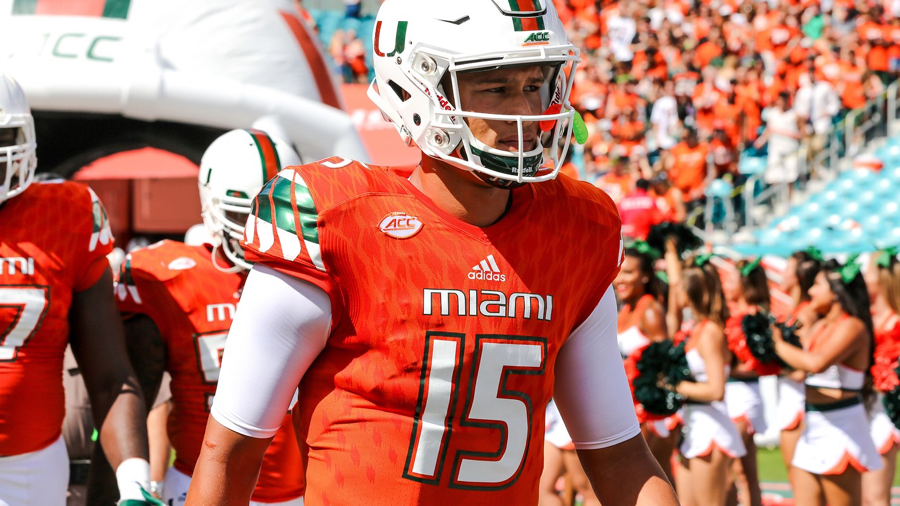
If I were to rate the strength of this Miami Hurricanes team on the Saffir-Simpson Scale, (note: not designed to evaluate football teams), they would be a Category 2. By comparison, a Category 4 'Canes squad made landfall in Blacksburg last year. This season though, with the loss of Duke Johnson, and youth scattered throughout the defense, the Hurricanes are weaker. That's not to say Miami isn't capable of causing damage; they are still certainly able to ruin Virginia Tech's day. Coming off of two tough losses to Cincinnati and Florida State, Miami is howling for a win. What does this forecast mean for the Hokies? What can Tech expect from Miami? Let's take a look.
Running Back Play
Although Miami did lose All-ACC running back Duke Johnson, to the NFL, Joseph Yearby (6.26 avg, but just 2.00 on third downs) has shown to be a promising replacement. Florida State was able to shut the running game down well, but Yearby put his athleticism on display against Cincinnati. I would expect to see more of the Cincy-Yearby versus the Hokies, than the FSU-Yearby. What do I mean by that? Take a look.
Yearby (No. 2) has displayed good vision, quick feet, and aggressive acceleration running the ball for the 'Canes so far this year. This combination of athletic traits enables him to pull off moves like the cutback in the clip above. I think Miami will definitely try to establish a run game with Yearby, especially utilizing a zone blocking scheme that opens holes for these sorts of cutbacks.
Offensive Line Play
Miami has a large offensive line (316, 312, 302, 325, and 318 pounds from left tackle to right tackle), that was able to dominate a smaller Cincinnati team at the line of scrimmage. In the next two plays, watch how the white jerseys are able to push the black jerseys to the left side of your screen. The first clip shows a similar zone blocking scheme near the goal line.
You'll notice the mass of three offensive linemen for Miami clearing space through the Bearcat defense, leading to a touchdown. Most of Cincinnati's defense is moving backwards or on the ground, unable to get near the ball carrier.
The next play is more of a power blocking scheme, with two of the linemen pulling into the hole.
Again, most of the black jerseys are moving the opposite direction from where they'd probably like to be. The Hokies are going to require stout play from their whole defensive line to fit their gaps against Miami's front-7. The more the defensive line can keep from getting pushed into the second level, the better chance Tech has of stopping the run.
From a pass protection standpoint, the Hokies' defensive linemen can use Miami's size against them. Although they are big, the Hurricanes linemen have not shown to be particularly athletic. Therefore, they are susceptible to the speed rush. Florida State's defensive ends were able to get pressure on Miami quarterback Brad Kaaya (No. 15) through speed rushes from the outside.
Indeed, that is Josh Sweat delivering the blow for FSU.
Hokies like Ken Ekanem or Deon Clarke need to exploit this Miami weakness and get to Kaaya.
Wide Receiver Play
Shutting down the running game puts the game into the hands of Kaaya and his wide receivers. From what I've seen on film, Kaaya will feel pretty comfortable in that situation. Miami has a tall and athletic receiving corps at its disposal, which could easily cause trouble for Tech's secondary. The height and speed of the Hurricane wide receivers allows them to create matchup problems across the field, as well as giving Kaaya a big targets to lob the ball up to when he's in trouble. The first clip below highlights one of those matchup issues.
Miami's wide receiver, Stacy Coley (No. 3, 6-3, 187), runs right past the Florida State defender. Whether it's a nickel corner or a safety, the point is that Coley's speed enables him to get down the field quick.
The same thing happens in the clip below. The receiver lined up second from the top of the screen (can't quite make out the number, but believe it's Coley) again blows straight past the Florida State defender. He makes a nice adjustment to the well thrown ball from Kaaya.
In other situations, Kaaya seems pretty comfortable throwing the ball up and allowing his receivers to win jump balls. The first clip below shows a downfield pass into double coverage. The slightly underthrown ball enables the receiver Rashawn Scott (No. 11, 6-2, 203) to make a play before either defender. The Florida State safety goes for the ball instead of the tackle, freeing Scott to keep running downfield.
Scott makes an athletic play on a pass again in the next clip. Kaaya casually launches a throw off his back foot under pressure over the middle to Scott's general vicinity, where Scott climbs the ladder to make the catch. Making this throw so non-chalantly is indicative of Kaaya's confidence in not only his own abilities, but that of his receivers' as well.
It will be very difficult for the Hokies' nickel corners or safeties to match up with the Miami receivers for plays like these. The Tech defensive backs will need to be physical with the Hurricane receivers at the snap to throw off timing so that the defensive front has time to pressure Kaaya. Otherwise, Virginia Tech defensive coordinator Bud Foster may need to get creative with his coverages to keep Miami from moving the ball downfield through the air.
Miami's Linebacker Play — Coverage Responsibilities
I think the key to how Miami performs on defense is the play of their linebackers. In the two games I watched, the linebacker play was not particularly great. At times, the Hurricanes' linebackers seemed to fall out of position and lose sight of their responsibilities. In this first example, the Miami interior backers lose the Florida State tight end in coverage, allowing for a completed pass.
While they are responsible for underneath zone coverage, I think the linebacker in the left-center of the field is unaware of the tight end filling in behind him. Plus, the two backers ended up drifting pretty close to one another.
A similar thing occurs in the next clip. Here, it's not the tight end that is lost in coverage, but the running back leaking out of the backfield.
I like this play design from Florida State. All three receivers to the right side of the field run their routes back towards the center. The running back delays, then sneaks out to fill the spot vacated by the receivers. You can see the Miami linebacker to the right of the formation figure this out, albeit just a hair late as he is unable to make a play on the ball.
Miami's Linebacker Play — Positioning
I was also not impressed by some of the pursuit angles / positioning of the Miami linebackers (and to some extent, their secondary). I think there were times throughout both games where they had the opportunity to make a play, but either were positioned poorly or took a bad angle to the ball. In this play, you'll see No. 51, No. 35, No. 2 and No. 17 all have a chance to make the tackle on FSU's Dalvin Cook (No. 4), but all come up empty.
How might Tech take advantage of this? By making sure those linebackers are in a position to be out of position (see what I did there?) as much as possible. For the run game, this can be accomplished quite imply by having a freakishly talented running back with "Moves like Jagger". If this isn't possible, the same thing can still be accomplished with a running back the recognizes cutback lanes as they develop. You see this in the clip below.
Although the play is designed to go to the right, and there is definitely a hole there at first, the Miami defenders slanting their way upfield get in the way of Cook before he gets there. But, two jump cuts later and he's off running down field.
In the passing game, Tech can also force the linebackers to be out of position through the usage of play-action. Cincinnati took advantage of this to give more room to their already-wide-enough spread offense. A quick play-action fake pulls the Miami linebacker in just enough to create space to complete the short pass.
Downfield Passing
In the beginning of the Florida State game, the Hurricanes ran some pretty tight man coverage. However, I didn't see as much of it in the second half of that game, or during the Cincinnati game. As Miami dropped more into a softer zone look, holes developed for the passing game in-between the linebackers and the defensive backs. Watch how the space develops to the top of the screen in this next play.
The Cincinnati receiver in the middle of the trips found the hole between layers of Miami's defense, and the Bearcat quarterback made sure he stayed there with a correctly placed underthrown pass. If Miami remains in the soft zone coverage they have shown a lot on film, it will require heads up route running by the Hokie wide receivers to identify the gaps in the Miami coverage, while at the same time requiring good throws from either Brenden Motley or Michael Brewer (probable) to keep the receiver in the open area.
Final Thoughts
Ultimately, I think the Hokies have a tough challenge facing the Hurricanes on Saturday. That shouldn't come as much of a surprise, because it's Miami. The Hurricane offense is built to press the long ball thanks to the size and skill of their wide receivers, while relying on their big offensive line to push the line of scrimmage to move the ball along the ground. Their weakness may be the play of their linebackers on defense, which the Hokies will need to capitalize on to earn the W. Here are my keys to the game.
Offensively for the Hokies:
- If Miami plays man: crisp routes and tight throws on time.
- If Miami plays zone: find the spots between the LBs and DBs.
- Spread sets will pull the LBs in Miami's 3-4 scheme further out of position before the snap
- Utilize cutback lanes from zone runs / play-action fakes on passes.
Defensively for the Hokies:
- Physical coverage with Miami's tall receivers.
- Win in trenches against Miami's big offensive line.
- Pressure Kaaya to feel less comfortable in the pocket.
Enjoy the game everyone.

Comments
I hope the officials called that nasty chop block in the 3rd clip. Oof, I cringed for that d-linemen who got hit there. Good write up though!
I saw that too and I had to rewatch it because I thought for certain it was a chop block. But as you watch, the nose tackle is not engaged with a blocker up high when the OT cut blocks him so I think, as bad as it looked, that it was still a legal cut block....
The Center and LT pull. The Left Guard takes on the Right Tackle, the TE takes the right DE, and the Right Guard chips the Left Tackle before moving to the next level. After he finished his chip is when the Right Tackle cuts the Left Tackle. The left DE is left unblocked. That's how I see it anyway...I defer to French for professional analysis, though.
I think it still could be called. While the blocker was not directly engaged with him exclusively, he was still there up high. Either way though, I think it's still an illegal block because it came from behind the defender.
Clipping is legal on the line of scrimmage so long as the ball has not left the free blocking zone (pretty much tackle-to-tackle within 3 yards of the line). The only time this is not legal is if the blocker makes contact at or below the knee. It seems like that's what happens, although it can be argued that the blocker has "committed himself in intent and direction or movement" in which case that is also legal.
As for the chop block, the defender pretty much just runs into an offensive lineman who's engaged with someone else as he gets clipped (again, legally). That's fine. From rule 2-3-3, "it is not a foul if the blocker's opponent initiates contact" which is pretty clearly what happened.
Fair enough. Sounds like it could be a very subjective call argued either way. Just feel bad for that player's knees.
That sure looked like a clip to me. The blocker didn't commit until the defender was facing away and the block hit below the knee.
But yes it wasn't a chop block.
Exactly my feelings. Everytime I've watched them this season and seen he and Nnadi flying around on FSU's defense, I feel some sadz inside.
It's stunning, and sad, how often this gif is appropriate.
Yeah it's a great gif, but it's probably not a good sign for our program how frequently it's used on this board haha
Stacy Coley, huh? Put AJ Hughes in at DB and let him cover him. No problem.
From that picture, Coley is getting double nailed by AJ. Ouch!!
Ball's already out and AJ's still trying to dislodge the ball.
Dislodge which ball?
#rightinthejameis
#BYUed
"Saw that BYU player punching a Boise player in the jimmy. Mormon sex ed is weird." - Hatin' Ass Spurrier
"Win in trenches against Miami's big offensive line."
As pointed out in several threads the defense played Pitt well enough to win. Despite some missed assignments and spectacularly poor tackle attempts they held a team to 17 points. Pitt's O-line packs 1573 lbs vs Miami's 1535 lbs. So I feel we can handle the line of scrimmage with focused play. FWIW. ECU only fields 1496 lbs. I completely agree that pass coverage and QB pressure will be key issues. Maybe we need to force the run by taking away the passing game. Now that would be a different type of game plan for Bud.
I think this is the most frustrating part of the Pitt loss for me. The defense proved that they could take care of business against a big O-line. One that caused problems last year. The offense chose a spectacularly bad time to forget how to move in the right direction.
I feel good about Miami. I think we will shut down the run well enough and I think the secondary will hold up enough. There are going to be lots of scores on both sides, I just think we get the last one.
As far as the crisp throws vs Miami's man coverage, who would be better suited for that? Brewer is listed as probable, and I think he generally would be the better precision passer, but I'm still not sure how durable that collarbone will be.