

Most Hokies recognize the transition from Frank Beamer to Justin Fuente represents more than just a new face and name. Fuente brings an entirely new offensive philosophy to Blacksburg. While French recently wrote about Fuente's run attack, I wanted to provide a snapshot of how a Fuente offense compares to the former status quo in Blacksburg.
To make the comparison, I created a hypothetical 2015 matchup between Memphis and Virginia Tech. Analyzing how well each team performed overall is not particularly useful, and to put it nicely, Virginia Tech was the second best team. Rather, my focus is on the personality of each team and where each fared relative to other teams.
Virginia Tech vs. Memphis Defense
Here is an explanation of S&P+ ratings, and FEI ratings. All statistics are opponent-adjusted.
Although the offensive side of the ball is where the biggest changes are anticipated this season, all phases of the game are of interest, starting with the defense. Memphis' defense took a step back in 2015 with the departure of coordinator Barry Odom. That unit was the obvious weak spot on the field for the Tigers (No. 27 S&P+ Offense, No. 73 S&P+ Defense, No. 7 FEI Special Teams). Of course, the Hokies had their own struggles on defense as well. Here is a look at the Pass-Run performance for each team relative to all teams:
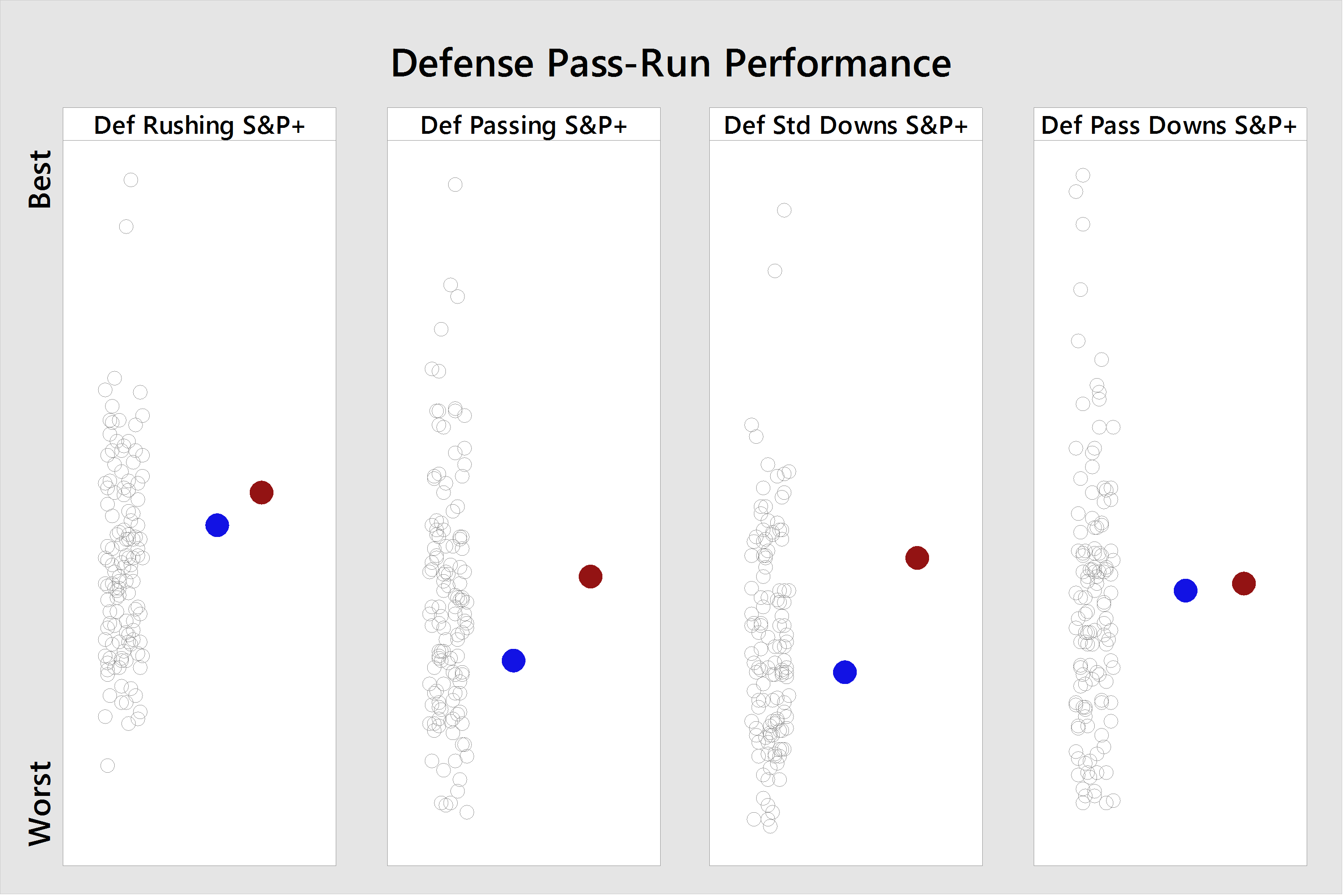
Put simply, be happy Bud Foster was retained and hope suspensions and injuries don't hold back Tech's defense. Memphis' defensive performance would not have been something to feel optimistic about had Fuente brought his former defensive staff to Blacksburg.
Now a look at the personality of each team's defense:
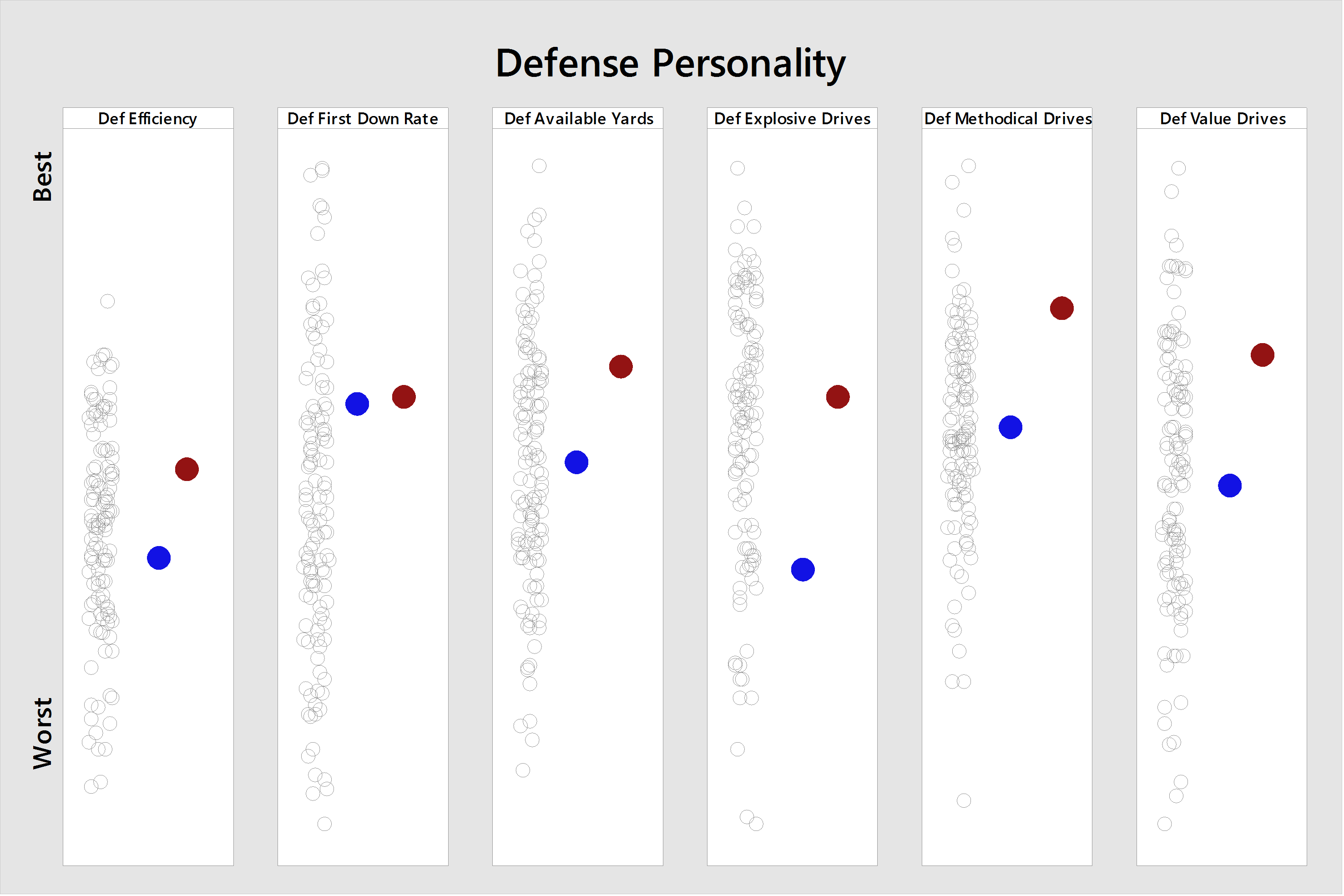
The graph illustrates that while the Tigers fared fairly well at creating 3-and-outs (First Down Rate) it came at the expense of frequently allowing explosive drives.
Finally, defensive line performance is compared:
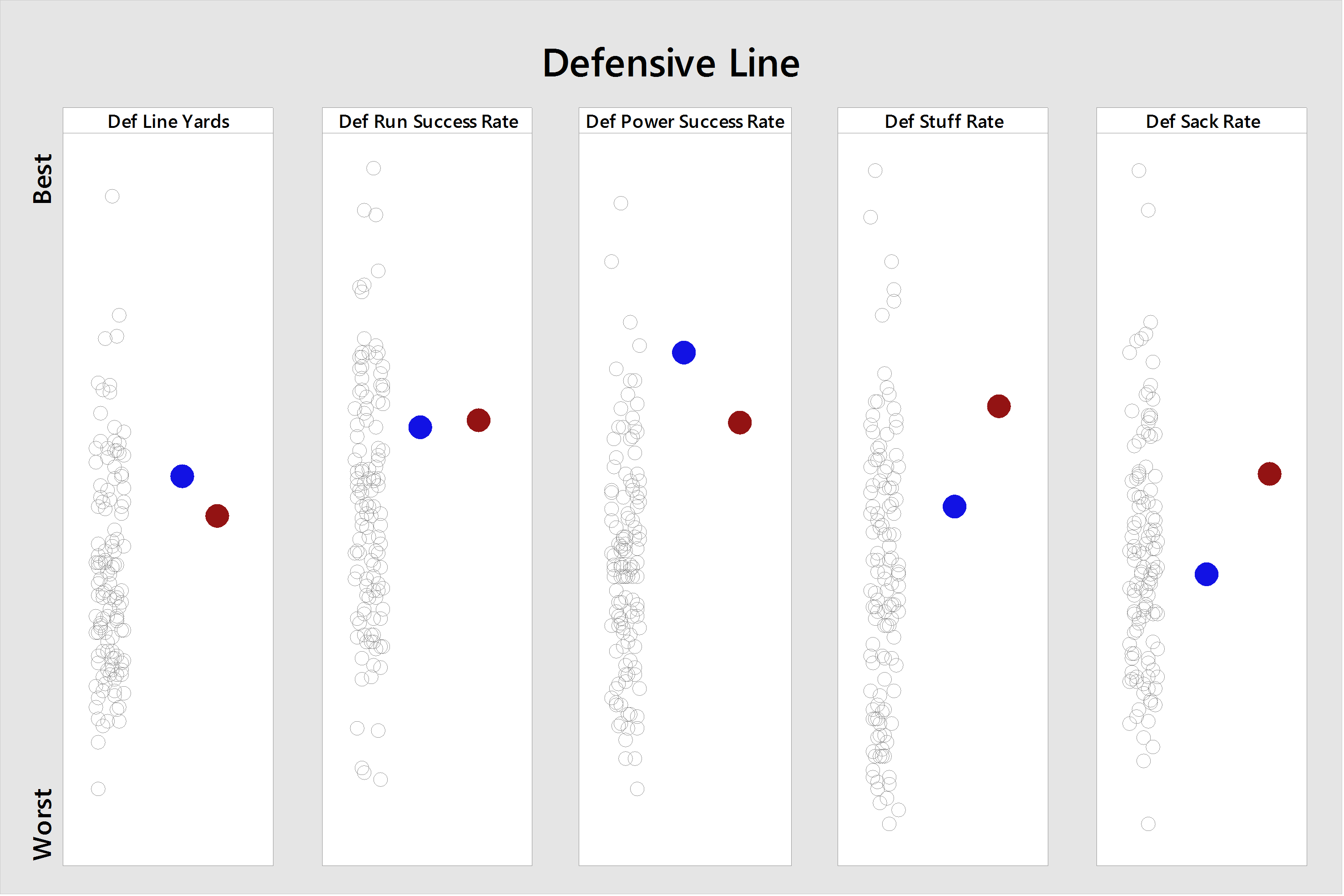
Given the overall mediocre defensive performance by Memphis in 2015, the defensive line could hardly be blamed, rating in the top third of teams in multiple metrics. While the Tigers struggled to create sacks, the line performed very well at stopping the run and even surpassed the Hokies in two metrics.
The FEI No. 43 Virginia Tech defense was closest in personality to:
- West Virginia
- LSU
- Baylor
Talk about running with the wrong crowd.
The FEI No. 53 Memphis defense was closest in personality to:
- Pittsburgh
- Buffalo
- Louisiana-Lafayette
Virginia Tech vs. Memphis Offense
Perhaps the biggest cause for excitement stemming from Fuente's hire was the promise of a potent offense in Blacksburg, something not seen in maroon and orange in some years. So how effective of an offense is Fuente and staff trying to implement. First a look at pass/run effectiveness:
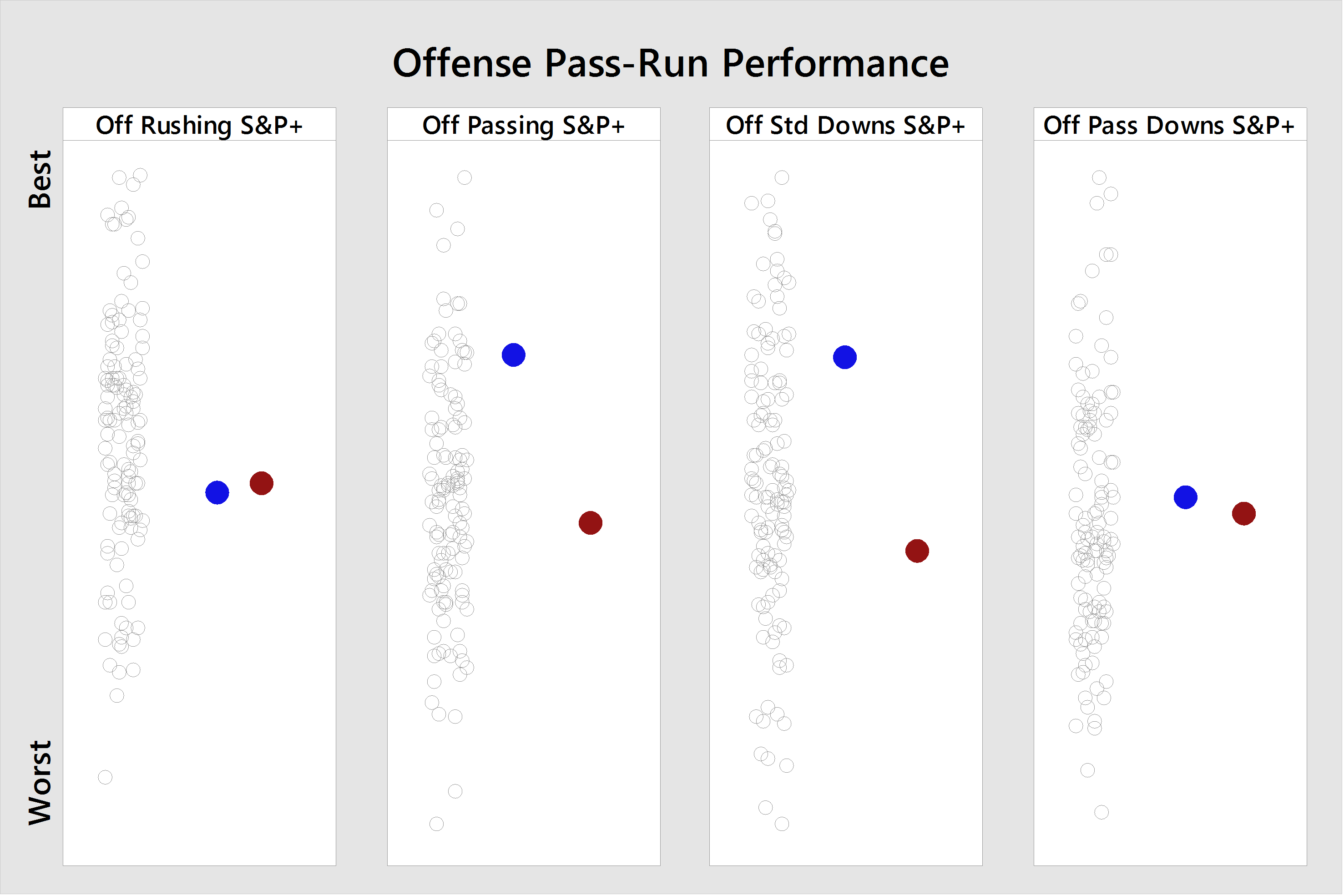
Surprisingly Memphis was roughly equal to Virginia Tech in rushing S&P+ and pass downs S&P+. But the other two metrics — passing S&P+ and standard downs S&P+ — show drastic differences. The Tigers were very effective through the air as QB Paxton Lynch developed into one of the top quarterbacks in the NFL draft.
While it would be easy to interpret the charts representing Memphis as a team good at passing and mediocre at rushing, it's not so simple. Despite the unimpressive rushing rating, the gap between standard downs and passing downs shows just how much defenses are scheming to stop the run. If the run wasn't so feared, teams would scheme for the pass more even on standard downs and the passing game wouldn't be so effective. Instead, only when the Tigers were put into obvious passing situations were defenses able to favor defending the pass and slow it down. This is the profile of a team that is effective through the air at least in part because of the fear of the run. Based on this data, at least, it would appear that Justin Fuente made Paxton Lynch more than the other way around.
Next, a look at the personality of the offenses:
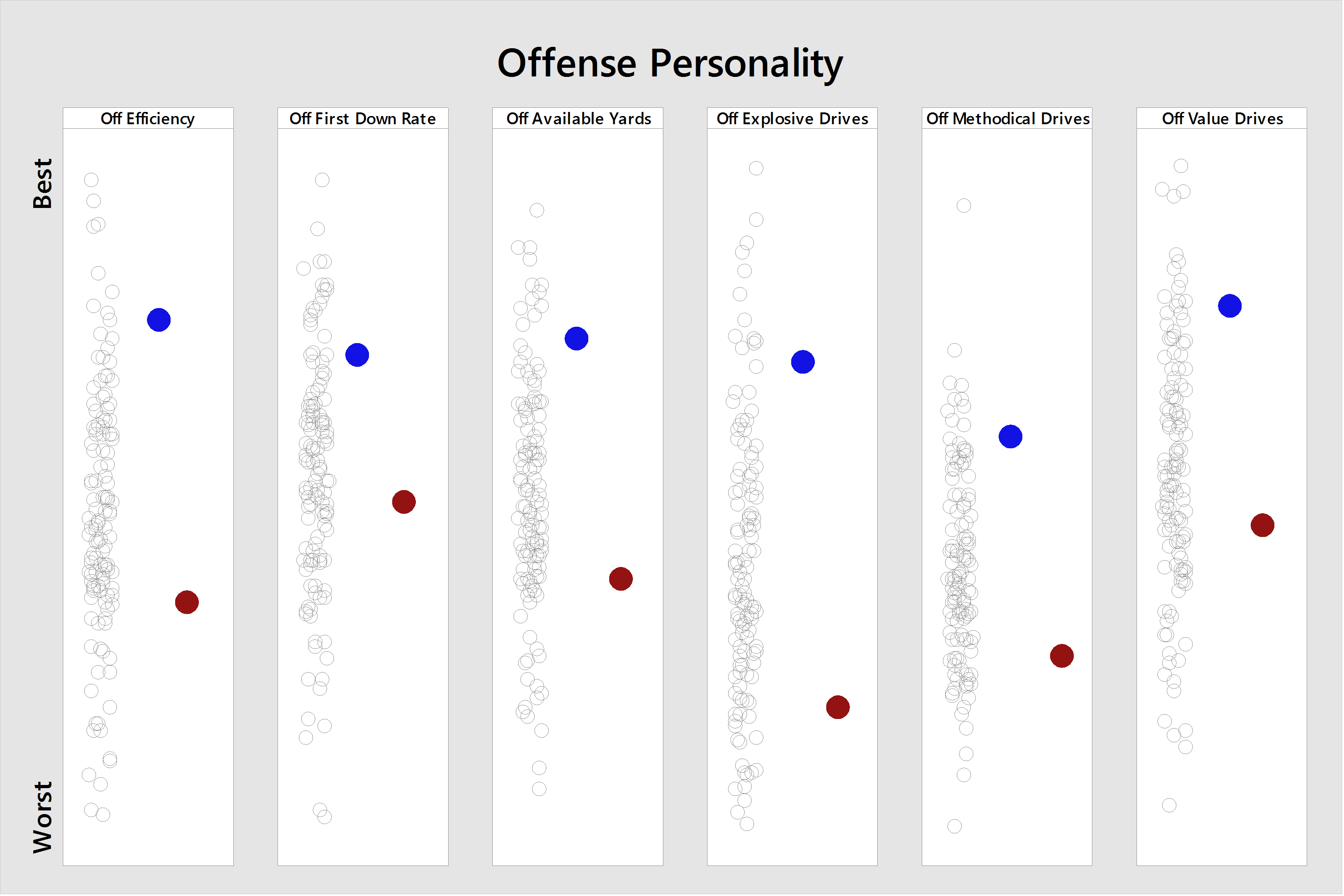
The personality graph shows just how much more devastatingly effective the Memphis offense was than Virginia Tech's. Across all metrics there is an enormous gap between the two, with the Tigers among the best in the country at all metrics and the Hokies among the worst.
Perhaps the greatest illustration of the gap is the measure of explosive drives — those that average 10 yards/play or more — and that of methodical drives — those that last 10 plays or more. A single drive will essentially never reach both objectives so teams will tend to be better at one than the other, unless the team is exceptionally good or exceptionally bad. In the graph above you see an example of each — on a high percentage of drives, Memphis either achieved explosiveness or methodical gains. Set up a defense to stop one and they gave you the other. Contrast this with the Hokies, who were rarely able to achieve either.
Those two metrics paint the best picture of the Memphis offense, which is in my opinion a team so multi-faceted that no matter what was thrown at them, they took what the defense gave them. Let's hope that offense developes in Blacksburg.
Finally, the offensive lines are compared:
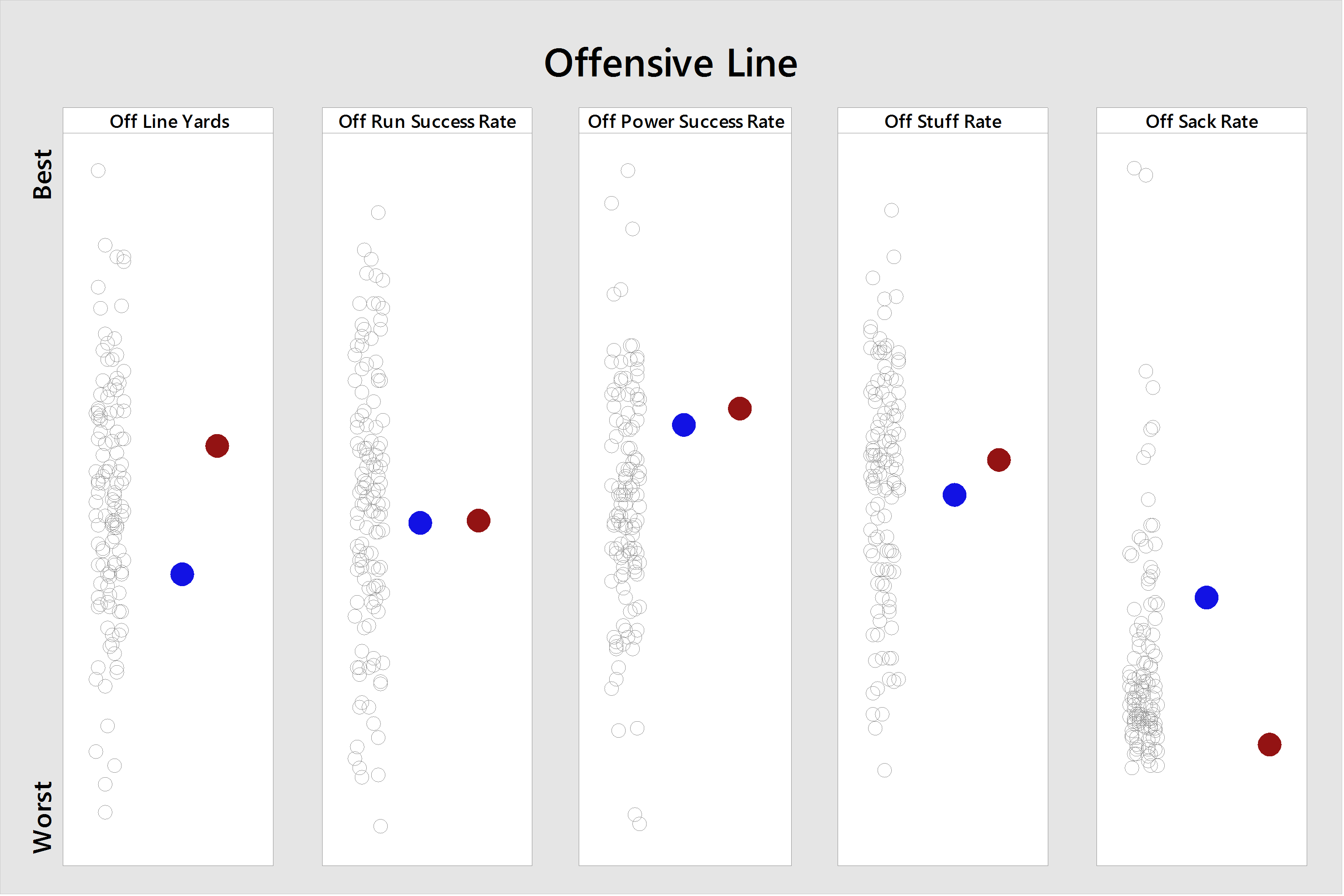
Given that most offensive line metrics are rated on running ability and not pass protection, it should not come as a huge surprise that Memphis is not rated well in them. In most cases, offensive line success and offense success go hand-in-hand but that's not the case with these metrics.
One bright spot is sack rate — while Virginia Tech was among the worst in the country at allowing sacks, Memphis was among the best.
While discussing the offense, it would be irresponsible to leave off the most prominent difference in philosophy between the two: pace.
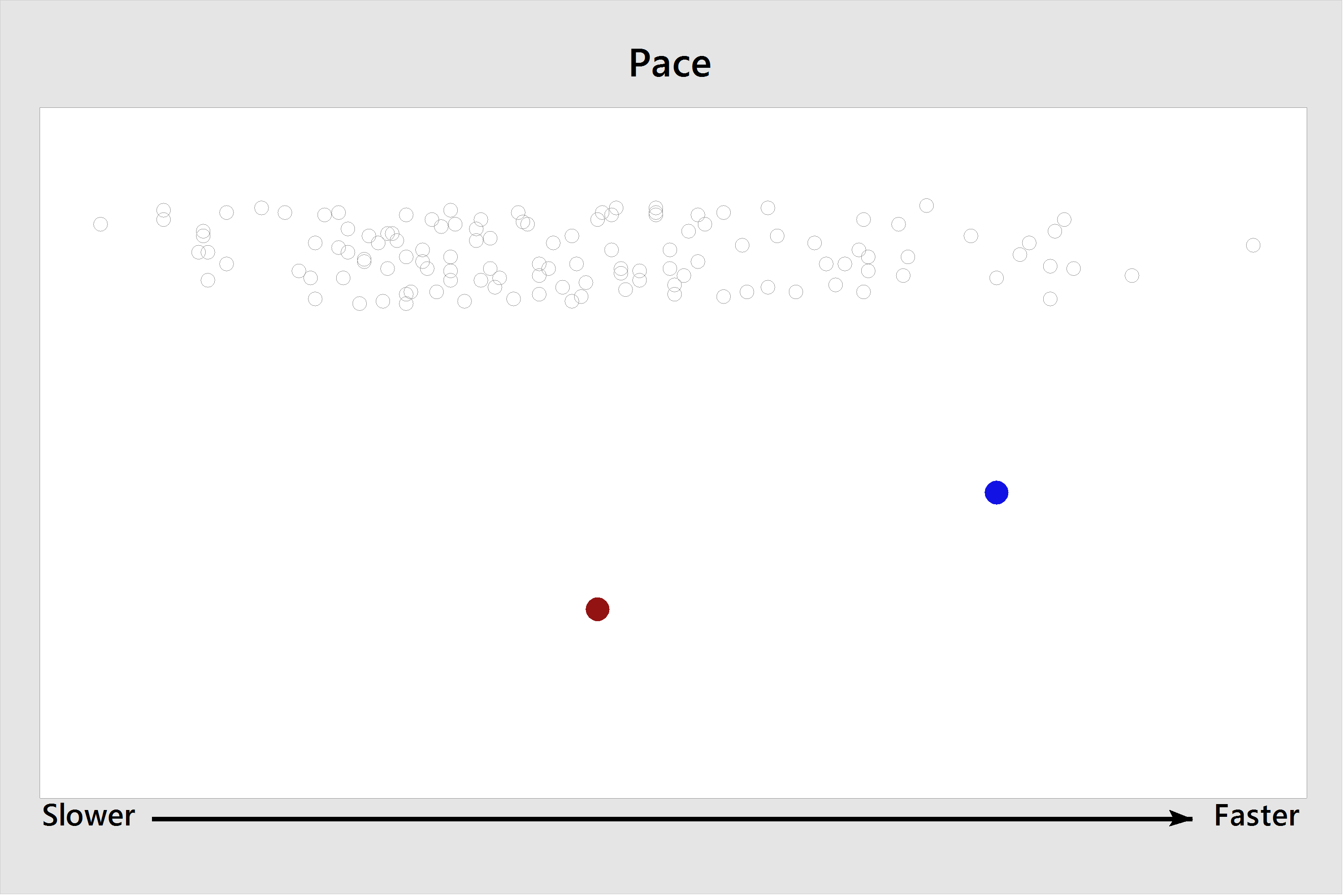
While Scot Loeffler did sometimes use a more up-tempo, no huddle offense, the Hokies remained a below-average team in terms of pace of play. Memphis, on the other hand, is among the fastest teams in the country and tries to catch the defense out of alignment by quickly lining up and snapping the ball between plays. Not news, but nice to see in graphical form compared to other teams.
The FEI No. 96 Virginia Tech offense was closest in personality to:
- Akron
- Louisiana-Lafayette
- Kansas State
The FEI No. 13 Memphis offense was closest in personality to:
- Arkansas
- Cincinnati
- California
No. 96 Virginia Tech. No. 13 Memphis.
Virginia Tech vs. Memphis Special Teams
With so much focus on the offensive differences between the typical Fuente and Beamer teams, special teams have not received their due attention (a comment not thrown out lightly to Hokies). Virginia Tech had a rebound in special teams in 2015, gaining the No. 8 FEI rating in the country. Who was No. 7? Well, that would be Memphis. But take a look at the last few years — those in which James Shibest was special teams coach at Memphis — and you see it was Frank Beamer's special teams that weren't exceptional.
| Year | Memphis Rank | VT Rank |
|---|---|---|
| 2015 | 7 | 8 |
| 2014 | 3 | 37 |
| 2013 | 15 | 75 |
| 2012 | 15 | 62 |
Remarkably, it might be the coach replacing Frank Beamer who brings BeamerBall back to Blacksburg.
Here is a look at how each unit rated nationally in each aspect of special teams:
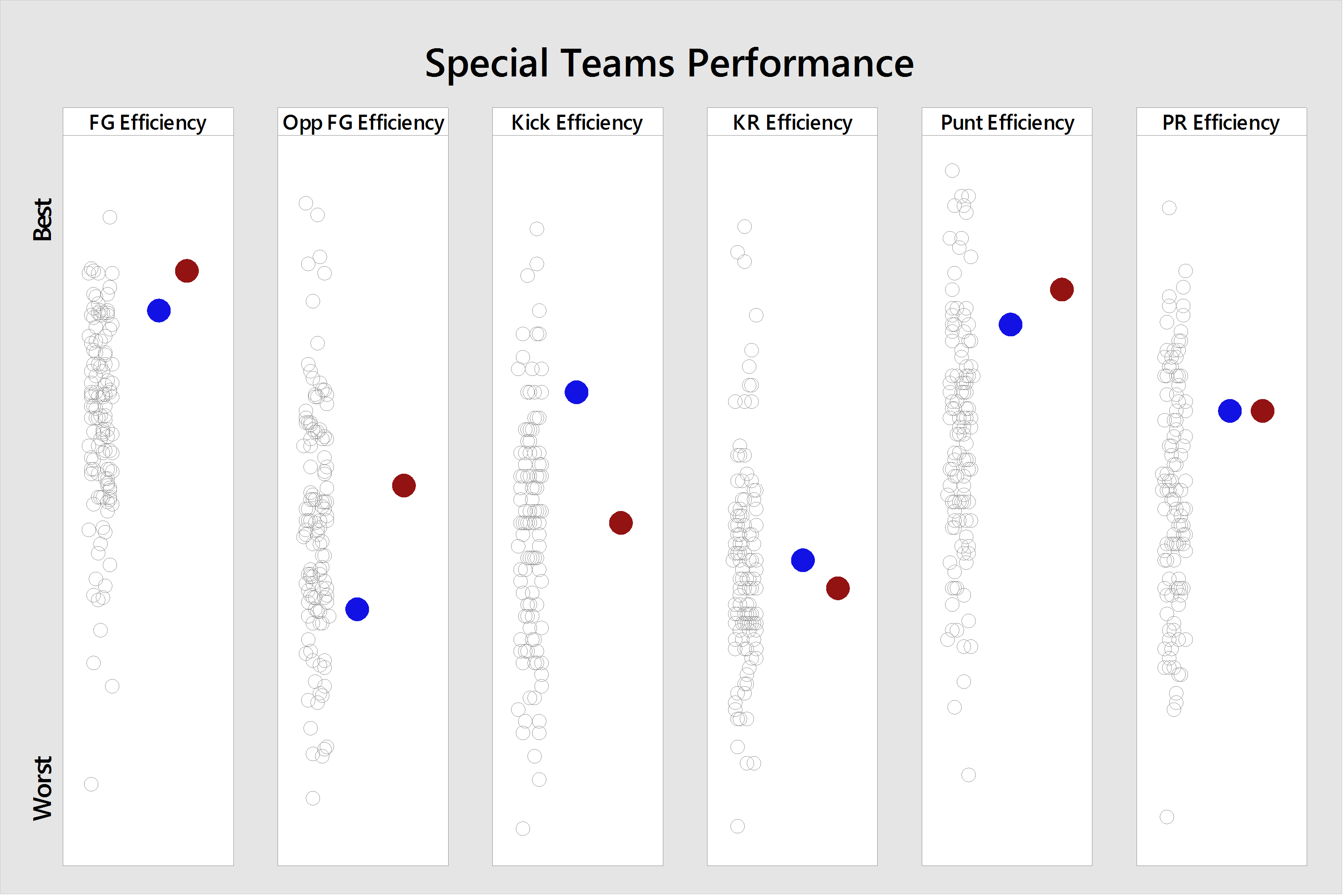
The only category in which Memphis rated below average was opponent field goal efficiency, a metric not included in overall special team ratings (because it is mostly random). Otherwise Memphis was among the best team at all kicking phases and at least above average in returning.
Given Shibest's sustained success in Memphis with less talented players, it is easy to imagine that the Hokies will field elite special teams units moving forward.
Block that kick!
As always a thanks to Football Outsiders, cfbstats.com, and Minitab Statistical Software.

Comments
Great monday morning article. Glad my wife has me attending plenty of events this summer, so that I can bear the wait until football season.
Damn I knew our ST was rough the last few years but all the way down to 75th?! Looking forward to consistency and improvement in all aspects of the game hopefully over the next few seasons...
This is terrific. Thank you. The personality chart is really telling. I really believe all the excitement around the new offense is warranted. That being said, it should be noted that we should not expect a top 20 offense in the first year. Year 2, maybe, but I think certainly by year 3 this offense should be lethal. Hopefully Bud sticks around long enough to make a run.
I think we'll be as good as the QB play.
That's usually the reason you see success in years two and/or three of a new quarterback (let alone a new system). Happened with MV7 and Tyrod, as the prime examples.
We'd probably have seen it with MV5 as well, had he not been such a jackass.
Where in the ST stats do you find blocking kicks? Based on the graph alone, looks like it should fall in "Opp FG Efficiency", which even though random, isn't pretty. Does it figure into PR/KR efficiency?
Great question - extra points are ignored, so it would be "Opp FG Efficiency" which is not included in the overall formula and "PR Efficiency" which is. If it is a field goal, it's for the most part a return that matters - otherwise blocking a field goal is pretty much worth the same as a missed field goal since you get the ball right around that spot. For a punt, on the other hand, even without a return you've created a huge shift in field position.
In either case it depends on where you are on the field. Blocking someone's 60-yard field goal attempt is not worth a lot because they are not expected to get many points from that distance anyway. Blocking someone's 23-yard attempt is worth much more.
For what it's worth, Memphis was tied for 7th last year with 4 blocked kicks (2 FG's, 2 punts). Virginia Tech had 2 (both punts).
Great article. Interesting perspective and comparison.
If we can get back where we were with our defense and our offense is even slightly improved, we should have a pretty good 2016 season. I am looking for a sustained improvement over the next couple years.
Those special teams though! I believe you, but I don't believe it.
No! I'm happy, I'm just a little sad at the same time.
The most important thing I took from that was that we were above average in PR efficiency @Stromanhaters
#TeamStroman
He didn't average above 6.6 yards per return for any month during the season (excluding the one game in December). Take away his 67 yard PR for 6 in the Independence Bowl and where do we end up?
I got into a very lengthy argument about this, I'm not going to do that again, this was meant to be (as I structured it as a tweet) a lighthearted jab. I don't intend to get into it again. :)
I've lamented the lack of anything exciting in the return game as much as anyone, but according to cfbstats.com (http://www.cfbstats.com/2015/leader/national/team/offense/split01/catego...) Virginia Tech was 62nd in the country (just above the middle) with 8.59 ypr. Supposing our opponents generally held people below average, we'd get a small adjustment upwards which would explain the rating.
Sure doesn't feel like it watching the "returns" though.
Great article. Thanks for posting!
I'm really anxious to see how quickly the offense adapts to the nuances of Fuente's system. I think the team will finish well, but may be a bit slow out of the gate (I hope I'm wrong).
Sack prevention rate anyone?
One bright spot is sack rate — while Virginia Tech was among the worst in the country at allowing sacks, Memphis was among the best.
The way people talk about this kind of stat would make JJ Owens bald head light up. I know what you mean, but weren't we actually among the worst at preventing sacks while Memphis was one of the best?
Based on my understanding of French's breakdown, I think a lot of the difference in the sack rate are due to the play calling and design, not the play of the O'line or the QB, which means that should transfer over fairly quickly. Am I correct in this, or was having a non-mobile QB a big factor in our rate (which also should change), or was it their O'line was better at pass blocking than ours?
I don't think it will take that long. When Lefty came in, he had to start recruiting differently to get players to fit his spread, since we were moving from a prostyle offense to a spread.
Fuente inherits a team that has the personell and has run similar plays. The kids should be familiar with the spread concepts.
It is not like coming in and having to reinvent the entire wheel. It's just fine tuning.