
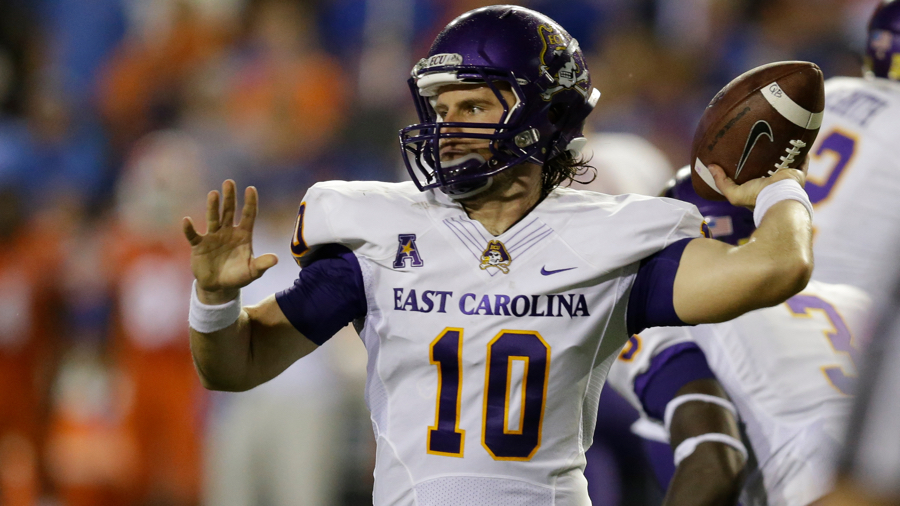
It's no secret that a big question mark going into the Hokies' game on Saturday versus East Carolina will be the play of the Pirates' junior quarterback, Blake Kemp. Kemp (99 of 140, 70.7%, 893 yards, 6 TDs and 2 INTs) showed flashes of reliability against Navy and Florida, but a few costly mistakes on poor throws sunk the Pirates to 1-2.
The first clip below is a good summary of what ECU will probably bring to the table, and how Navy chose to defend it. You'll see ECU (white) spread the field out, generally with 4 or 5 wide receiver sets out of the shotgun. East Carolina's objective on offense is to get the ball out of the Kemp's hands quickly, to receivers running 5 yard stop routes, quick slants, or screens. The Hokies' secondary will need to come to Greenville ready to make tackles in the open field when they meet the Pirates' uptempo, short, pass-centric offense.
Navy chose to defend this formation with a soft cover 2 defense (two high safeties) and nickel personnel (5 defensive backs on the field). I don't think Virginia Tech defensive coordinator Bud Foster will let the Pirates off that easily. I expect the Dean of DBU, Torrian Gray, to take a more aggressive approach, potentially utilizing more man-to-man cover 1 (one high safety) in his defensive scheme. Florida did this to reasonable success when they played ECU.
The cornerback for Florida at the top of the screen (No. 31) plays man coverage about 6 yards off from ECU wide receiver. At the snap of the ball, the corner doesn't really move as he reads the drop of Kemp. Once he reads the short route and the quick pass, the he breaks on the ball and disrupts the throw for an incompletion. I expect Tech's defensive backs to play as aggressive; relying on reading the drop of Kemp at the snap to help get a jump on the play.
The only trouble with this aggressive approach is the susceptibility of Tech's secondary to the double move. The Hokies have been caught by a few double moves already this season, and I'm sure ECU has taken notice. Tech needs to be on the lookout for plays like this one, which led to a ECU touchdown after the Florida defender fell for the feint.
The disadvantage (from an offensive standpoint) to waiting for a double move route to develop is that it takes time. Kemp tries to get rid of the ball quickly, and there isn't really enough time to reach him for a sack. In that case, the best bet for the defensive line is to get their hands up in the passing lanes and aim for batted balls. But if Kemp is going to try and pump fake and wait for a longer route to develop, the Hokies need to sack him, force a scramble or pressure a throw sooner than Kemp would like. The earlier in the game Tech gets to him, the better chance they have later on of Kemp thinking there's pressure when there really isn't.
In this clip, Kemp actually had a decent pocket and plenty of time to pass. However, as he worked through his progressions he seemed to feel some pressure, and started to drift (which led to the defenders actually being able to pressure him), and then had to throw the ball away. The job of Tech's d-line gets easier when a quarterback feels there is pressure when there really isn't.
A lot of the throws Kemp makes seem almost... scheduled. It appears that he is looking to throw the ball based on a count in his head, rather than reading the field and making a decision. These timing routes can lead to quick completions before the defense has a chance to react, but can also lead to trouble if the defender plays a route differently than expected.
In this next clip, Kemp throws a quick out route assuming the outside defender is running with the fade route. However, the corner at the top of the screen (No. 31) reads the drop, sees the out and makes a break on the ball to intercept it for a pick six. His feet never move at the snap of the ball. I wouldn't be surprised that, based on the number of timing throws I've seen Kemp make, Tech has at least an opportunity for one pick 6 during the game.
Although most of the throws Kemp is called on to make are short routes to the sideline or underneath, he is not afraid to try and fit the ball into small spaces between defenders. On this play, Kemp completes a nice TD pass on a seam route over the middle into a sea of Navy defenders.
However, on a very similar play call towards the end of the game, he throws an interception trying to do nearly the exact same thing.
There is certainly opportunity there for Tech to capitalize on the poor throws Kemp makes (because he will make some). In the two games I scouted, I can remember 6-7 times where it seemed Kemp just threw up a prayer down the sideline. Most of these fell harmlessly incomplete or out of bounds, but again, I wouldn't be surprised if Tech was able to get an interception on an ill-advised, arm-punt, especially if the Hokies can get pressure on Kemp.
Even so, as this next clip shows, Kemp certainly has the ability to drop a ball where it needs to be for his receiver to make the catch (even if it isn't the prettiest form). While I don't expect ECU to be able to string together too many plays like this in a row, a few here and there could certainly help to keep the crowd engaged and the momentum rolling for the Pirates.
As far as running the ball goes, I was not overly impressed in how the Pirates moved the ball on the ground in either of their games that I saw. Their offensive line was susceptible to domination by Florida (see clip below), and their option offense was non-existent.
That said, based on the success of Ohio State (and to some extent, Purdue) running the option against us, I wouldn't be surprised if ECU keeps it in the package. Their backup quarterback, James Summers, is an athletic QB turned WR turned QB who may make an appearance versus the Hokies. Although to date he hasn't shown to be much of a threat, ECU may still switch it up with him in specific packages.
Based on the film I watched, I don't think ECU is the same threat they have been in the past. However, given the history between the Pirates and the Hokies, that doesn't really matter. I still expect a tough game in a challenging environment. I think if Tech can get into Kemp's head with pressure early, make him rethink himself on quick throws, and capitalize on the throws he tries to force, the Hokies will be able to navigate back to Blacksburg with the W.

Comments
That last clip was Curt Newsome'esque.
And this was a nice touch:
Those seamen will really get after ya.
Speaking on the option, and I meant to ask this question earlier it just slipped my mind. When we defend the option against Ohio State it looked like we committed to defending the running back and forcing Cardale Jones to keep the ball.
Is this because we would rather have the ball in his hands for the run or is this our philosophy and are we sticking to it? In my mind forcing the QB to take hits and make decisions makes sense but we also don't want to give up easy runs in "must stop" situations.
ECU's Air Raid attack is definitely weaker without the weapons they had but they seem to be able to recruit the jump ball wide receiver well. Putting pressure on Kemp seems to completely throw him off. I predict this is Dadi and Ken's 2015 coming out party.
Go Hokies!
I remember reading that we were purposely trying to make Cardale keep the ball and turn the play inside towards help. We didn't want the faster running backs to be able to get the edge. And for the most part it worked. How we play the option will depend on the team we are facing and their strengths and weaknesses.
Really? During the Purdon't game I kept hearing how Cardale carved us up. /s
In the past, I think the plan has been to make the QB keep the ball to punish hm. The more he gets hit the more he wears down throughout the game leading to more mistakes.
Or put it this way, when we were making the QB decide, was there supposed to be another player there to clean up after the pitch/keep? As much as we talk about similarities to GT, that game features assignments to the QB and the pitch man, which seemed to be missing for OSU this time around.
That's probably because OSU is much more of a threat through the air than GT is, so our secondary plays differently than our front 7 do on those plays.
MLB has QB keeper responsibility usually, but he has to read it, scrape across, and make the play, after he reads the play to be certain he can vacate the middle zone..
Foster historically defends the option this way, taking away the dive and pitch eliminates the most likely to hurt us parts of that offense, forces the QB to carry and get into a rhythym running the ball, which can later be attacked by interspersing "spill" calls, aka taking the QB instead of the pitch (usually in third and shorts). Forcing the QB to carry gives us free hits on him, limits the big-play ability, and gives us a solid chance to get into his head. There are 2 weak points to this method, the first, is a huge QB, who can still get 5 yards a pop, keeping the O on schedule, the second, and the method that GT uses, is to ignore what we do, and attempt to dictate by forcing the dive, and running quick pitches. In short, this is Foster's philosophy, and it works. The few times it doesn't, the QB is durable, unaffected, and the O executes without mistakes...needless to say, those times have been few and far between.
Why don't we just play cover 1 with man press across the board? The high safety has our back and playing man press will allow us to stifle the quick 5 yard routes. Florida kinda did it, but they were playing soft coverage. I'd rather just jam them at the LOS and have our DL sack the heck out of him due to lack of routes and time.
The potential problem with pressing the LOS with our DBs is then you're asking them to run stride for stride with the WRs on every play. WRs sub out more often than DBs as I believe. It works if the D forces a quick 3 and out but get a couple first downs and now your starting DBU is winded and subbing. Giving them a little slack with softer coverage gives the DBs a chance to see where the WR is going, where the QB may be looking and, if done correctly, time to adjust and make a play on a ball thrown in their direction.
Agreed - but quick 3-and-outs combined with our new-found ability to sustain drives means that they don't have to do that very often! Plus if anyone can run with WR's all day errrday easily, it's DBU.
I only said it was potential. I hope they don't get a single first done in the game and each one of our drives is 10 plays, 75 yards (after a touchback) and 5 minutes off the clock! #GROUNDANDPOUND
I like the approach Florida showed in the clips above. The DBs know the route is going to be about 5 yards, so they start 5-7 yards off the line and let the play come to them. That way they're running toward the play, not away from it, when the ball is in the air.
What happens when both outside receivers double-move past our press??? The QB looks off the safety, who now knows he has to make the play, and throws the other way for the TD. Staying soft gives us the chance to break on the ball, with high safety support to clean it up if they complete it.
Is the field artificial turf or natural? How much of a factor is slipping when you change direction in coverage/making a move going to be?
It is a grass field.
Technically it's a clay court if it's as poorly kept as it was 3 years ago. I remember thinking that my middle school's field was in better shape than the Pirates'.
Hopefully it wasn't as bad as St. Edward High in Illinois last week.
Actually, St. Edwards might have them beat. I couldn't see the field lines at ECU.
Artificial, grass, whatever. It's going to be sloppy, sloppy wet by Sat at 330pm.
This is going to be a very interesting game. The short passing game could have moderate success in adverse weather conditions.
I want to see Loeffler/Beamer play grind it out ground control. This is going to be a street fight, and our dudes on both sides of the ball need to hit first, often, and hard.
I can see Foster choosing a zone combo like how we played Cinci last year in the bowl game. No need to play straight-up man and allow them their only advantage (WR height.)
Confuse this QB and he looks like he could throw about 4 INTs, just what we need to pad the FAINT and MAINT count.
Fuck Blake Kemp. Hard. Harder than Ryan.
Is anyone else getting tired of this, every time, every week? No? Just me? Okay, nevermind then.
If he provided reasons, either well-intentioned and supportive of his opinion, or sarcastic non-reasons that made us laugh...I would be entertained...but I am not.