
As I wrote in my review of the running attack, I anticipate that most of the Virginia Tech rushing offense will come from inside and outside zone stretch plays to both the strong and weak side. Critical to the success of the stretch play is the ability to create seams in the back side pursuit of the defense for the tailback to cutback. Defensive ends and outside linebackers have success by crashing inside to fill those cutback lanes. The offensive chess match requires the base run plays to have counters built in that force those defenders to stay at home.
The best tool at Scot Loeffler's disposal for doing so is the basic bootleg play. The bootleg is a fake handoff with the quarterback turning his back to the line of scrimmage and then rolling away from the run action. The most used route combination for bootlegs has the receiver nearest to where the quarterback rolls, often the fullback or the H-Back away from the run action, run a short out route to the flat. The tight end or wide receiver on the run side drags against the grain of the defense mirroring the quarterback's rollout.
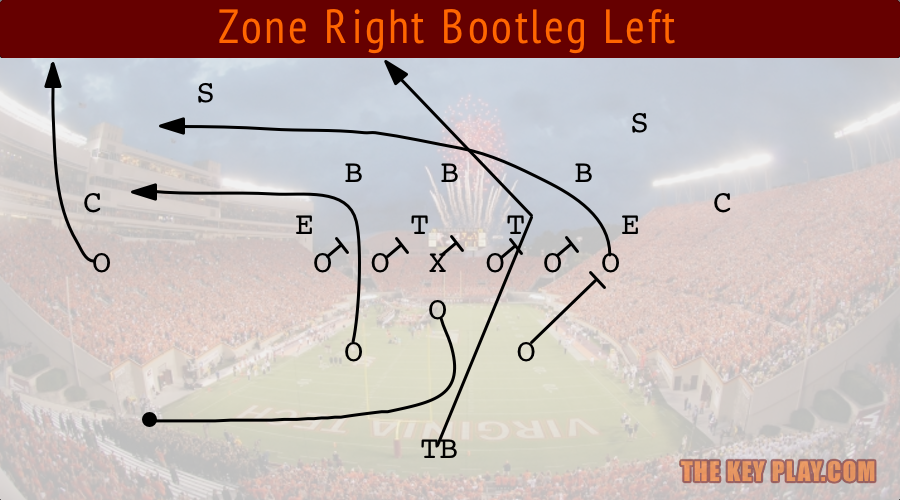
The quarterback has three reads based on two defenders. First, he must get outside the contain rush of the defense end (on the image above, the defensive end to the left of the formation). If that end is crashing upfield, it limits the effectiveness of the bootleg, BUT it opens a huge cutback lane for the tailback on the inside zone. In the spring game, the ends (most often Ken Ekanem) were crashing heavily on the inside zone, completely leaving the bootleg wide open, but Scot Loeffler stayed away from calling it frequently.
The second read is on the outside linebacker, located again to the left of the image in the above diagram. If the outside linebacker crashes on the run fake, the left H-Back (D.J. Coles in most of the first-team offensive alignments) takes a step inside to sell the seal block on the back side, and then races out wide open in the left flat. Based on the limited film from the closed scrimmages, this read was repeatedly wide open. If the defense is in Cover 2, the H-Back will be covered by the short corner. So if Logan recognizes Cover 2, he needs to look back to the tight end (as pictured above), or the wide receiver crossing against the grain on the linebackers. In college football, this is usually less open than the flat, but if that outside linebacker is managing to cover the drag, it should make the inside zone much more effective. The third read, if neither route is open, the quarterback should run. I should note, in my experience running bootleg from either a Wing-T or I-formation, any kind of post route on the backside is ALWAYS open, but it is a very difficult throw, especially if the quarterback is rolling out to his left.
Bootleg is symbiotic with the zone stretch. Successful running makes the bootleg more effective because the back side pursuit starts to crash to stop the run. Success on the bootleg forces the defenders to stay at home, which creates those seams for the tailback on the zone stretch and inside zone. If one doesn't work, it limits the effectiveness of the other.
A downside of the bootleg is that the primary receivers tend to be the less explosive receivers, the ones selling the run action at the snap, like fullbacks and tight ends. However, versatile personnel can be used to create mismatches. On the primary bootleg shown above, Loeffler designs the play to incorporate D.J. Coles in the flat instead of a fullback. I would imagine that ACC defensive coordinators would shudder at the thought of their outside linebacker covering a healthy D.J. Coles man to man. Loeffler also uses formation to hide his best playmakers in positions where they can be utilized in boot action.
Here, we have the Hokies aligned in a two tight end set with twin flankers right, and Josh Stanford is lined up tight, basically as the left tight end. Logan Thomas fakes a handoff for a weak-side zone and then bootlegs back to the right. The offensive line sells the run by coming out of their stances aggressively, while still stopping the Mike linebacker blitz.
4:38–4:48
Now, the pass structure is really interesting.
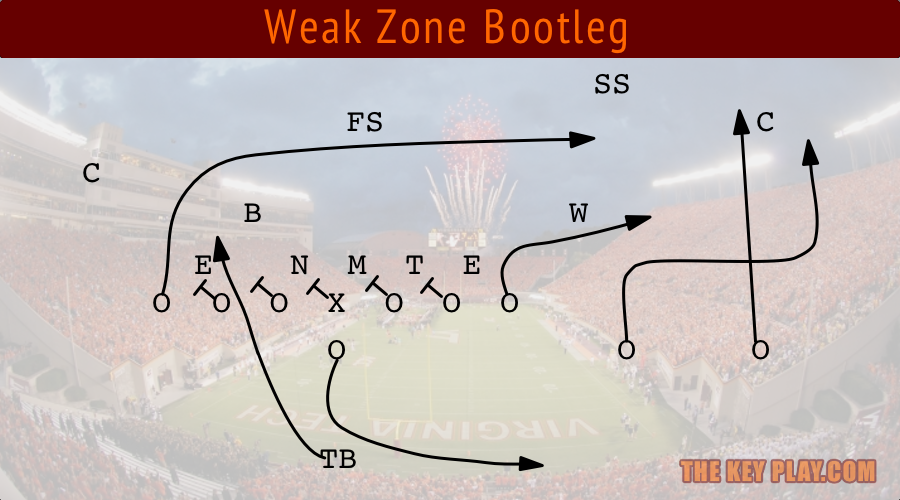
Coles, line up wide to the right, runs a go route, but angles inside to tie up both the corner and the safety. Knowles (the inside twins receiver on the right) runs a wheel route and initially is wide open, but Thomas doesn't look at him. Malleck seals the defensive end on the left inside, and then breaks back out to the flat, drawing the whip linebacker forward. Stanford performs the function of a tight end on a standard bootleg, dragging against the grain away from the run action and defensive pursuit. Stanford is able to get deeper before crossing, creating an opportunity for a big gain off the play action.
Establishing the bootleg will be critical to the success of the running game for Virginia Tech this season. The bootleg plays were wide open for the first team offense in the spring game, but I think Loeffler decided to limit how many bootlegs he called because the 2nd/3rd team defenses were not disciplined enough to give them a good look. The keys to success are simple:
- Offensive line has to sell the run and come out of their stance aggressively.
- The receiver going to the flat must sell the run first to force the outside linebacker to bite on the run.
- Quarterback must effectively sell the run fake, and set his feet to look flat to drag, to run.
- If the defensive end and outside linebacker on the back side of the zone stretch play are crashing hard inside on the run, the bootleg becomes more effective. If they are sitting on the bootleg, the inside and outside zone will be more effective. Against Alabama's 3-4, the outside linebacker is very susceptible to bootlegs, but he can also make a mess coming off the edge. The inside zone must be effective to prevent that outside linebacker from getting upfield.

Comments
Great as always French. Another key to the bootleg are the 2 receivers flooding that zone must keep proper spacing and depth between them not allowing one defender defend both of them. Malleck and Stanford do a good job on the clip above.
Absolutely correct. The drag from the back side must mirror the quarterback. He can't be too slow, or the quarterback has to throw back against the grain, which can lead to disaster (just ask Peyton Manning after the Ravens/Broncos playoff game.) At the same time, you want the linebacker looking at the quarterback rolling out and running to cover the flat. If the receiver dragging from the back side goes too fast, he draws the attention of the linebacker before the backer vacates the area.
It looks like this is the go-deep, play-action play that Loeffler designed into his scheme. With 2 receivers stretching the field deep and the defense changing direction on the play, Logan needs to get comfortable with recognizing the open route as soon as he turns, because there are gonna be some HUGE plays out of this bootleg!
Honestly the main reason the WR's are going deep is to clear out space for the underneath routes. The majority (over 70 percent) of these throws will be to either the TE in the flat or the TE/WR dragging underneath. About 20 percent (maybe even higher) will be throw aways. Less then 10 percent will be directed towards the vertical routes, and even fewer will be completed down the field.
With Logan on the move it's a surprisingly difficult throw to make down the field into man-coverage on those vertical routes. However, being on the move makes it harder for defenders to get into the passing lane because LT is changing the angle of the usual throw. It's a very tough short pass to defend, especially if the run game is established.
Play-action where the QB stays in the Pocket will be where most down-the-field, double-move, big-chunk throws will be completed.
logans strength last year was the deep ball though so i would expect him to take more shots than not on these plays
Not on Scott Loeffler's designed bootlegs. Pretty much just a long hand-off to counter aggressive rushing fronts.
We'll just have to agree to disagree though and see how it plays out.
Great write up French, perfect review of bootleg play action.
My favorite part of this game clip though is how it shows just how much of a disadvantage the offense had in the spring game. The defense was only allowed to rush four guys right? Well here we are, 1st and 10, and there's five rushers (4 DL and a LB crashing the A-gap).
It's not technically a blitz because the LB could have had A gap responsibilities on a run-read, but on play-action it's essentially a blitz. Something the offense didn't really have running plays installed to counter.
I'll tell you that the OL guys will Thank you for noting that, they keep catching a lot of crap, which some is deserved, but most of the constant ragging are just guys jumping on the
"lets blame the OL for whatever goes wrong on the offense" band wagon.
There's a lot of blame to go around when plays don't go as planned.
Watch the videos before posting!
As someone who played o-line in Pop Warner, and in high school, it comes with the territory. Most people only watch games live, and without the benefit of film some fans might not notice the QB holding onto the ball too long, an overloaded blitz (resulting in 2 guys blocking 3+) that should've forced a hot read / audible, tailback making the wrong read in pass pro, among others.
The writers (and many of the commenters) here make the effort to watch the film (multiple times), and try to explain what happened. We're not always right though. We understand zone blocking, have watched film of Grimes' and Loeffler's offenses at previous stops, but we don't know of any nuances that only a playbook would point out. Also, we don't have all-22 film, which is gold.
I talked to a few of the OL after their individual meetings with coach Grimes & what he told each one they needed to work on over the summer was exactly what "French" noted that each individual OL player needed to improve on, I was pretty impressed.
Love the play breakdowns. I think these articles really help the fans understand our team as whole, weakness' & strengths. When watching the games live or even on replay, it's hard to see any particular play as it develops, the breakdowns really help to understand it all. Great job!
This just confirms my opinion that we're lucky to have great film analysts here at TKP...French is gold in my opinion! Hopefully, he doesn't get poached by a coaching staff somewhere.
I think the fact that we have a mack truck running outside the tackle box who can run or throw the ball is going to make some DC's cringe, because if he doesn't throw the ball, somebody has to tackle him, likely somebody smaller than LT3.
Point #4 is the scariest part of this whole scheme as there's nothing that makes a QB's butthole tighter than turning his back on a very fast, probably pissed off OLB coming clean off the edge. And, to your point, proper setup and execution of the inside zone will ultimately determine this play's overall effectiveness throughout the game/season. Hopefully we can sort it all out before August.
As always, great write up, French!