
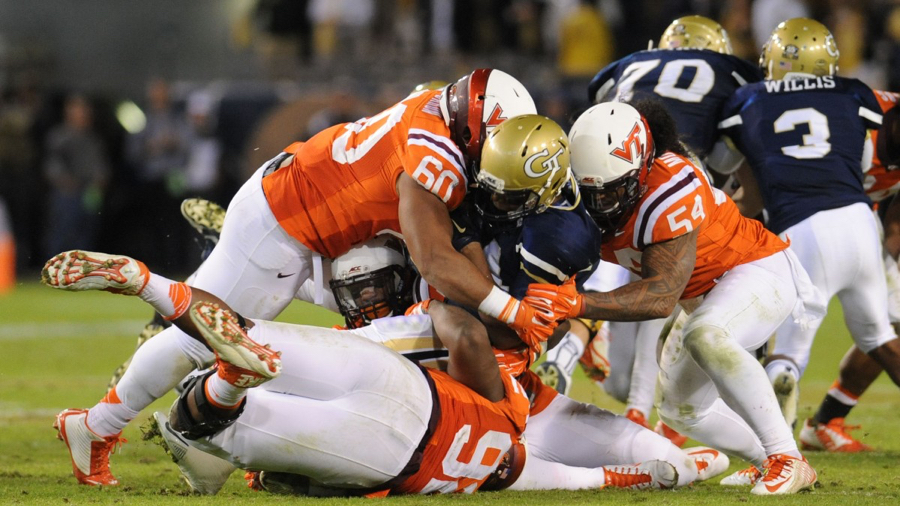
Thursday night's kickoff of the Frank Beamer appreciation tour got off to the rockiest of possible starts. Virginia Tech's defense gave up 14 points in short order and looked completely inept against Georgia Tech's flexbone offense. The Hokies' offense opened with a three-and-out and a fumble. Before I could finish my 12th Old Bay chicken wing, the score was 14-0 and the deficit felt much larger.
From that point forward, Bud Foster's defense recovered 3 fumbles and kept the Yellow Jackets off the scoreboard. Running back Travon McMillian finished with 135 yards rushing and 2 scores. Wide receiver Cam Phillips had a breakout performance to compliment another excellent game from fellow wideout Isaiah Ford. Tech had just enough offense to overcome a brutal Michael Brewer pick six. What changed? Was there some kind of masterful coaching adjustment that completely changed the flow of the game? The reality was correct assignment football and additional toughness completely derailed the Ramblin' Wreck.
Defensive Woes: Johnson's B-Back Dive Adjustment Bedevils Dadi
The lineup Bud Foster rolled out against Georgia Tech included several key players (Andrew Motuapuaka, Anthony Shegog, Tremaine and Terrell Edmunds) who made their first start against the flexbone. The beauty of the flexbone triple option is that any one of five players can touch the football on almost identical backfield motion. The receiver could be cracking back on a linebacker or he could be running a post route. The play-side A-Back opens up to either lead on or wheel behind the corner. The A-Back in motion could get the pitch, the quarterback could keep, or the B-Back could get the dive. If a defender looks for the football, he plays on his heels. That gives a blocker a huge advantage.
Johnson compounded the confusion of Virginia Tech's defense by adjusting how the play-side offensive tackle executed his block to set up the dive play. On a typical Georgia Tech triple option against a four-man defensive line, the play-side offensive tackle would cross the face of the defensive end and block down on the middle linebacker. The quarterback would then option the defensive end first. If the end crashes inside on the dive, the quarterback keeps. If the end stays wide, the quarterback hands the ball to the B-Back on the dive. With the down block on the mike linebacker and the crack back on the outside linebacker, the crash then leaves one defender (usually the rover) left unblocked to account for the quarterback and the pitch.
The Hokies usually aligned with a defensive tackle as a one-technique to the boundary side. Johnson really emphasized giving the football to the B-Back on the dive into the natural bubble between that one-technique and the defensive end. To mess with the keys of the defensive end and the mike linebacker, the play-side tackle drove straight into the defensive end on some plays instead of blocking down. The play-side guard would still double the one-technique and slide off to the mike instead of going to the back-side linebacker. Johnson doubled down on his bet that even if the guard could not get to Motuapuaka, Motu wouldn't be athletic enough to overcome initial confusion and make the play.
Early on, Johnson was correct. The change up definitely seemed to mess up Dadi Nicolas and Motuapuaka. The first touchdown run was the most telling example. Georgia Tech runs the triple option to the right side.
Based on alignment and the movement of the defense post-snap, Luther Maddy (one-technique) is responsible for inside dive through the A-gap (gaps diagram if needed). Motuapuaka has dive if it comes through the B-gap. Nicolas has the C-gap. Tremaine Edmunds has the D-gap. Donovan Riley has the alley, and Terrell Edmunds has the edge. Georgia Tech uses wide splits to increase the size of the bubble in between Maddy and Nicolas. Two things go badly wrong here.
Even though Nicolas may have C-gap responsibility, he gets cleanly beaten off the football by the right offensive tackle. Nicolas would normally not be blocked on the play, and the right tackle would go down inside on Motuapuaka. Nicolas should aggressively fire off the football and deliver a blow to the right tackle that would knock him off his path to the mike. Instead, the tackle beats Nicolas, gets under his pads, and drives him outside. When you freeze the play, freshman Will Bryan's (No. 70) right shoulder is in the middle of Dadi's chest. Nicolas is standing upright and looking over Bryan's shoulder at the football. Any coach will tell you, he is blocked at that point.
On top of that, Motuapuaka's eyes fixate in the backfield. As soon as Justin Thomas opens up to the right side, Motuapuaka should be running downhill like a heat seeking missile into the B-gap. Instead, at the mesh point between Thomas and the B-Back, Motuapuaka is still inside of Maddy and hasn't even moved laterally yet. This is unacceptable. Most of the commentators talked about how Motuapuaka ended up being driven backwards by right guard Errin Joe (No. 75) on the play. The real issue is that Motuapuaka should have been past him and up in that hole before Joe even released off the double team.
After the disastrous start, Foster made a subtle adjustment that changed the character of the game. It became pretty clear that Johnson was going to run the triple option look at the one-technique DT to the boundary. If the A-Back motioned from the field side to the boundary, the Hokies could expect triple option. If the A-Back motioned from the boundary to the field side, Thomas would either: fake the quick pitch and then hand off on the dive; execute the quick pitch to the A-Back in motion; or run the midline. Foster realized that Johnson was having tremendous success with the triple option by attacking the one-technique DT and confusing the boundary defensive end and Motuapuaka's keys. How did Foster adjust? He eliminated their read responsibility. From that point forward, Nicolas was crashing hard inside on the dive, and if Thomas opened up to the boundary, Motuapuaka was running immediately to take the pitch man on the outside.
Motuapuaka was a little slow to adapt. After the adjustment, he still had a tendency to get caught looking into the backfield and freezing on the dive or the keeper instead of just trusting his teammates to complete their assignment and running to pitch. Here is an example from a 3rd-and-5 conversion for Georgia Tech.
Ken Ekanem is the boundary defensive end does two things really well. He crashes inside to tackle the dive. Before he crashes though, he makes sure to chuck the left tackle inside so he can't get to Motuapuaka. Tremaine Edmunds aligns inside, and then widens out to take the quarterback. The center isn't quick enough to get to Motuapuaka's legs and the left tackle has been completely knocked off his angle to intercept Motuapuaka by Ekanem. Motuapuaka does a good job by recognizing the option and then heading in the direction of the pitch.
Unfortunately, Motuapuaka doesn't trust Edmunds to make the play on Thomas. Instead of running directly to the pitch man, Motuapuaka shadows Thomas and doesn't turn and run to the pitch until Thomas commits to the pitch. Stopping the option is assignment football. Edmunds had Thomas. Motuapuaka had to get to the outside. Donovan Riley, who had to play in centerfield because Georgia Tech had moved the play-side A-Back to a twins alignment on the field side, had a long way to run to prevent a touchdown.
I am sure after a few words of encouragement from Foster, Motuapuaka got comfortable flying to the pitch man. When he did, and as the Hokies defensive line started winning battles up front, the blocking scheme adjustments by Johnson were completely neutralized. The second, third, and fourth quarters were utterly dominated by the Lunch Pail Defense, and Motuapuaka went from goat to stud.
It wasn't for lack of effort by Johnson. He threw a variety of looks at the Hokies, especially at Motuapuaka and Nicolas. They stuck to their assignments and it paid huge dividends. Here are a look at three different huge hits by Motuapuaka on the option pitch.
On this play, Dadi crashes on the dive and Bryan (No. 70) gets on his outside shoulder and tries to drive him inside. Deon Clarke (now in at backer for Edmunds) takes quarterback. Motuapuaka isn't hesitating at all on the dive or the quarterback. As soon as Thomas opens up, Motuapuaka is running right to the pitch.
Also note the execution of Donovan Riley. He really is the edge player, and has force responsibility. That means he has to beat the block of the play-side A-Back without losing contain. Early in the game, several of the Hokie defensive backs lost contain, especially against the quick pitch. Riley makes a big time play by not being driven back while still maintaining his leverage. That was a common theme on all three of Motuapuaka's big hits. If Riley doesn't contain, the pitchman could use his speed and run outside and away from Motuapuaka.
Honestly, I thought Thomas should have given the ball to the B-Back here because Dadi got caved in. To his credit, Nicolas fought back across the block and could have possibly tripped up the B-Back if Thomas had read the play correctly.
Once Johnson realized that Motuapuaka was now running straight to the pitch, he adjusted by trying to release the play-side tackle outside of the defensive end so the tackle would have a better angle to cut off Motuapuaka's pursuit.
The hero here is Deon Clarke. Nicolas again crashes on the dive. Right tackle Will Bryan (No. 70) releases outside of Nicolas. Instead of just going to quarterback, Clarke violently shoves the Bryan inside and almost knocks him down before squaring up to Justin Thomas. This keeps Motuapuaka clean. Riley plays contain by working through the outside shoulder of the play-side A-Back Clinton Lynch (No. 49). Motuapuaka comes up the alley and knocks the ball free and Clarke recovers. This is beautiful team defense.
Johnson tried a third strategy. This time, he crossed the keys of the edge player by releasing the play-side tackle to block Riley and sending the play-side A-Back to cut off Motuapuaka.
Clarke is just enough of an impediment to the A-Back that Motuapuaka wins the race to the edge. It is a good thing he does, because Riley is in a bit of a pickle with a big offensive tackle bearing down on him. Assignment football and superior athletic ability wins out. Nicolas wins against the dive. Clarke wins against the quarterback. Motuapuaka wins and crushes the pitch man. If everyone does their job, the system works just fine.
North Carolina presents a litany of challenges for the Hokies' defense. UNC has an excellent run blocking offensive line. Elijah Hood is a stellar running back. Marquise Williams may be the best run-pass threat the Hokies face all season. Ryan Switzer is a dynamo in the slot, and both Quinshad Davis and Mack Hollins are big receivers that can win 50-50 balls against smaller corners. All of these weapons have almost two full seasons of playing together.
Despite UNC's blowout wins against Duke and Miami, they're vulnerable. Nicolas and Ekanem have had major success rushing off the edge against the Tar Heels the last two seasons, and Larry Fedora has shown a tendency to try and get everything in the playbook on the field rather than sticking with what is working. If the Hokies play sound football, and force Williams into some uncomfortable situations, perhaps they can generate enough stops and turnovers to give the offense a chance to win the game.
Old-Fashioned Toughness Sparks the Offense
When the Hokies' offense opened the game with a three-and-out and a Cam Phillips fumble, I thought perhaps the team was flat after an emotional week associated with Beamer's retirement announcement. The film told a different story. When the Hokies' offense could get a hat on hat, they were the significantly more physical and dominant team.
Georgia Tech defensive coordinator Ted Roof had his front-seven stunt all over the place, and to their credit, they caused significant confusion. Without an effective running game, the Yellow Jackets were able to drop numbers into coverage, and it seemed like Michael Brewer's timing was off. Several throws were late against man coverage, and he was locking onto receivers against zone. Early on, the only positive for the Hokies offense was their pass protection was solid.
Down 0-14, Virginia Tech's offense needed a spark, and it got it with some extremely physical plays from the last place you would expect it from: the wide receiver corps. I felt like the game turned around on a 2nd-and-10 reception by Isaiah Ford.
This is an inside zone read, packaged with a quick stop route by Ford on the boundary. Brewer makes the read of soft man coverage with no rover help, and the offensive line blocks downhill just like a normal running play. Ford runs five and stops as the corner bails out deep.
The play design is well conceived against this kind of coverage, especially when the rover slides down into the box to commit against the run. Still, the X's and O's don't matter as much as Ford not accepting just five yards on the play. Ford freezes the corner, runs through the arm tackle, and gets belted as he crosses the first down marker. This was the first moment where the offense really seemed to have Georgia Tech on their heels.
On a third down later in the drive, Scot Loeffler anticipated man coverage and went to a double crossing route package to break either Phillips or Hodges open as they weaved.
The offensive line picked up the blitz. Hodges crossing route caught the attention of linebacker P.J. Davis (No. 40). As Davis fixates on Hodges, Phillips makes the first down grab. At the moment of the catch, Isaiah Ford and Ryan Malleck don't just stop playing. Both guys lock on to defensive backs and stay engaged with their blocks. Phillips cuts off their blocks to turn a solid conversion into a game breaking play. Even young Yosh Nijman, who got a ton of work at left tackle, is running downfield step for step with Phillips trying to find someone to block. When Tech's leaders and best players are out there making those kind of effort plays, it makes everyone on the team better.
Now, the Hokies are on their toes, excited and chirping. Meanwhile, the defense is sagging. Two plays later, McMillian explodes up the middle on an inside zone read with a bubble screen packaged to the top.
There is nothing remarkable about this play. Nijman pancakes the defensive tackle. Wyatt Teller drives linebacker Brant Mitchell (No. 51) ten yards into the secondary. McMillian puts his head down and gets up the field. If Eric Gallo even bumps the free safety (No. 20), McMillian probably has a touchdown. The best X's and O's in the world won't help a defense if the offensive line is dominating up front.
McMillian's talent and great effort by Malleck made the Hokies' first touchdown look easy in the face of the o-line being stymied. Loeffler called an inside zone lead with fullbacks Sam Rogers and Steven Peoples leading to the left side.
Nijman and Peoples both get beaten on their blocks. However, Malleck gets so much push on the Yellow Jackets' corner that McMillian bounces to the outside and walks in with ease. This is a tremendous play by Malleck, and great recognition and athleticism by McMillian.
McMillian had an interesting game. He put up big numbers again, but didn't look quite as explosive as in past games. Loeffler didn't do McMillian any favors by taking him out several times in the second half when he seemed to be building momentum. I thought to myself that perhaps he was a little dinged up. Still, when the final whistle blew, McMillian was well over the century mark. His ability to make the unblocked defender miss is the difference between the current success of the running game, and earlier struggles when Trey Edmunds and J.C. Coleman received carries between the tackles.
The next clip is a really nice example of how Ted Roof was able to confuse the Hokies' o-line, and at the same time highlights how much of a difference maker McMillian is. The Hokies run an outside zone to the left.
Georgia Tech's DTs X-stunt, which confuses Eric Gallo and Augie Conte. Both end up engaging the right defensive tackle as he stunts across their face. Neither slides off to the second level, and that frees up linebacker Domonique Noble (No. 23) to fill the hole unblocked.
Teller and McMillian make the play a success despite the busted assignment inside. Teller pancakes the Georgia Tech linebacker, and McMillian uses assertive cutting to run away from Noble. I guarantee that in today's film session, Roof is telling that kid that he had to make the tackle on this play. Newsflash: McMillian was just plain better than Noble.
The offensive performance against Georgia Tech certainly wasn't without flaws. Michael Brewer had a shaky game, especially when Georgia Tech dropped numbers into the secondary. He missed several deep throws. He stared down Bucky Hodges on a fake screen and go, and almost threw an interception when Ford was wide open deep. On the pick six, the Hokies ran the same crossing pattern that Phillips broke open earlier. This time Georgia Tech was in a zone. Brewer and Loeffler discussed the play after the game.
"It was a weird play," Brewer said. "I was trying to throw to Isaiah [Ford] on a deep in route and the spacing was a little bit off and Bucky was coming in underneath, and the guy that was trailing Bucky turned around and picked it off. I was trying to throw a low ball to Isaiah and the spacing wasn't really there. The shallow route runner kind of ran right underneath the dig route. So kind of a weird play, but we couldn't dwell on it."
"He was trying to throw a ball low and away to protect the ball and didn't see the poach and he got him," Loeffler said.
I initially thought Brewer locked onto Hodges and saw the corner coming up to his outside so he couldn't lead Hodges on the throw. As a result, Brewer short-armed it in an attempt to throw it to Hodges' back shoulder. Either way, teams may reconsider sending blitz pressure and could drop more defenders into coverage after seeing Brewer's performance. North Carolina doesn't have the reputation of being a top defensive team. However, outside of struggling with the Yellow Jackets' flexbone to the tune of 31 points, the Heels have held every opponent except Duke under 21 points. Duke and Miami scored 31 and 21 respectively, however Miami trailed 45-0 before scoring a point and Duke trailed 38-10 at the half. A win against the red hot Tar Heels in Frank Beamer's last home game would be a monumental triumph against one of the top ten teams (in my opinion) in college football.

Comments
Great write up French. I get the feeling that you might actually love doing the review on GT
It's fun when we sports good and win.
I am still kind of shocked that Johnson was so predictable. I know that coaches prefer to run option to the boundary, but I still went back and kept watching film to see if I could find a single option to the field. Nada. If the ball was right in the middle of the hashes and they ran triple, they ran at the one technique side/backer/rover. It really surprised me that Johnson could have so many in-game adjustments with the blocking scheme, yet would continue to run into the crash when it was clear that-unless Motuapuaka didn't get to his spot or Dadi busted, they were not going to get yardage on that side.
Could the injuries he has had to his "backs" played into this?
Even with the injuries and freshmen playing on the OL, he was making HUGE changes in blocking scheme play to play.To me, flipping the formation isn't a big change. I was also surprised that he didn't consider bringing in Skov and start hammering dives at the 3 tech side.
To me, the biggest reason they didn't run to the field was that- when they ran the base dive off the quick pitch fake to the field, they couldn't block the one technique on the backside. How many times did they run that dive and Maddy made the tackle for no gain? Johnson must have believed that he had no chance to block the one tech on the backside of a play with a scoop, so instead, he ran at them and tried to keep working the natural bubble between the one tech and the DE.
cont: that was Dadi's best 3 quarters of the season. If he isn't taking away the dive, the rest of Foster's adjustment doesn't work.
I almost seemed though with what you were saying that they gave up on the dive when they changed the blocking schemes. When they had the OT trying to pick up Motu or Riley it seemed like Dadi was able to meet the B-back in that B gap more or less unblocked most of the time.
I don't think they gave up on the dive. It is a QB read, and the first read is on that DE. The DE (mostly Dadi) was crushing dive, which makes it an automatic QB keep/pitch.
Oh I know but when they started using the OT to (attempt) to block Motu and then Riley were they not vacating putting a block on Dadi which essentially allowed him to fill the B gap uncontested and as a result forcing Thomas to keep it on the option basically every time they ran that play?
PS: I'm not trying to argue, I'm honestly just asking.
Have you ever compared VTs strategy to other teams that have been successful stopping GT? If yes, do they use similar scheme, use their own scheme with better/bigger/faster athletes, combo, or neither?
As I indicated in the GT preview, Bud changes things up every year. Miami used the Jimmy Johnson 4-3 to destroy GT every year in the Randy Shannon era. I loved Notre Dame's scheme this year- however you have to have giant beast mode two gap down linemen in order for that to work.
Bud adapts based on his own personnel and GT's strengths. Thomas was clearly the most dangerous potential ball carrier, so on options it was clear that he was ALWAYS accounted for. Thomas only made headway on midlines, not triple.
Also, even without Kendall and with some questions about the D backs, it looked to me like Foster was defending the run every down and taking his chances with the pass, knowing that GT really didn't have much in the way of downfield threats.
I actually thought he was pretty conservative against the pass. There were at least two deep in zones on most plays (the boundary corner and the free safety), and to the boundary Riley was in position where he aligned deep enough to turn and run if a WR flooded out. Outside of those goofy little flare outs from the A-Back when Alexander and Motu respectively got fixated on Thomas, the long throw to Jeune was the only time they had a guy open.
Edit: back got behind Clarke on a play as well.
My comment on that flare play was that I could't ever recall seeing GT run that play. Maybe I'm wrong on that but did they just completely catch the VT defense off guard that play with something they hadn't seen on film (much, if at all)?
How much of the defensive turn around was on Deon Clarke coming back into the game? It looked like he missed the entire first quarter
Because he did. He was benched for an undisclosed violation of team rules.
Not sure how much Clarke impacted things. When Edmunds was in the game, he was solid assignment-wise except for the play on the goal line where he got sealed inside on a quick pitch. Otherwise, after Foster made the change, Edmunds was fine but other guys were still busting (as exhibited above.) After Clarke entered the game, it looked like the other defenders had become comfortable with their keys. They were better when Clarke was in, but it would be unfair to blame the early struggles on Edmunds. He was solid assignment-wise. Most of the big chunk plays GT had before Clarke came in had little if anything to do with Edmunds.
So unfortunately, it's not that the light has turned on for Motu, but that Foster took the variable of his brain out of the formula.
Oh well.
Perhaps- but he made the tackles. How many times this season has he been in position and not put the guy on the ground?
Never complain about something when it works!
And while Foster may have taken the decisions out of Motu's hands a bit, it has to be a confidence builder to be doing the right things over and over in the later parts of the game. On-field training.
Don't disagree with either of you. But it doesn't give one confidence that the light is actually going to turn on.
The thing that worries me the most is the way he consistently finds someone to block him when the run is between the tackles. I just don't get that. He's got speed & agility & good power for his size, but he doesn't seem to be able to put that to good use, far too often getting blocked by anyone & everyone the O assigns to him.
I swear it often looks like he is running to meet the blocker, instead of running to fill a gap or meet the ball carrier.
Love that down field blocking on the Cam reception
I love seeing the chess match between Foster and PJ play out over the course of the game (especially in slow motion). Motuapuaka was a great surprise, and my fears of how we would defend the option proved groundless. Next Saturday is going to be a huge test for Bud and his D. Can he improve the inconsistencies in the pass rush (76th in sacks), and continue to defend the pass exceptionally (7th in PYA) against a Tar Hole Offense that has caught fire?
After Saturday, I hope we can say that the Tar Hole Offense really has caught fire
Wow... what a blatant chop block on Maddy in that first GT TD clip. Center #58 gives him a straight up cut block to the knees while the OG #75 drops a shoulder into him. Uncalled because the OG slides off quickly to block Moto. Ugh.
Too bad PJ won't get fired for one down season. Ugh. Can't wait for his BS blocking schemes to be gone from the ACC.
I just hope there's no lingering injuries from this game.

As much as I hate to say it, that one was actually legal. Point of initial contact was high (Maddy's chest, and he swatted the center down) for both offensive players, which is the distinction for a block below the waist. That's a tough one to call, but I think the umpire made the correct decision to keep the flag in his pocket.
Great review. What about the presnap movement of our DT (thought it was Maddy). Looked like a wrinkle Bud added after the first quarter. Thought he was waiting for the GT QB to read his keys before he would get set.
Watching live, I really thought that Bud was having Maddy move around pre-snap to get Thomas to call the option to the three tech. Watching on film, it looked like ultimately whichever VT DT was aligned on the boundary always ended up as a one tech or shaded off the center in the A gap regardless of all the pre-snap. I think the freeze and look to the sideline business that we saw GT doing was probably more setting up the likely read (dive, keep, or pitch) and setting up the blocking scheme playside. However, there is no way to know for sure.
On the play where the OT released on Riley, a part of me wonders if that was keep-pitch all the way and the dive fake was just window dressing. It doesn't seem like there was any chance of the dive working if you are leaving both the DE and the backer unblocked when you know they are crashing hard.
I can't recall but did GT run any of the counter triple option? Especially once AM started flying towards wherever the motion was going seems like VT might have been vulnerable to that. I don't remember seeing it much but I may be wrong.
They ran a counter (wasn't an option, just a guard pulling and Thomas following) in the middle of the fourth quarter. It was tough because on any play going to the wide side, GT was asking their guard to scoop block Maddy or Baron and that just wasn't happening. Maddy and Baron had very good games (as did Nigel Williams and Corey Marshall when they got reps.)