

CBS Sports: Discussions about eliminating kickoffs in college football have begun
The main reason for this is player safety. There's roughly twice the risk on kickoffs of a player getting seriously injured than on any other play in the game. Both the AFCA (American Football Coaches Association) and the NCAA D1 Rules Committee have brought the issue to light and are in discussions on how to completely eliminate the play from the game. Won't happen this year, but its looking incredibly likely this will be adopted within the next 5 years, and if I personally had to guess, you'll see the NFL quickly move to adopt shortly thereafter.
Its a shame because Special Teams can certainly change the course of the game, but at the end of the day, the safety of the players have to come first and foremost, and if there is unanimous support that this will better the game long-term, I can't argue.

Comments
eliminate crack back block and chop blocks but don't you dare touch kickoffs.....
The Kickoff is one of the biggest plays in college football and should not be messed with because this play below wouldn't have happened.
Sucks, but I'm glad that the NCAA is taking more safety measures than NFL seems to be
There's an interesting slippery slope here that I often wonder how far we will slide down. It has to deal with how much risk of injury is "too much" in college sports.
Once we eliminate the kickoff, what's next? I'd assume any play with a higher-that-average concussion risk is certainly on the table at some point.
I agree, and I hate that some plays are more dangerous than others, especially when they're something like kickoffs that are so important to a game. But I would be crazy if I said that we should keep said plays in the game even though they are detrimental to player health.
Removing the on-side kick would change the entire strategy for the end of the game, and would make many games practically over with several minutes left on the clock. How many of the greatest football finishes of all time involve a kick return on on-side kick recovery? Maybe good for injury prevention, but bad for the fans...
Wonder if it would be possible to eliminate the kickoff but still allow for onsides kicks?
The downside there is it makes it blatantly obvious that an onsides is coming, but most are telegraphed as it is with some rare exceptions (although didn't Alabama use one in the NCG out of the blue that basically completely turned the game their way)
Otherwise, as you stated, a number of games are going to just be over with a couple of minutes left with no appreciable mechanic or play available to at least intentionally try and swing possession.
I feel like if you eliminate kicking, you also need to eliminate some of the other plays that allow for draining the clock late in the halves. I would be alright with something along the lines of "when there are less than X minutes left in the half, the clock stops after every play." That would come with its own issues, but there needs to be something to prevent the situations where you're down by 14, score to bring it within 7, but you've only left 1:50 on the clock so it's game over since you already used your timeouts.
This strikes me as one of those things I would be disappointed to lose because of tradition but get over it about 3 games into the season once its gone.
Anyone who knows more about this, is there the same critique for punts? I understand the general philosophy that there are awkward blocking angles and two teams running full steam ahead at each other but punts have a lot of the same ingredients but we aren't talking about changing those because you need the punt on 4th down.
I thought about punts at first but after thinking about it they are not as risky. Punts still have guys lined up around the line of scrimmage who will be engaged with another player before sprinting 15 yards. The returner just needs to have a healthy desire to protect himself.
Kickoffs on the other hand allow players on both sides to get to full speed before colliding head on. We often think the blindside hits are the bad ones but the head to head collisions are like being in a car wreck.
I recieved a concussion in high school while covering a kickoff. I was the wedge buster and went head to head with a guy who closed the gap between us much faster than I anticipated. I don't think either of us went down at the point of contact but I remember my legs feeling like jelly. Went about 10-15 yards before the other player and myself were both on one knee trying to figure out where the play went.
Why not keep kickoffs but require that all but two players on the receiving team line-up within 10 yards of the line of scrimmage. This would slow-down the hits to something closer to a punt situation and would actually expand kicking strategy when that much of the field is available as "uncovered" for the kicker to use.
Good idea...that or something similar.
There is nothing inherently dangerous about putting the ball in play with a kick. The problem is the structure of the play.
The problem is when the returner doesn't protect themselves. The amount of injuries I feel like I see on non-fair catches where the back man is eliminated seems ridiculously high (nothing scientific). At least a kick off returner can see what is in front of them most of the time.
Just playing devils advocate and I agree with a lot of what you say. There is definitely more danger on the kickoff return for the blocking units.
IMO leave it how it is
The flag football jokes have already started.
I think it is a mistake to entirely eliminate kick offs. Its an entire phase of the game....gone. At some point we have to realize that the sport will never be entirely safe and these kids will have to choose whether or not to play it.
We need the threat of an onside kick to keep games interesting in the 4th quarter. If they want to improve it some they could make the opening possession of each half start at the 20.
I don't think we are trying to make the sport 'entirely safe,' but the concussion research coming out is eye opening and startling to say the least. If it's found that this can eliminate 200 concussions per season (not that ridiculous seeing as there are 128 FBS teams, playing 12 games each), is it worth it?
Interestingly, roughly 28% of all college football players will self-report a concussion. There are about 12650 players across all of college football. If we go down to a single year of players (this is the same as saying "in any given year of football") that's about 3162 players in a class. Of those, about 885 will get a concussion. So if you reduce 200 concussions per years, you've just done away with roughly 20% of all concussions in the sport (I'm rounding down to account for the plays that we run instead of the kickoffs adding in a few concussions).
Football is a dangerous sport. It always has been. If you start down this road the game is going to eventually morph into a completely different game in light of player safety. If they're really concerned about player safety they would just do away with the sport altogether instead of continually changing it to remove all of the "unsafe" aspects of the game. Before long you're going to have rules preventing things like running and tackling because they could lead to injury and the game is going to look a lot more like ultimate frisbee than traditional football.
This is right in line with the pussification of America. If kids don't want to get hurt, don't play. It's that simple.
Just award everyone a participation badge, sing kumbayah, then go home.
Exactly!
I think pain and heartbreak is a good thing for people. Toughens you up. Life is hard and people shouldn't be protected from that. If you can learn how to deal with pain and disappointment you can learn how to live. You give everyone a participation trophy and protect them from physical harm they don't learn how to fight for things, deal with failure, or learn what is dangerous to do and what is not. You're crippling them for their future. In terms of removing a play from football you don't necessarily hamper them directly but it's the principal of the matter. If you continuously protect people and implement all these rules "for their protection" they don't learn those things on their own and we end up with a bunch of brazen idiots roaming around doing stupid shi* because they don't understand what consequences are. When you cater to people and protect them for their whole lives you create a dangerous and cancerous culture. A culture that fails to let people learn from their own mistakes and grow as individuals in light of personal failures.
*steps off soap box.
Crippling them metaphorically vs. crippling them literally?
I appreciate the opinion, but I think an argument could be made that you can learn all of those relevant life lessons with or without the game of tackle football. People can understand the danger of physical harm/pain without having to break their neck on the field to figure it out.
Its one thing to say trying to implement rules to protect people from the reality of everyday life and everything that could go wrong or possible adversity. It can't be done, for starters, and it shouldn't be done for the reasons you mentioned. I just don't know if I see the connection there with implementing rules for protection in a game, one that could cease to exist and life would keep going on just fine.
sure. like other sports.
My point is that we're going about this the wrong way. When the NCAA changes the rules to protect people in a game it, by itself, isn't as damaging as I'm implying. However, it's the principal of the action that worries me. You're setting a precedent that when something is identified that could negatively affect an individual we rely on a governing entity to make rules changes to mitigate or eliminate whatever it is that was identified as a potential danger to said individual.
By making rules changes in the name of player safety we are inadvertently cultivating a culture of changing rules to protect people instead of letting/forcing people to find ways to protect themselves. We can realistically only take that so far. By changing the rules to protect people instead of educating people on the dangers and letting them make the decision for themselves you send the message that if something is adverse we'll eliminate it from your life. In football that's fine, but when you build that expectation people get to real life and aren't prepared to deal with the fact that they no longer have an overwatching entity that will protect them from things that are dangerous to them. We're building a reliance on some governing body to protect us from every possible thing that could harm us. We need to figure that out on our own.
I think making significant rules changes like this is a slippery slope. I also don't think we're dealing with the problem properly. If the game of football is dangerous (it is) and you think it is necessary to protect children from the game (I won't argue that point) then you should get rid of the game or properly educate people on the risks and leave it the way it is. Changing the rules is putting a band-aid on a gushing wound. It's a short-sighted way to fix the bigger problem. But there is way too much financial interest in the sport to get rid of it altogether so the only other option is to tell people, "Hey, this game is dangerous, and you're probably going to get hurt. Make your choice" and let the game go on as it should. If people decide they don't want to play then, fine, they'll find something else. I don't have a problem with people not wanting to play (or let their children play) but leave the game alone and just educate people on the risks. Don't change the game just to try enticing more people to let their kids play because you're afraid your revenue stream is going to suffer. For hundreds of years to come people will want to play football. I don't know what percentage of American citizens are professional football players but I'm certain it's a tiny number. There are thousands (probably millions) of people out there who will want to play the game. If someone doesn't want to because they think it's too dangerous somebody else will take their place.
TL;DR - leave the game alone or get rid of it. Don't change it just to try keeping people interested in playing. There will continue to be people who will want to play the game even knowing the risks.
Somewhat related article on playgrounds becoming too safe. Excerpt:
My boys were not allowed to run in elementary school recess whenever it was moved inside to the gym for rain, cold, heat, teacher not wanting to go outside, etc. And then they wonder why the kids seem hyper. Probably why the oldest took up boxing as a club sport in college, and the younger one tackle football as soon as he was old enough. As a side note, our high school averaged more concussions in girls soccer than boys football over the past several years, despite having less than half the participants.
So the NCAA is becoming UVA?
Participation badge: Participation Commonwealth Cup
Sing Kumbayah: Sing the New Year's Song
then go home: UVA pre-game ritual
The problem is that player safety is already taking a toll on the youth football game, with a significant dropoff in participation happening in recent years as parents forbid their kids from playing, in fear of potential long-term repercussions from playing the sport at a young age. We're not at or really approaching critical mass yet on seeing this falloff impacting all levels of the game, but it completely makes sense to take a long term view of the game and make the adjustments that need to be made to ensure the game doesn't go the way boxing did.
WARNING: UNPOPULAR OPINION ALERT!!!
If football goes the way boxing did another sport will fill the void. I don't necessarily think it would be a bad thing if football fell by the wayside. As much as I love the sport it is dangerous and the culture in this country has produced countless football players who turn out to be poorly educated, overpaid criminals.
I love watching football and will continue to do so as long as it remains in existence but phasing the sport out may end up being a good thing.
I support rugby becoming the safe replacement option.
Title of this thread needs to be changed to warn of how hot the takes are in here.
Please. Anything but cricket. ANYTHING!!!
When you look at it simplistically, taking out 6-12 plays in a whole game of football will not sway parents to allow their kids to start playing football. Kickoffs come with the territory of playing football and NCAA should recognize that.
Edit: Zero plays if it's us and Wake Forest playing
No, I agree... I think this is step 1 of molding american football into something that will survive over the next few generations by those in charge of the game. Eliminating the kickoff isn't going to be the moment that brings youth football back, but its a good starting point.
I really do think the game of football has about a 10-15 year window right now where it either needs to seriously adjust its style to be less violent and safer for the participants, or reach a tipping point where its inevitable the game will eventually lose so much popularity it essentially withers away over the long haul. And they have to be especially careful nowadays with the rising popularity in soccer in the US, because there's a boatload of potential money to be made in that sport in the US, and if the NFL takes a step back, that's a sport setting itself up to be a prime candidate to take its spot.
I don't understand how violence would have anything to do with the game losing its popularity? The violence and intensity is what draws many in to the game. I would guess removing kick offs and other things like that will result in more fans lost than keeping it. I think you are overly optimistic about the relevance of soccer in America in the future.
There's a big difference between getting hurt (example: breaking a bone) and having issues that change the way you think for the second half of your life. You can recover from broken bones. If you have to live the last thirty years of your life walking with cane, it's a major inconvenience, but you can still live a largely normal life. But battling depression and dementia (and other CTE symptoms) starting in your late 30's/early 40's, and continuing to do so for another 40-50 years is really scary to me. This isn't an example of the 'pussification' of America. If players in the 60's and 70's new that every concussion increased the chances of CTE and mental illness, they would have reconsidered their decisions just as people are now.
We're seeing it two different ways. I see "protecting" people by changing the game as a bad thing. I'm not saying that people should shut up and play the game. It is important for people to know the consequences of playing a game as physically dangerous as football. It's great that a lot of research has gone into the study of concussions and that we're learning that concussions can have serious long term effects. What we need to avoid is coddling parents and children by telling them we're taking the dangers out of a still-very-dangerous game. Educate them. Let them know the risks. Keep the game the same and if they don't want to take the risk they don't have to. It feels like a bad used car salesmen saying that he's going to install seat-belts in a car you think is a death-trap in order to sell it to you. Changing the rules stinks of catering to the concerns of the public in order to keep people interested in the game. It's still a dangerous game. If you remove kick-offs you're still going to have concussions. Just like if you put seat belts in a car with no air-bags you can still have fatal accidents.
Removing a significant part of the game just to "prevent concussions" isn't a move to make the sport better. It's a move to quell the concerns about a dangerous game. They are trying to say "this game isn't that dangerous, you can still play...it's okay...you can't get hurt now.."
That's crooked. Tell them straight up that this game is dangerous. Leave the rules the same.
Otherwise, you change the rules and give people this false sense that the game is getting safer (and it is, marginally) in order to keep them funneling their children into the sport. It's a sales pitch. Removing the kick-off is drastic. It's a hail-mary attempt to keep people interested in the game in light of recent revelations.
It's bad for our culture because you tell people something is safer when it really isn't THAT much safer, and they expect one thing and get another. We're masking stuff and telling people we're going to protect them so they'll keep buying our products when we're really only interested in them continuing to buy our products.
It's the pussification of America because you're encouraging people to play a tough, dangerous, game under the pretense that it's safe and then when somebody does get hurt everybody will get all up-in-arms about it. They believe they're entitled to some compensation because they were told it was safe and yet they still got hurt. They play a game that is inherently and obviously dangerous under the false believe that its not that dangerous.
You leave the game the way it is and tell people "hey this game is going to hurt you and could even cause long term problems down the road." You lay it out for them and if they decide to play (they don't have to, and obviously I wouldn't recommend it...but to each their own) they can't complain when they get hurt. You change the game, sell it as safer, and then somebody gets hurt, they whine and cry about it and act like little sissys because they were told they weren't supposed to get hurt and now that they are hurt it's someone else's fault.
This might not seem like such a big deal when you're just talking about football, because it's just a sport, but the idea driving the move is prevalent in other aspects of life and is very much a part of our society and culture. We are weakening the perceptive prowess of the general public in order to make it easier to sell them stuff they don't need.
Allow me to introduce you to the NCAA...
Not really. You just see something vaguely like this idea in other parts of the culture and get upset about it, and now see it everywhere because you're looking for things to be upset about. It's confirmation bias that has more to do with you taking up a cause than what's actually being talked about.
Other people have spelled it out quite well here. Games have to change in order to survive, football has changed more than most over the generations. If you're against the kickoff being taken out, that's fine, but don't make up a phony culture war to justify it.
I can't really reply to your post without getting political but I'll address this point.
Survive what?
What does football require?
What is it about the climate we live in that mandates the need for football and the "survival" of the sport?
Are you telling me that those whom are "concerned" about the "survival" of the sport and think it needs to "change" in order to "survive" are "changing" the sport in order for the sport to "survive" and they aren't making this "change" in order to protect the safety of the players?
What is there that "requires" the game to "change" in order for it to "survive" exactly?
This move isn't about protecting players. This move is an aggressive PR move to show the public they "care" about the players so you'll keep spending money on it. This isn't about concussions or CTE or being tough or weak. This is about money. If you think otherwise you're blind to the reality.
And this isn't exclusive to football. Look around your home and see how many things you can point out that you really truly need. How many things can you point out that you don't really need?
We are brainwashed into believing we need all kinds of things that we don't actually need. We are bred to be consumers. Consumerism drives everything. People don't think for themselves anymore. They believe what they hear about the things they need and they go out to buy those things because they need them.
The rules don't need to change. People should be able to see the dangers of the game, but they can't. Since they can't see it, we have to change the game for them? What does that do to the people? Give a man a fish. Teach a man to fish. We've stopped teaching fishing. Stopped a long time ago. Education vs Enablement. There is a fine line and we have crossed it too many times.
With all those quotations, i can't help but picture chris farley saying it.
Wait a minute. Is VPIhokieME actually Bennett Brauer in real life?
Hey, a real argument! If this was your point you should have said that a long time ago and left the half-baked social commentary at home. Of course it's about money. It's also about keeping the sport alive so that those people continue to make money. It's also about keeping the sport relevant because it's something a lot of people love and means a lot to a great many people (we're all on this site for a reason). Being a cynic doesn't make you smarter than everyone else, it just makes you harder to reason with.
Could not disagree more.
okay. why?
Probably because of this mentality which leads to a stigma about players talking about their mental health issues stemming from CTE or just concussions in general. How many times have you heard about a high school coach dismissing a player with a head injury because he needs to "quit being a pussy" and get back on the field. These aren't broken bones that heal. Its good that there's a discussion about what can reasonably be done.
Also the line in general about America. I guess we should pine for days when men mined for coal 12 hours a day and child labor laws didn't exist. What a great time it was
I'm not arguing that these revelations about concussions and how they can lead to CTE are a bad thing. In fact, I think they are a great thing.
The "pussification of America" line isn't about men being macho and doing things that put their health at risk. I'm not advocating for coaches to make high school players play hurt to "toughen them up." I actually think that should be punished severely.
I'm arguing that by coddling the general public and wooing them into playing a sport under the false pretense that it is safer than it used to be is damaging to the social fabric that makes us wonderful.
There is a fine line between education and enablement. I think people need to be educated appropriately and then allowed to make their own choices, not coaxed into dangerous choices under a guise of safety and security. We should have to think for ourselves, evaluate what we need/want, and work hard to achieve goals we set for ourselves. Instead the general public is spoon fed this garbage that we're going to change the game to make it safer and get rid of concussions and then you can play it and it'll be okay and you won't have to worry about CTE and all the dangers that come with traditional football. No. I just don't agree with it. Don't insult the intelligence of the people by pretending to change the game and trying to sell it as safer to keep people engaged. You can change the rules but football is still going to be a dangerous game and people are still going to get hurt. Changing this rule does nothing but attempt to quell the general public in an attempt to keep a dangerous pastime alive and well.
for some reason this seems appropriate here:
Speed and Danger
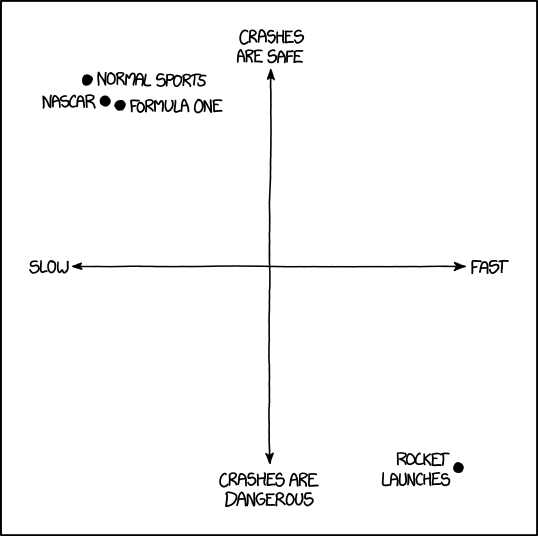
So I guess they've decided to give it the boot?
Obligatory:
If the data shows that most concussions and severe injuries happen on kickoffs, then we should do away with them. I don't like seeing players having to be carted off the field with neck braces and suffering later in life. They can end the kickoff, but still allow for on-side kicks.
Here's my problem with data. There will always be a "most dangerous" type of play out there. If we remove kickoffs it is very possible that it is the end of it. It's also very possible that another type of play becomes the next on the chopping block.
I don't think anyone likes to see players get injured. If you do, go step on the field with these athletes on kickoff and see what happens. There is risk though. These students are getting a college education, some of them are looking at the NFL, and others have their own reasons to play. When it comes down to it, there needs to be a clear and understood assumption of risk. I used to be an athlete, everyone I knew never though "it'lll happen to me" we were all invincible at the time. Players need to know that this is a real threat and they have to consciously accept that risk if big time ball is for them.
I agree with "there will always be a most dangerous type of play", but if that most dangerous type of play is WAY more dangerous then measures should be taken to reduce the danger. For instance if the data says the kickoff is 300% more dangerous than plays from scrimmage, then shouldn't we get rid of it?
The slippery slope argument is labeled a falacy for a reason. Making an action on one type of play doesn't automatically mean they'll get rid of the next, just like eliminating clothesline tackles and head-first launching didn't eliminate all tackling. The argument for or against kickoffs should be on it's own merits, not on the false premise that there will suddenly be a witchhunt on plays to eliminate.
I'll agree with you and I know full well it is a fallacy. In general, I see a lot of eliminations recently as a good thing with regards to chop/crack blocking, targeting, and other recent changes. It seems to me that a lot of other unsafe "football moves" have been remedied. Instead of throwing the baby out with the bath water we could look into the specific types of moves that are causing these concussions. Saying a type of play is the most dangerous in football so let's ban that play means whatever move is causing these concussions is still out there. Let's address the issue instead of kicking the can down the road.
If you're allowed to choose to serve your country at 18 then surely you have the ability to choose if you want to play football. They say you know the risks of joining the military, so you probably should also know the risks of a sport you choose to play. I know they're doing this because youth football is dying, and football has probably peaked, but I just don't care if players get hurt playing. I know a lot of people are going to get really mad at that last part, but it's just how I feel. They choose to play it, they're adults, it's their decision, they know the risks. That's my opinion, feel free to downvote, my turkey leg war with HDubya is over now anyway.
Would be sad to have it eliminated as it can determine so much
in the outcome of a game. It's exciting and can be game changing.
Given the recent state of our kick return game, it would seem we stand to gain about 15 yards in average starting field position. So I won't be too upset about it.
You're not wrong. From Bill Connelly (success rate=taking the kickoff past the 25):
What is up at FL???? 15%....That's a special team's coaching problem. To have the talent but to be that bad is amazing.
Well at least we know who is behind the movement to remove the kickoff........
The $EC.
(I'm hoping they count touchbacks in the number of kicks for the percentage.)
I have seen a lot of injuries in the pass game so lets remove that. The qb gets hurt a lot too, so get rid of that position. The rb as well. Linebackers hurt a lot of people, so goodbye. Linemen are big and always seem to have knee problems. Not cool.
In fact, lets just make the ball round and teams can just use their feet to move it around. To make the game as safe as possible, anytime a player from another team gets close, the player should fall to the ground and act injured.
funny cause when I think of a team sport that has a very low likelihood of injury, I think baseball, not soccer.
Yea, soccer actually has pretty high concussion rates too.
I believe it is classified as a full contact sport same as football and rugby for violent collisions and high risk of injury.
Maybe he was referring to Crab Soccer.
Of course, Crab Soccer is mentally devastating, so it should probably be banned as well. I am living proof that Crab Soccer Post-Traumatic Syndrome is real and is reeking havoc on our society.
Baseball actually has a high chance of injury from RSI aka Repetitive Stress Injuries. They are noncontact injuries but if you had a surgeons pay for every rotator cuff repair there was in baseball, you would be a wealthy surgeon.
something something God kills a kitten...
What if the NCAA tries this in order to at least eliminate some risk –
Give the return team the touchback option BEFORE the kickoff. Prior to every kickoff, the return team can opt out and take the ball at the 25 yard line. In order to keep the onside kick as part of the strategy, the touchback option is null during the last two minutes of the game. Most teams are not going to try an onside kick before the 2:00 mark. (At least the ones that can do arithmetic aren't going to anyway.)
Look at you! How DARE you start to make sense, dammit!
I think this is a great idea, but a little known team from the deep south sprung one on a lesser known team from somewhere in South Carolina a few months back with 10min left in the 3rd quarter. One could argue that it won them the game and those boys from bama got to hold up a big golden vagina afterwards.
Whenever these rule changes come up, my first thought is "meh, that hardly ever happens so I probably won't miss it." As more discussion goes on, I am reminded that it's the rare occurrences that make football fun to watch. What if we got rid of blocking kicks? What if we outlawed kicking any field goal over 50 yards? What if we just assigned victory to whatever team wins the coin toss in OT?
The biggest problem with this is it ruins Madden. Sometimes I get bored and onside kick every time. No matter what strategy I employ though, I always win.
They can already do that, in essence. There's nothing stopping the coach from telling the return man, "No matter what you do, don't touch that damn football until it crosses the goal line." All your option really does is give the coach with the lead an opportunity to prevent an onside kick attempt, which would be a viable option in a lot of situations outside of the final 2 minutes. If you're down 2 scores with 3:00 left, are you telling me that kicking it away is actually a better strategy than trying for the onside kick right away? Or if you're down 3 TD's late in the 3rd quarter and think you can catch the other guys off guard? In my opinion, the ability for the team who just scored to steal a possession is too valuable to the game to discard. Whatever they come up with really should provide some analog for the onside kick.
I can see your point, to a degree... most of the time a ball that is kicked by a scholarship kicker will end up in the endzone. BUT, I can't believe that, under the current rules, that a coach is going to tell his return unit to not touch a kickoff. That's a live ball. Anything can happen with a bounce, the wind, etc.
And, yes... I'm down by 2 scores with 3 minutes left, and I have my TOs, I feel like I have a better shot at pinning you deep, and my defense getting off the field, than I do at an onside kick. I'll take Blackjack odds over Roulette odds any day.
Also, to the third quarter scenario, The team could still spring an onside kick in the third quarter, if the return team in the lead doesn't opt out of the kickoff. Also, if a team is up big in the 3rd quarter and they're opting out of the kickoff, I would assume they are anticipating an onside kick anyway, so the element of surprise isn't there to begin with.
I'll withhold judgement on this until seeing what they have in mind for a replacement. I get the concern over injuries, but simply awarding the ball to each team on the 25 after their opponents score takes away too much from the game. As others have mentioned above, a successful onside kick can keep a trailing team alive late in the game or completely change the momentum in a close game. Likewise, a big return can also keep the recieving team alive.
Whatever replaces the kickoff needs to have some drama and the potential for the kicking team to 'steal' a possession. I wonder if a punt situation from midfield, where the kicking team could retain possession if they gain 20 yards on a fake, would be a viable option? It keeps a lot of the spirit of the kickoff alive, where a touchback is possible, but not a given and the opportunity for a big momentum-swinging return is there. Because you have to defend the possibility of the fake, more players will be close to the line of scrimmage, which should reduce the number of head-on full speed collisions. On top of all that, you have the opportunity for a block, which always adds excitement to the game. The biggest problem I foresee is that this idea gives such a short field to the team that successfully executes the fake. I'm not real sure how you'd compensate for that without moving the kickoff punt farther back, which would likely reduce the number of touchbacks. Since the impetus for eliminating the kickoff is a reduction in major injuries, I assume that increasing the touchback rate would be a key goal.
How about this?
When a team scores a TD they have three options. A) kick the PAT. No change. B) Go for two as per the current rules. or... C) Go for two from 25 to 30 yds out. If they score, they get the two points and the ball back at their own 25. If they miss, the other team gets the ball at their own 40 yd line.
Feel free to shred this idea, as I did not think it through whatsoever. Because... the internet.
I think it merits some discussion (read: I like it better than your kickoff moratorium before the 2 minute mark). Would you get the same opportunity after a field goal? Cause that would totally change the strategy of the game. Normally being down 4 points means TD or bust. Now you could put in a 40 yard field goal and have a hope of a 5 point play WITH possession.
I don't think that it'd work to do the same thing after a FG. Giving the offense a chance to get 5 points without scoring a TD would bee too drastic a change. If the idea were to work (and I obviously like my own idea better), it'd have to exclude the possibility of getting the extra points. Give the team the opportunity to punch it in from 25 and if they're successful, they get the ball back. But I think getting the ball back after you score should probably be more difficult than making a single play of 25 or 30 yards.
Future of football.... 'The way he pulled that flag after the 3 yard run was incredible!'
So at home games do we wear orange or maroon flags? I say that around 50% in jest. Football is football, it has and always will be a collision sport. You line up your biggest and quickest and we shall do the same and see who wins. I realize they are talking about this out of player safety, but at some point it comes down to the players. Concussions are terrible (had one myself) but it wasn't due to football. If the players made tackles the correct way it would cut down on a lot of head injuries. We've all seen the running back, backer or safety fly up crown of the helmet first, getting rid of a single play isn't going to stop concussions.
No more 12:30 kickoffs!
(I didn't realize taking the 'foot' out of football would be how it happened, but whatever)
In spirit of safety, i like the idea of positional weight limits. Players are getting outrageously big and fast.
So no 300lb lineman? 230lb running backs? How long until a group rises up and fights the inclination that they can't perform a task because of weight? Are you trying to fat shame?
*Edit: Personally I don't care/take offense but many people across the country would.
I don't view it as shaming or discrimination; think of it more like wrestling weight classes. There's a heavyweight division, but you can't put a 500-lb guy in that class since he's well over the upper limit. I don't know how it's actually workable in the case of football, because anyone can hit anyone, but it circumvents Baylor's approach of having a 400-lb TE trying to be tackled by 200-lb DBs. Perhaps by leveling the playing field, the thought is that fewer collisions of disparate mass would occur, though I think this is probably an inefficient way of doing it.
The thing is that it's really not fat shaming. I would guess that the body fat on players are less than ever. The athletes are basically over engineering their bodies. While impressive, it's definitely leading to higher intensity collisions. I don't know how feasible a weight limit approach could be, but it is worth exploring in my opinion.
I thought he was being sarcastica.
That's fat shaming. Check your privilege. /s in a massive way
I'm really regretting having created this thread with how politically charged some of these snarky replies have gotten.
My comment was totally in jest. I love seeing fat guy touchdowns. I think the injury conversation is interesting to listen to. If they stay on topic.
If they are going to mess with the kickoff, they should move the ball back to the 20 and give teams the option to either punt or kickoff (like in an onside kick). Most--except those with extraordinary kickers--would choose to punt.
As for the safety of the game:
1) Put the resources into creating a helmet that makes concussions nearly impossible.
or
2) Get rid of helmets and pads all together. This would have to start at pee wee league. https://www.washingtonpost.com/opinions/ban-helmets-during-practice-to-m...
Re: #2. I think concussion rates in Rugby are considerably less than football. They deal with more face lacerations and broken bones and noses, but those are preferable to brain injuries. Removing the helmet (and pads) would slow collisions way down, but it would drastically affect the forward pass and change the game as whole....certainly way more than eliminating the kickoff.
Perhaps you overlooked the stipulation that helmet removal would only take place in practice rather than live games. Basically it's just a form of conditioning, during a time when collisions can be monitored and controlled rather strictly. During games, players get their helmets back for the necessary protection reasons, but after they've spent every practice without it. Over time, proper tackling form would be apparent again.
Along those lines, I remember reading something that the reason rugby has fewer injuries is because of the lack of padding. Football players feel like they are invincible because of the pads, so they throw themselves full force into a situation. Meanwhile, rugby players don't get that false sense of invulnerability.
Lets make a contraption that holds a chicken egg on top of the players helmets. If the egg gets broken, the player has to sit out a play to get it replaced. /st
Not much different than what our own research staff equipped the helmets with to monitor collisions. Something in the spirit of this will become mainstream at some point in my opinion.
I was thinking more about this and wondering which positions on kickoff units are being injured the most. My hypothesis is that there are more injuries on kickoffs due to there being more players running at full speed much like a skill position player on a normal play. If true, the individual player risk may be less on kickoff than an individual skill position player on a normal play. Much like the perception that interstates are more dangerous because of the number of fatalities whereas the per vehicle risk of fatality is usually greater on other roads; the interstates just have a much larger volume of traffic.
My entire hypothesis could be thrown out the window if the numbers actually show the ball carrier or tackler being the majority of the injuries.
interesting point. As we have all learned, statistics can easily be molded to shape whatever story you want to tell...I'll leave it at that.
The desire to make the game safer by those that sponsor it, make their living from it or host it as part of an educational institution, I believe is genuine and well placed. Certainly big-time money influences the process but my cynicism has not grown so large that I dismiss the humanity of the real people making these decisions. What we have come to know about the long term effects of CTE and its causes can not just be dismissed out of hand as a known risk, player beware.
However, attempts to save the game from itself, if taken to the point that the game is unrecognizable, will only hasten the very thing that was trying to be prevented. This is the challenge for those on the rules committees and other leaders in the sport. This is especially tricky with a sport that has become so ingrained in our culture. Football is almost undeniably the true American pastime. These issues are complex and without easy answers and most of us prefer simple.
Should the kickoff stay or go? A robust debate and data-informed analysis is a good place to start.
Did you just write and introduction for a research paper?
Maybe....and 93% of it is actually NOT plagiarized.
I see you're not a politician.
Almost as bad........I 'm an academic