
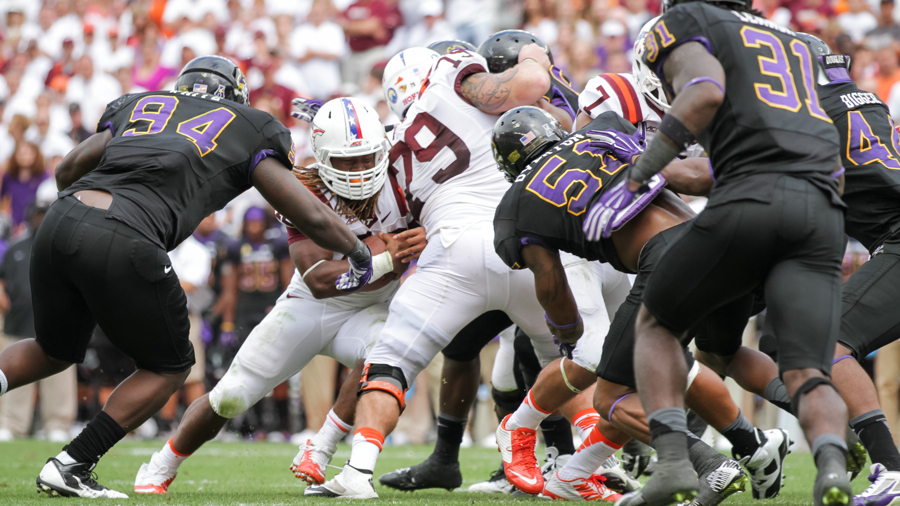
Instead of Western Michigan, I accidently loaded the Georgia Tech game film yesterday and I stumbled upon a very interesting development. It's been a challenge for the offensive line to generate much push and movement on zone runs. Part of that struggle stems from the difficult angle that an o-lineman must take to get his head past a defensive lineman who is not only closer to the path of the run at the snap, but who is generally quicker and more athletic. This requires the zone blocker to take a lateral or slight backwards step at the snap to improve the blocking angle. The "bucket step" helps the lineman improve the blocking angle, but it also means that contact is made with the defensive lineman in the backfield. Losing ground to gain it is effective if the blocker can get lateral movement and create a bubble between his man and the nearest secondary defender. If that gap doesn't appear, those blocks can often lead to a loss of yards. Coach Searels' effort to "bulk up" his linemen made those blocks a little more difficult to execute, but almost all the runs in the first couple of games besides counters involved zone blocking across the front.
Let's look at zone blocking scheme for an outside zone against a 4-3 under front. (Reminder, a 4-3 under means the strong side defensive tackle is playing a one-technique. 4-3 over means the weak side defensive tackle is playing a one-technique.)

The center has to snap the football, pull his arm back forward, step laterally, and either scoop the one-technique defensive tackle back to the inside or drive that defensive tackle into the sideline. This is a very tough assignment, compounded by the fact that the defensive tackle already is closer to the running back's path than the center is before the snap. Once the defensive tackle reads the outside zone, he is also going to be running at an angle away from the center.
Caleb Farris has struggled with executing this zone block, which isn't shocking given that the Hokies have played a series of outstanding defensive tackles and Farris began the season with a shoulder injury. Against Georgia Tech, Farris was much more effective because this zone technique was mixed with the "Roll-It" or "Pin-and-Pull" technique that Mason and I have discussed over the years.
When facing zone blocking teams, defensive linemen want to move laterally while maintaining their gap responsibility, to stretch out the play. The "Roll-It" technique uses that movement against the tackle. Let's see the Hokies use the Roll-It block to spring Shai McKenzie for a big play.
Everyone else zone blocks to the right, but watch right guard Augie Conte and Farris at center closely. Instead of stepping to the right, Conte blocks down on the defensive tackle, who is blindsided by the down block. He can't see Conte coming because he is looking at the ball. Farris pulls behind Conte and delivers a beautiful cut block on the linebacker. At Emory & Henry, we called this a "Roll-It" block. Most in today's coaching circles call this a "Pin-and-Pull" because the defensive tackle get "pinned" inside by the guard while the center pulls and cuts down the linebacker.
The execution here is fantastic across the line of scrimmage. McLaughlin and Rogers take a quick lateral step to the right, which forces the defensive end to widen with him. Conte traps the defensive tackle inside. Farris looks much more comfortable pulling behind Conte. The linebacker is the only player who can fill the gap created between Conte and McLaughlin, and Farris cuts him right to the ground. Gibson and Wang make sure there is not penetration from the back side, and McKenzie identifies the hole and explodes through it for a nine-yard gain.
While the offensive line didn't consistently dominate the line of scrimmage, generally when they utilized Pin-and-Pull blocking against the Yellow Jackets (which happened most often on sweeps from the shotgun with Trey Edmunds and counters by McKenzie), the Hokies were very effective running the football. While I don't expect the pure zone blocking plays to be abandoned, expect the Hokies to use more and more of this technique as the season progresses.

Comments
when it comes to O-line analysis, in French I Trust.
What's the downside or counter to this technique?
If I could guess without a football brain, I'm supposing a blitz in the guard-tackle gap would be especially bad, and if the guard gets pushed back at all the tackle could get a two-for-one?
Correct. If the play is quick hitting and the linebacker is getting downhill instead of scraping, there is a good chance that this technique isn't going to work. At EHC, we as linemen had the option based on the defensive alignment and the play call, to change blocking assignments at the line of scrimmage. Let's say we ran a toss sweep to the right and I am playing right tackle. When I walk up to the line of scrimmage, let's say the defensive end lines up on the inside shoulder of the tight end. My assignment is to reach that defensive end, and he is almost three feet wide of me and he is coming hard up field to contain. That is a tough block to execute.
So, I come up to the line. We see this alignment and I yell to the tight end (toll it, roll it!" He then blocks down on the defensive end and I pull behind him and lead up on the safety. The end gets blindsided by the tight end because most of the time he keys on my first step. It also messed up the safety/OLB because they are keying on the TE. TE steps inside, safety may read that the ball is going inside. If the safety hesitates, that increases the chances of the tailback getting to the edge.
I mention this because I don't know if the Hokie OLs have been empowered to make this kind of adjustment on the fly in situations where the alignment coupled with the DL being really good dictates it.
Now I want to go back to last year's GT film and see if this is (part of) the reason Kyle Fuller spent so much time in their backfield. If they were using this type of blocking scheme and he was consistently attacking that gap, maybe he didn't even need his super powers to dominate them the way he did.
In practice, did you actually yell "roll it, roll it!" or did you have a disguised call? I've always wondered how you keep the defense (or offense in the case of a blitz) from identifying your protection calls. With a keyword or phrase, do you have to rotate the keyword throughout the game so they don't pick up on it? Did you ever utilize fake calls to attempt to make the defense think you were changing to a specific blocking technique?
Thanks for the analysis, French. It's always cool to read what you say and then watch it happen.
One of the thoughts I had was that this method wouldn't really work in goal line situations, because there's less vertical space to defend, so the safeties are closer to the line by default. Is that an accurate observation or am i an idiot?
Everything depends on alignment and the skill set of the defenders. The power play that Marshawn Williams scored on was a "pin and pull" technique, with the exception being that you had three blockers pinning defenders inside and one guard pulling around. In 2012, the Hokies best short yardage running play was a pin and pull power play where the play side guard pulled down and the tackle and tight end blocked down (which resulted in the infamous "Brent Benedict loves Pancakes" gif.) It all depends on the alignment and the skill set of the defender, and having an offensive line and running back that understands when to make that adjustment and the staff having the trust in the group to make the call.
I have no idea if this adjustment was a designed play by the coaching staff, or it was a coaching decision to put in the ability for the linemen to make the call and adjustment based on the alignment and the ability of the opposition. If I could ask that question to the staff, I would. The speed of the game is so much faster than what it was when I played, it may be just something new that the staff put in as a designed play and the staff called it at the right time. But whatever the case is, I like it, and I think we need to see it more often to get the running game going. I don't want to abandon the zone scheme, but when you can run the zone and then come back with this, it keeps the defense guessing where they are going to get blocked from. And that is a good thing.
Note #18 WR dives in hard from teh right and makes a nice effective block on the second LB.
Looks to me like because the Tackle's and influence of Rogers is an effective block against the DE, Rogers then has the responsibility of the defender (CB?) on 18.
18's responsibility from the start was to get to the second LB and does so with speed and panache.
Also I note the play side DT is slow in making any move. I think he's confused by the unexpected move of Conte, trying to see where the ball is. I think he read zone block properly but when Conte didn't go with everyone else, he just doesn't get out of his stance easily at all.
So let's see it more often :)
I love learning this stuff. I admit that, until TKP, I just saw the line of scrimmage as bodies colliding in apparent chaos obscuring my view of the guy with the ball. Now, I can impress my wife and friends by pretending like I saw o-line adjustments like this happen in real-time.
Maybe not simple questions... Who in college football really executes zone-blocking well consistently, and why are they better at it than us? Faster lineman, better coaching, simpler game plan?
I can answer that last bit before French destroys the internet: Anyone who runs it with success never had Curt Newsome as their O-Line coach.