

Last summer, I devoted three French on the Bench columns to the design of Bud Foster's 4-2-5 gap defense. Foster developed the 4-2-5 scheme from 4-4 attack principles (that root back to Phil Elmassian's time at Tech in the mid 90s). The 4-2-5 scheme moved the rover back into more of a traditional strong safety role, while the whip transitioned into a hybrid outside linebacker that was part nickel corner, and part free ranging outside linebacker. As the rovers and whips became smaller and more coverage oriented, Virginia Tech made fewer impact plays (sacks, tackles for a loss, forced fumbles) with the front seven, and instead focused on forcing turnovers with innovative coverage strategies. Eight- and nine-man run support was facilitated through the use of inverted cover 2 zone coverage. In the inverted cover 2 zone, the safeties moved forward to support the run while converging on their underneath zone responsibilities. That left special talents like Jimmy Williams and Jayron Hosley free to sit back in robber coverage and rack up interceptions. Foster even went so far to essentially play nickel corner in place of a whip on a majority of snaps over the course of two seasons.
In 2012, that plan just did not work. With an inexperienced secondary, the Hokies safeties and whip linebackers were consistently taken advantage of by opposing defenses. Foster slowly adjusted his scheme by trying to utilize Michael Cole and Detrick Bonner in roles that made them more comfortable. There were some positive results, but the defense failed to make the big play to win games while the offense struggled. On the eve of the Florida State game, and with expectations at their lowest in recent memory, Foster kicked the can and returned to the attacking 4-4 defensive scheme that brought Virginia Tech to prominence. With it, the roles of the rover and whip changed drastically. Despite the graduation of Bruce Taylor and Alonzo Tweedy, who flourished in the reborn system, Foster utilized the same fronts consistently in spring practice, and I fully expect that the Hokies will use the 4-4 as a base defense this season.
The Basics
From all the film I've watched, regardless of defensive formation, there's one truth that always holds true for the whip and rover at Virginia Tech. Regardless of formation, the Rover ALWAYS goes to the PASSING STRENGTH of the formation, meaning the side of the football with the largest number of eligible receivers. That does not mean that the rover will always line up to the tight end side; for example if the tight end lines up to the left, and the offense has a split end and a slot receiver (twins) to the right, the rover will align to twins side. The whip ALWAYS lines up away from the passing strength of the formation. Given how offenses use formations based on field position, most often the Whip will also be on the same side as the boundary corner, while the rover will be on the same side as the field corner. In these alignments, the rover has more coverage responsibility and is comparable to a second field corner, while the whip free flows to the football in a similar fashion to the free safety. Both can be utilized as blitzing defenders from positions where an offense is unaccustomed to seeing a blitz.
Defensive Alignment in the Four-Four
In the 90's, Bud Foster used two alignments with the 4-4 defense. Following Michael Cole's injury, Foster mostly used the old "46" alignment made famous by Buddy Ryan and the Chicago Bears.
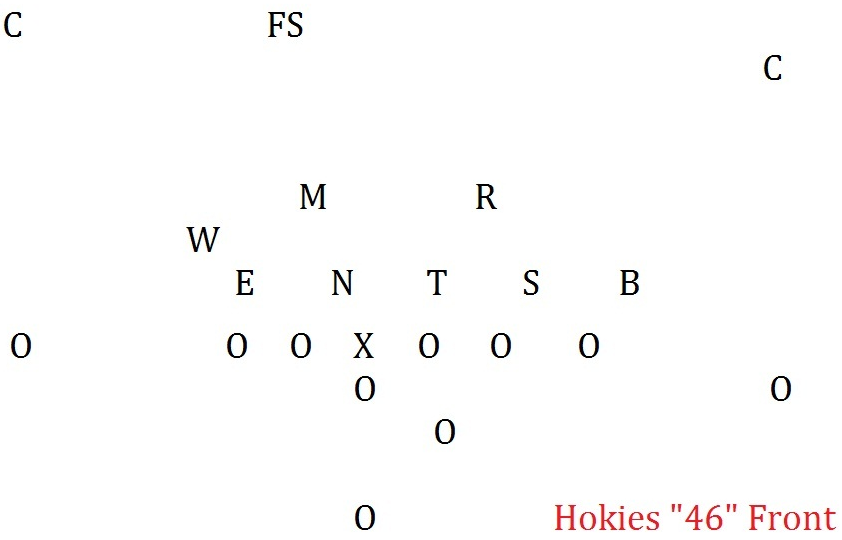
It was Foster's secondary alignment in the 90's, but Bruce Taylor's diverse skillset (remember his stint at defensive end) made him uniquely situated to act as an edge rusher and play as containment. By formation it brought Taylor closer to the strong side flat in zone coverage. As the rover, Kyshoen Jarrett aligned in an inside linebacker alignment. From this position, he would cover the inside receiver to the strength of the passing formation or he had free reign to find the football in run support. Because the three-technique tackle, stud end, and backer are all aligned to occupy gaps, the rover does not have a gap fill assignment in this alignment. Instead, if he identifies run, he is free to attack the football. Jarrett's experience as a cover corner coupled with his unique ability as a tackler in tight space made him ideal for this front.
If teams overload to the strong side, like Rutgers does with this two-tight end strong set below, the middle linebacker and the rover adjust over.
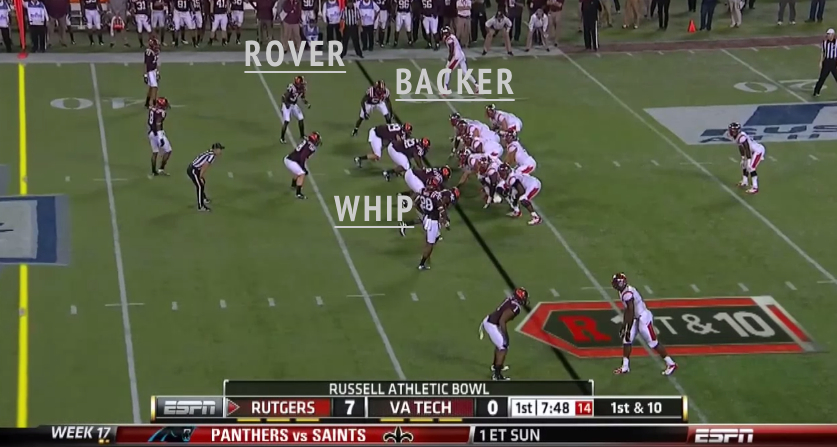
The defensive alignment is shifted over to the strength of the formation, but on the weak side, there are only three blockers to account for four defenders. The whip is unblocked. In this spot, the defensive end can stunt across the face of the tackle and track down the play from the inside, with the whip staying outside to take screen, throwback, bootleg, and reverse responsibility. Or, the defensive end can play contain and the whip can pursue flat down the line.
00:03:06–00:03:12
Both tackles and J.R. Collins stunt to the left and make the play, with Tweedy free and unblocked to take a cutback or a bootleg. The scheme overwhelms the offense with the slant to deliver defenders to the point of attack, and the whip is free to clean up from the backside.
This season the Hokies are without the services of Bruce Taylor and Alonzo Tweedy. Those two were unique talents that allowed them to have success within the 46 front. In their place, Tariq Edwards will play backer and Ronny Vandyke will play the whip. Edwards has better mobility than Taylor, but isn't as comfortable taking on blockers on the outside. Vandyke is not as effective free-ranging in pursuit, but is far superior in man to man coverage.
Accordingly, Foster has adjusted his base front again. Foster will continue to use the 46 front, but as an alternative blitzing front. Based on spring practice, the Hokies will use their old "G" front, which was their primary base front against pro-sets in the 1990's. The "G" front uses the same personnel as the 46 front, with two primary adjustments in the alignment.

Against the G front, the whip and the rover both play on the edge of a six man front, with the rover again going to the strength of the passing formation, with the whip going to the weak side. This gives the Hokies eight men in the box, and because they play so much inverted cover 2 (with corners dropping deep and the free safety coming forward to play zone short and to the strength of the formation) that the free safety becomes a de facto ninth man in the box.
As discussed above, the rover and whip continue to be hybrid positions in this defense. They must be athletic and quick enough to cover secondary receivers in man and zone coverage, but force the run in a similar fashion to a 3-4 outside linebacker. "Force the run" means if a running play comes to your side as a whip or a rover, your assignment is to get up the field with an aiming point at the inside leg of the running back and take on the lead blocker with your inside shoulder. This should force the running back to cut back inside, where the defenders outnumber the blockers.
On the first play of the spring game, we see not only the G alignment, but we also see Kyshoen Jarrett demonstrate that he can be effective on the edge while executing his force assignment.
00:00:10–00:00:18
On this play, the Hokies run a lead-stretch play to the strength of the passing formation. Kyshoen Jarrett is lined up outside the tight end to the strong side. At the snap, he takes an aiming point at the inside leg of the tailback. When he identifies the play as a run at him, he challenges the fullback with his inside leg forward and his inside shoulder.
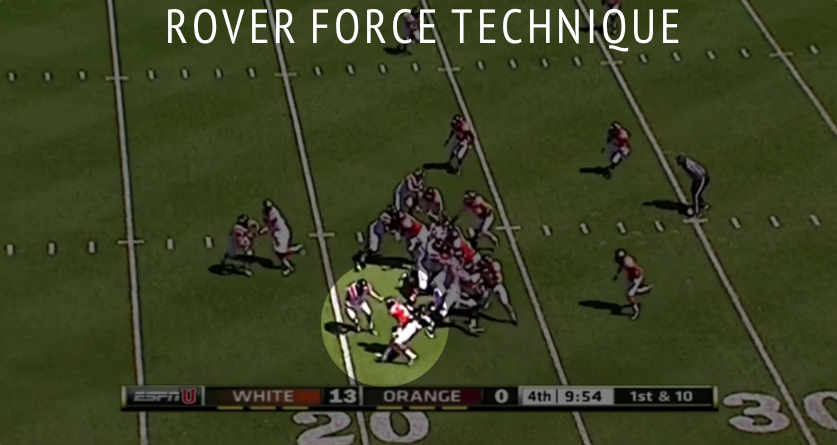
If the tailback tries to bounce it outside, Jarrett is deep enough into the backfield that the back would have to stop his forward momentum. Jarrett also has his outside shoulder free, so the fullback would lose leverage, and Jarrett should be able to pursue the tailback (with help from the free ranging field corner). Instead, the back cuts it inside the fullback's block, right into the teeth of Kyle Fuller, who fills a decent hole (because of an excellent block on James Gayle), and turns it into a 1 yard gain.
At the whip position on the other side, Ronny Vandyke identifies run away. He delays his pursuit until he confirms that the quarterback did not keep the ball on a bootleg, and then he pursues flat down the line in a support position.
On the next play, the Hokies run the stretch play from a two tight end set back at Vandyke at whip, this time without a fullback.
00:00:17–00:00:24
The tight end looks to reach Vandyke, sealing him inside to allow the tailback a clear lane on the outside. However, Vandyke immediately recognizes this and attacks the outside shoulder of the tight end, again with his INSIDE shoulder. He gets up the field and forces the tailback to again cut back inside into the teeth of the pursuit. This is an outstanding example of quality assignment football. Vandyke does not make the tackle, but he was in a very vulnerable position against a good blocker. He leveraged himself to cut off the seal block, and prevented a big play on the outside. Alonzo Tweedy and G-W struggled repeatedly to do so in similar situations over the last three seasons.
From the other side, Jarrett has the backside pursuit assignment. He is a little quicker in identifying that the quarterback has handed the ball off (come on Coach Loeffler, makes those play fakes sharper!) and pursues almost directly flat down the line of scrimmage. He is in position to make the tackle if the back eludes the initial pursuit.
Coverage responsibilities vary for the rover and the whip, most of which were highlighted last summer. When the Hokies run their base inverted cover two, the whip will have the flat to the weak side, while the rover will have the flat to the strong side. In the Four-Four G coverage that was diagrammed following it's devastating effect in the Rutgers game, the whip and rover drop into a four deep look. To a QB, it appears to be man, but if a receiver leaves their quarter, they do not follow unless the throw is made.
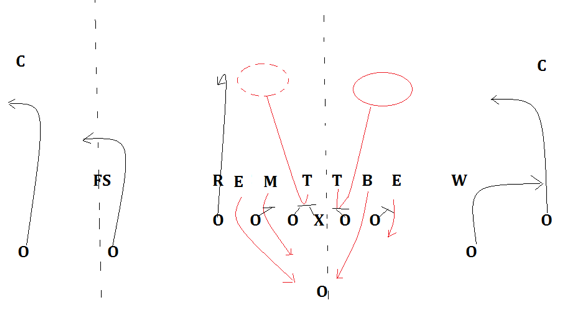
In straight man to man coverage, the rover and whip will align over slot receivers (although last season Foster went against his normal tactic and moved Bonner over the slot, with Jarrett dropping back to play a de facto free safety). In the nickel package, the whip leaves the field and the nickel moves to cover the slot receiver, regardless of which side they align, and the rover plays a traditional two-deep safety to the strength of the passing formation.
In passing situations, whip and rover's new role means one thing, pressure on the offensive line and quarterback to account for 8 potential pass rushers with 5-6 blockers on every play. It forces the offense to play defense, and limits the amount of receivers that can go out in the pattern as well as the routes they can run. Based on the film that I have watched, Vandyke and Jarrett are both much more adept at man coverage than blitzing, but the threat of their blitzing creates opportunities for pressure on the inside. I would anticipate that early in the Alabama game we see blitzes from both the whip and the rover to establish them as threats, and then as the game moves forward they will feign blitzing and drop into coverage to force turnovers.
Over the years, Bud Foster has been able to tailor his system to the strengths of his players while mitigating their weaknesses. His defenses have competed with more talented teams through the use of an attack mentality, one gap responsibility, and creating abnormal situations that force the offense to defend itself. The whip and rover positions demonstrate the premium that Foster places on flexibility, deception, and forcing the defense to account for players that can cover the pass, defend the run, and blitz.

Comments
I love the fact that I can further learn the game on this site. Never seen anything like it before. Thanks guys and keep it up.
Thank you!
No problem its the greatest game in the world and the more I can learn the more I like it
Great explanation once again.
Is it possible for you to use a GIF or maybe your own youtube vid showing the X's and O's? It's at times hard to follow since Coach Foster's schemes are so complex. Seeing the GIF / Vid where the X's and O's move would be tremendous.
Keep up the great work!
Gifs would also be helpful for people like me who read these at work and have youtube blocked. But if you can't, it's no big deal, I can always go back and read them at home (well, I do anyways).
Excellent work sir!
French, I've said it dozens of times before on these boards, but you sir are the titties. Thank you for all that you do, kind sir.
So...how do I call this defense in
NCAACollege Football on the ol' XBOX?When playing as VT on the xbox I switched my base D from a 4-3 to a 4-2-5. You use 2 strong safeties in the game. It is a great blitzing D on the game and a good cover D too.
You could also use a 4-4 defense but switch out a LB with a S or something.
I'm wondering about coaching responsibilities given this shift back to more of the 4-4 look... Coach Cav used to coach Rovers and Whips, with Gray taking the Corners and Free Safety. More recently, Gray took over the 'whole' secondary, coaching corners, FS, and Rover, with Coach Brown just taking the Whip (and Foster the Mike and Backer). That made sense as my understanding (which could definitely be wrong) of the scheme used for the past few years had the Whip as the only true Hybrid, with the Rover as a more traditional strong safety. Now that Whips and Rovers are the hybrids, does it make sense to have one coach (Brown?...) coach them both, as before?
As good as our coaches are on the D side, it's always been a bit strange to me to have a single coach on a single (non-quarterback) position. I know Brown helps with the D-Line, but that still seems a little soft, overall.
Not sure if French (or anyone else, for that matter) is in a position to answer this kind of question, as it it logistical rather than tactical, but just thought I'd see if anyone has any thoughts...
Oh, and I forgot (always implied, but also worth spelling out...) Great job with this French! Love TKP so much...
It is a great question, and one I have asked myself over the course of the spring. For the most part, the coaching staff stayed off the field during the spring game, so it was difficult to gauge where Jarrett was going to for coaching input. I think we should be able to answer this quickly in the spring game.
In Coach Cav's own words, the rover is more like a hybird of a linebacker and a corner, and the whip is more like a hybird of a linebacker and a free safety. My guess would be that Cornell would stick with the whips, and Gray, because he played in the old version of the system and is well versed in the rover responsibilities since, as a free safety, he made all the defensive secondary calls and needed to be familiar with everyone's assignments.
Vandykes in a critical spot against Bama can he prove himself in coverage (he has the intangibles but is still a work in progress) against a team full of superior athletes and stay on the field, or else we become very vulnerable against the run while sitting in nickle with him off the field.
Yeah, RVD is going to be in a bind with only one foot to run on. The other foot, of course, will be squarely up somebody's *ss.
If Saban follows the pattern from the 2009 game, the backer will be the most important position on the field. In 2009, Alabama ran to the passing strength over and over again (hence Jake Johnson's abnormally high number of tackles and an even larger number of missed tackles.) They will attack Tariq Edwards and he must be able to neutralize his gap and let other players come clean up the mess.
Well, I feel a lot better about Tariq Edwards than I did Jake Johnson.
But did Saban single Johnson out to pick on? And aren't they multiple OC's past that game now?
Saban doesn't forget.
Same head coach, same philosophy: target weaknesses. Edwards is playing in his first real game in over a year against Bama. Against a team that has very few liabilities (especially in run stopping), the only weaknesses you can target are Edwards (I doubt anyone considers Tyler a weakness whatsoever) and the BC on the edge. If Exum is back, they'll test his knee. If he isn't, they'll test the Fr/So who replaces him (and weighs less than 190, more likely than not).
Kendall Fuller says #alltheinterceptions
So long as Bama isn't trying to beat him deep (where he struggled a bit last year), they'll probably try other spots in the defense first.
I believe you have your Fullers confused good sir.
yea kyle got beat several times last year partially due to the multiple nagging injuries. i swear it looked like he couldnt cover a post route to save his life last year
Yes I did.
I thought Edwards got a decent number of snaps in the bowl game. He looked good in the Spring Game. He will defintely be better at the point of attack (he looked much stronger) but I will be interested to see how well he plays in space following the year off.
I feel that They will try to hurt Tech's morale first with their passing game, and then pound it out with power runs. I really hope we have answers, but their WRs are scary good.
Alabama runs to their strength more than 2/3rds of the time. Unless there is motion, the backer will be to the strength along with the rover, so the backer becomes critical at the point of attack, while the whip has to come in from backside pursit and take the cutback lane away from the running back.
They'll keep attacking the critical spot over and over to tire him out or get him winded. Then they will start getting big plays. It will happen either at the point of attack or because someone else comes off their assignment to assist the point of attack. If Bama coaches are good enough they will pick up on defensive adjustments and counter them. I hope our new offensive coaches are that good. The previous ones seemed to fail at making second half adjustments.
You're just a shining light of positivity about this game aren't ya?
I am not negative on the game. This is a thread about schemes and strategies. I am no football genius so it might not even work. I played football and other sports and know that if you get tired you make mistakes or get run over. Foster and the D coaches need to have strategies and a game plan to compensate for possible attacking strategies. They need to rotate people in and out to keep them fresh. Individuals need to make plays on the field. We have talent to hang with Bama but if someone gets worn out on a series or in the 4th quarter any scheme will break down. If we can make stops and get the ball back to the O, who can hopefully sustain drives, we will be okay. If we are evenly matched, a couple of big plays, turnovers, or penalties will make the difference in the outcome. I am ready to watch a battle and hope VT comes out the winner. Maybe we can roll the Tide.
I'd qualify that statement....we have good talent on the first team....when Bama substitutes, the drop off usually is far less than the dropoff of their opponent's second team. This is where most teams run into problems. You have to sub someone in, and the Bama coaches immediately test them. I hope our subs do their job.
The key there is for the offense to be able to slow the game down to keep the defense off the field as long as possible, so we don't need to sub as much. Granted, this requires an offense that is capable of a slow, methodic march downfield, which will be difficult enough in the first year with our new staff, not to mention against Bama's defense.
But the same principle applies to our offense against their D; our subs (especially the OL) have to do their job well.
Part of the "slow and methodical" part should also give most of the O time to catch a breather in between plays, so that we hopefully don't have to sub too much.
I'm not too sure our offense will be going for "slow and methodical." Jack Tyler had some good quotes recently about offensive tempo (citing it as the biggest change he's noticed in the offense) that suggested Loeffler will be trying to keep defenses on their heels by varying the tempo:
There is more from Tyler's interview on Aaron McFarling's blog:
http://blogs.roanoke.com/aaronmcfarling/2013/07/hokies-tyler-on-offense-...
I just hope it isn't like the "hurry up" offense we saw in the last few seasons. It was more like the "hurry up and fail" offense.
French, this is good. Too damn good to be open content on the interwebs. I feel like we need to password protect all your posts so other teams can't learn our defense.
Thanks, but I don't think there is anything here that a college staff would not pick up very quickly. This is the base look. Foster always makes adjustments, and the balance of the look allows him to bring pressure from places where the defense can't expect it. The scheme will be good against Alabama.
The big question mark is, and always be, can the Hokies front seven physically hold up to the Alabama front. This front is one of the bigger ones VT has had, so I feel pretty confident. Collins and Nicolas will be battling with Kounandijo. That will be a big matchup.
French, along those lines, how does bama's front compare to FSU's? I feel like they had good size (310, 326, 312, 327, 320) and the D did very well against them with a very experienced QB. I know they are different teams but given the lineage (Fisher coaching under Saban) are there any takeaways/beacons of hope to be derived from that game?
I think FSU runs a zone-blocking scheme. Don't know if Bama does that too exclusively, but i thought they did a lot of man blocking.
Bama is primarily zone blocking, like most other teams these days.
Collins & Marshall you mean?
Dadi backs up Gayle at Stud. The fact that their RT is potentially the least good of the OL bodes well for those two guys.
As of right now Dadi is top line opposite of Gayle. Screen grab is from the media guide that was just released.
I don't know whether to cheer for Nicolas or smh at Collins and Marshall.
I'd still put the odds at 100-1 that Nicolas doesn't start over those 2 guys.
In the spring, Nicolas and Collins were splitting reps at DE opposite Gayle. Wilson is back to back up Gayle. Marshall was terrific in the bowl game, but he really vanished in the spring. He wasn't just not getting reps. He was not being talked about in any context at all. I don't even remember him getting a snap in the spring game with either the 1's or 2's.
I think Marshall might have been injured during the spring game. I'm pretty sure he didn't even dress for it
I defintely didn't see him playing. His tape job/gloves stand out on the field.
If Marshall was injured maybe Nicolas was slotted in there push Collins harder. But reading around a bit more it sounds more like the coaches think he's got a shot to be the #2 DE. I revise my estimate to 50-1 :P
Good info!
I thought, based on your article earlier, that we moved away from the 4-4 because offenses started using more complicated passing schemes. Isn't passing still way more frequent now than the 90s? Will going back to the old method hurt us?
I love QB sacks as much as the next guy, but the interception method seemed to be working for a number of years.
What will be different from how Foster's scheme was in the 90s?
Awesome as always French. Question, how would our 4-4 stack up against these?
http://smartfootball.com/defense/translating-nick-saban-three-plays-from...
Great work as always, French......Question...Does anyone else Alabama regularly faces have a similar defense to ours? I know we've talked before about facing our defense is kind of like playing GT's offense, but didn't know if anyone in the SEC does similar things, perhaps giving a clue how evil Nicky would scheme on us.
I think he will look to exploit weaknesses in personnel and create mismatches in speed, strength, fitness, and experience. Basically he runs his base offense and dares us to stop him. I think there are already mismatches. He will try to wear VT down. They may put in a couple plays based on some tendencies they see on tape. His base package is so strong that it is difficult to stop. We need several turnovers leading to points to balance out other parts of the game.
We will get a good idea early. If our defensive line is making tackles, it should be a good day. If you see Bonner making tackles for 4 yard gains early, it could be a very painful day.
Still, and I will discuss this more on the eve of the game, I am much more scared of the Alabama passing game than I am the Alabama running game. Their receiving corps is worlds better than in 2009 (Jones and a bunch of stiffs) and their QB is much better at the same point in their careers than in 2009.
Agree with that fear. Even with early success we will need to convert with lots of points. We'll need to keep the pressure on all game long. Otherwise it will be like a scrimmage for them. AL is not going to panic unless they are way behind in the 4th (maybe not even then). Need an exceptional effort all game, good bounces, and some good luck.
Especially if Exum isn't able to play and we are breaking in a new corner.
Bama will keep working and adjusting to find the weaknesses. Once they do they will exploit them. The key to success is to not let them find weaknesses. Keep them hidden with movement and change ups. Don't show any tendencies. If they have to keep guessing they will struggle. It's like a poker game, not a chess match.
Most SEC teams run a true 3-4 or 4-3. If I remember correctly (and I admittedly don't watch a lot of SEC football outside of the big games), Arkansas and Mississippi State ran variations of the 3-3-5 stack, and South Carolina runs a very different version of the 4-2-5 where the front plays much more like a traditional 4 man front, but they utilize a whip/nickel style free ranging linebacker.
If Alabama can successfully run the ball against the 8 man front, then using it makes the secondary much more vulnerable. The key to using the front is to create impact plays and put the defense behind the sticks. They must shut down the run and then hope to rattle McCarron (who is much better than Greg McElroy) early. Alabama has the receivers to decimate our defense, but a receiver can't hurt you if the QB can't get the ball.
In the past, Foster was content to play coverage and rely on great corners to make plays. Last season, he trusted that strategy, and his corners and safeties were abused early. I think he kicked the can and said "if we are going to get burned anyway, let's improve our odds by beating up the quarterback." We saw a slow transition starting with the Clemson game where the D made good QB's look bad through pressure. By the Rutgers game, the Hokie defense was playing like an F-5 tornado and Gary Nova had no answer.
Pro-Tip to AJ McCarron: Be Gary Nova.
French--- question about the Carolina 4-2-5. I get that based on the front 4 and their spur who is their rover/whip combo there are some differences, but are their any similarties between Ellis Johnson's defense and Buds. Ellis had a lot of success in 2010 I believe, against Bama where they held Bama under 50 yards rushing for the game not to mention Bamas two backs that game were Ingram and Richardson. Is their anything Bud could draw from that?
I can't claim to be an expert on South Carolina's D, but from what little I have watched, their front 4 plays much more like a one gap 4-3, where their ends and tackles are getting penetration and getting up field. VT slants much more often, which either leaves guys unblocked or keeps blockers off the linebackers.
Thanks. Just was curious becasue looking at that South Carolina front 7 in that game they obviously controlled the line of scrimmage, and they did not have any more talent than tech does.
I agree with you, having watched that game, but I would add another point: Carolina controlled the ball, and Garcia played his fanny off and kept Alabama on the defensive. USC flat attacked, held onto the ball, made offensive plays and wore down Alabama with Lattimore, and then Alshon Jeffries had a banner day catching.
Garcia was 17/20 passing and looked like a Heisman candidate that day.
NO TWEEDY, IT'S WHIP!
Multifaceted question for French. You mentioned the Rover always plays against the passing strength. However, the offense can easily swap the passing strength with simple motion. 1. How does this affect the formation of the 4-4 (do the Rover and Whip swap sides)? 2. Due to the nature of Foster's flow defense, how effective has motion been to create a weaknesses against the defense?
If VT defenders do swap sides, it seems a late motion would cause chaos at the time of the snap, preventing the defense to fill their gaps effectively. If the defenders do not swap sides, it would seem the offense could use the weakness of the Rover and or Whip to create obvious mismatches.
Thanks again French. Your football I.Q. is remarkable.
This is a terrific question and one I am still researching, because the film I have had a chance to review does not really give me a clear answer.
One pattern I have noticed does change the scheme significantly. When the whip linebacker is replaced by the nickel cornerback, the nickel goes aligns over the 3rd most dangerous receiver (primarily the primary slot receiver to the twins side.) The rover aligns over the tight end or the #4 receiver in the slot if there is not a tight end. When there is motion, the DB's do not cross the formation with the receiver. It appears everyone bumps over, but I need to watch more to confirm.
I know that in the 2009 Orange Bowl, if the whip was on the field, Stanford went against tendency. They lined up in 3-tight end sets, with two tight ends to the strength and one away. The tight end to the weak side ate JGW to pieces the entire game. The other linemen would block down and kick out the defensive end, and VT could not stop it.
Additional info: in base formation, it appears that if there is motion away from the rover, the free safety moves forward to the new strength and takes over the rover's assignment. The rover backs up to play free safety. The whip stays put but makes sure that he doesn't get sealed inside by the motion man. I am sure there is variety to these adjustments, but that is what I have seen so far. If I see any other adjustments, I will post them.
Thanks man. Information like this is bar-none. I'll be watching for this now when I watch the games on tv or replay.
I envision French much like Herb Brooks sitting in his home office watching 8mm tape and taking notes. Obviously there is no 8mm tape, but it seems much cooler this way.
+1000 turkey legs to you French, you are the bee's knees!
French, Saban had some turnover in his staff this year. How does that play into the equation?
I love these articles but HATE THOSE HELMETS!
I would have used more exclamation points and caps but kennyhokie used them all up
Long time reader, first time poster.
French, my (totally amature) understanding of the defense is that alignments are split into field-side (wide-side) and boundary-side (short-side). Your use of the term "passing strength" seems a bit incongruent with this dichotomy. What adjustments/alignments are you seeing that prompted you to think of rover and whip responsibilities in terms of passing strength (rather than just field and boundary)? Doesn't the whip almost always take the field side?
I'll defer to French's opinion, but my understanding is the alignments are specific to the 4-4 fronts. Check out this: http://www.playbookexchange.net/playbooks/Defense/02060201-VirginiaTechA... from 1999. Coach Cav had this to say.
Thank you for the question. I am putting together so detailed diagrams and stills to add to this response later in the thread, but being at work I wanted to address this verbally quickly.
In defensive terminology, when the front six (for the Hokies, the mike, backer, stud end, nose, tackle, and end) call the strength of the formation, they are calling the running strength, which is the tight end side. The secondary calls the strength of the passing formation, which means the side with the maximum potential number of eligible receivers. MOST of the time, the strength of the passing formation is the tight end side. However, if an offense has a tight end to the left, and two receivers aligned in twins to the right, the twins side is the strength of the passing formation.
In the BASE defense, which is the 4-4 or the 46 look, the whip is always away from the strength of the passing formation. More often than not, that means he is also to the wide side of the field, because most teams (including the Hokies) run the football much more often to their strength, and the most teams also run much more heavily to the short (or boundary) side of the field. Therefore, on running downs when the Hokies are running their base fronts, the whip will be on the wide side of the field most of the time. If the formation is balanced, ie, one back with a tight end on each side and a flanker to each side, the whip is on the field side.
In the rare case where the offense lines up the strength of the passing formation to the wide side of the field, the whip will be on boundary side. It doesn't happen very often, although I have a couple of stills from the bowl game last year where this applies.
As discussed above, if the offense lines up either in a balanced formation or in strength, but motions the strength of the passing formation to the whip side, the whip and the rover do not switch sides (and if they tried, it would be a mess.) Instead, the whip takes on the rovers assignment for coverage on the inside receiving threat, or the free safety takes the rovers coverage role and the rover takes the free safety's assignment. Communication is critical (hence the early struggles with inexperienced guys at those spots last year.)
Last year also posed an additional ananomly. When the Hokies run their nickel defense, the whip comes off the field. The rover drops back as a two deep safety to the strength of the formation, and the nickel back covers the slot receiver to the passing strength of the formation.
When Michael Cole was injured, Foster made the decision to keep the whip on the field, but, and this is really important, the whip (mostly Alonzo Tweedy) was not actually playing the whip linebacker position. He was playing nickel corner. Therefore, when you see film where Jarrett (the rover) and Tweedy or Van Dyke are on the same side of the field and Jarrett is lined up deep in the secondary, they are actually in the nickel defense.
You see that on all the plays where the number 1 defense played against the shotgun formation in the spring. The backup defensive backs were on the white team, so for the purpose of the scrimmage, the whip (Van Dyke) again moved out to play the nickel corner. The whip must learn the nickel corner responsibilities because if a team comes out in a pro set where the Hokies have the whip on the field, and then spread out after no-huddle, Coach Foster does not have time to rotate the whip out in favor of a nickel corner.
Here is a play from the Spring game where Ronny Vandyke is playing whip and is lined up to the boundary (short side, or the top of the screen.)
00:11:48–00:11:54
The offense is in a balanced look, two tight ends, two flankers and a one back. The rover is lined up to the wide side (bottom of the screen) meaning the free safety has called the strength to the wide side (likely because vs balance, the free safety must call the strength to the most dangerous receiving threat from the inside.)
While it would take hours of additional film-watching to confirm, the only players impacted by field side vs boundary side are the corners. The field corner always plays to the wide side, and the boundary corner always plays to the boundary.
(If the embedded link gives you trouble, here is the direct link. The play starts at 11:48 and ends at 11:56. http://youtu.be/e5sQqH2bFx0?t=11m48s )
Here is another example of the whip to the boundary, with the rover playing on the slot receiver vs twins to the other side from the Rutgers game.
00:05:09–00:05:13
Thanks guys, really appreciate the dialog. As fluid as this defense appears to be I'm just trying to get a sense for the core concepts. It seems that the boundary and field alignments remain static only with the corners (edit: though the rover usually lines up on the same side as the boundary cb and the FS usually takes the wide-side). The front six key off the run (or "run strength") and the back five (to include the whip/nickel) key off the pass (or "passing strength"). Man coverage becomes a factor when blitzes are called. And this can make things pretty interesting.
Granted it's a gross oversimplification, but is that about right?
No wonder it takes most guys a few years in the system to be able to play at game speed.
Edit: Regarding the play v. Rutgers above, did you mean trips to the wide side?
I am sure there are variances specific to game matchups, but those are the basic rules of the defense. They also have some rules on slanting their front based on formation and a variety of keys. I am still studying those keys and perhaps next offseason we will do a deeper dive into that discussion.
I want this team to unleash hell, every chance it gets!
Also, we discussed the basic coverage packages of the Hokie defense last summer. Check the archives of French on the Bench for more detail.