

Parity.
It is the six-letter word that has come to define the contentious debate about the state of college football. We read about it ad nauseam. "The Rich are Richer than Ever..." "Highest-rated [Alabama recruiting] class ever might get better." "Is Georgia's two-year run the best ever?"
At the upper echelon of college football, success is highly correlated with recruiting rankings. There is no getting around this. Teams like Alabama and Georgia dominate the sport because they accumulate the most talent — more, in fact, than they ever have before. That talent is reflected in recruiting rankings, which are tracked by sites like 247Sports and ESPN.
At the same time, there are some programs that always seem to get the most out of their talent. Who are these programs? And what do they get right that other programs don't?
I ran some numbers and came up with a methodology for evaluating the best development programs in college football — those that consistently do more with less. In doing so, I also identified what I believe are the key ingredients for success through player development. To what degree do recruiting rankings matter? And why do some schools out-perform them?
This is my attempt to answer those questions.
It Ain't That Easy
Winning in football is really, really hard. How hard? Let me illustrate it for you.
Like many of you, March Madness is one of my favorite times of the year. I love the upsets, buzzer-beaters, and, well, the madness. Say what you want about the lack of parity in college football; there is certainly no such shortage in college basketball, which features a new champion almost every year and where mid-majors like Florida Atlantic and San Diego State regularly make the Final Four.
By contrast, since the introduction of the College Football Playoff in 2014, 78% of the available playoff spots have gone to just five programs. There has not been a first-time national football champion since Florida in 1996. From a statistician's perspective, this does not make sense. We would expect football to have more parity, primarily because of the short season length: the fewer the games, the more random the outcomes.
But that's not the case. Why? It's a function of how recruiting translates differently to success, which I boiled down to two basic principles.
1) In college basketball, there is no recruiting benchmark required to win a national title.
In football, the requirements for winning a national title are clearly defined: you must have a blue-chip ratio over 50%, and you must average roughly a top-15 recruiting class over the previous four years. This litmus test has held up for nearly two decades.
By contrast, the two most recent basketball champions — UConn and Baylor — ranked outside the top-50 in 247Sports Composite talent. Of the last three basketball champions, none had a five-star recruit on their roster. You certainly need a handful of top-100 recruits to win a title. But basketball recruiting benchmarks change every year, which means they don't matter very much.
2) Football recruiting rankings are mostly predetermined.
We tend to associate recruiting rankings with coaches: a good coach will recruit highly-rated players, and a bad coach will recruit lowly-rated ones. But from a pure rankings perspective, there is incredibly little variation in football recruiting classes within programs over time. Most programs have a rigidly defined recruiting ceiling and floor that transcends coaching staffs, win-loss record, and many other variables.
This presents a challenge for the plebeians of college football; that is, the preconditions for success are highly exclusive. To win a championship requires an elite level of recruiting that most programs will simply never achieve.
And this phenomenon holds true not just if you want to be a championship program, but merely compete at a top-15 or top-25 level, too. In short, the "coaching and player development" route provides a much easier path to winning at a high level in basketball than football. (Perhaps this is due to the lack of a one-and-done rule in football, and the fact that it's just easier to develop 4-5 players than it is to develop 40 players.)
So doing "more with less" in football is hard. But it's not impossible. We know this because there are several programs that do it really well, and we're going to take a look at them.
The Best Development Programs
Who gets the most out of their talent? To measure this, I looked at the end-of-season SP+ rankings (to account for strength of schedule) and compared it to a team's composite talent ranking on 247Sports, going back to 2017. Using a simple linear regression, I spit out a "development rating" (far right column) that shows how many "adjusted" points per game a team performs relative to expectation based on their recruiting.
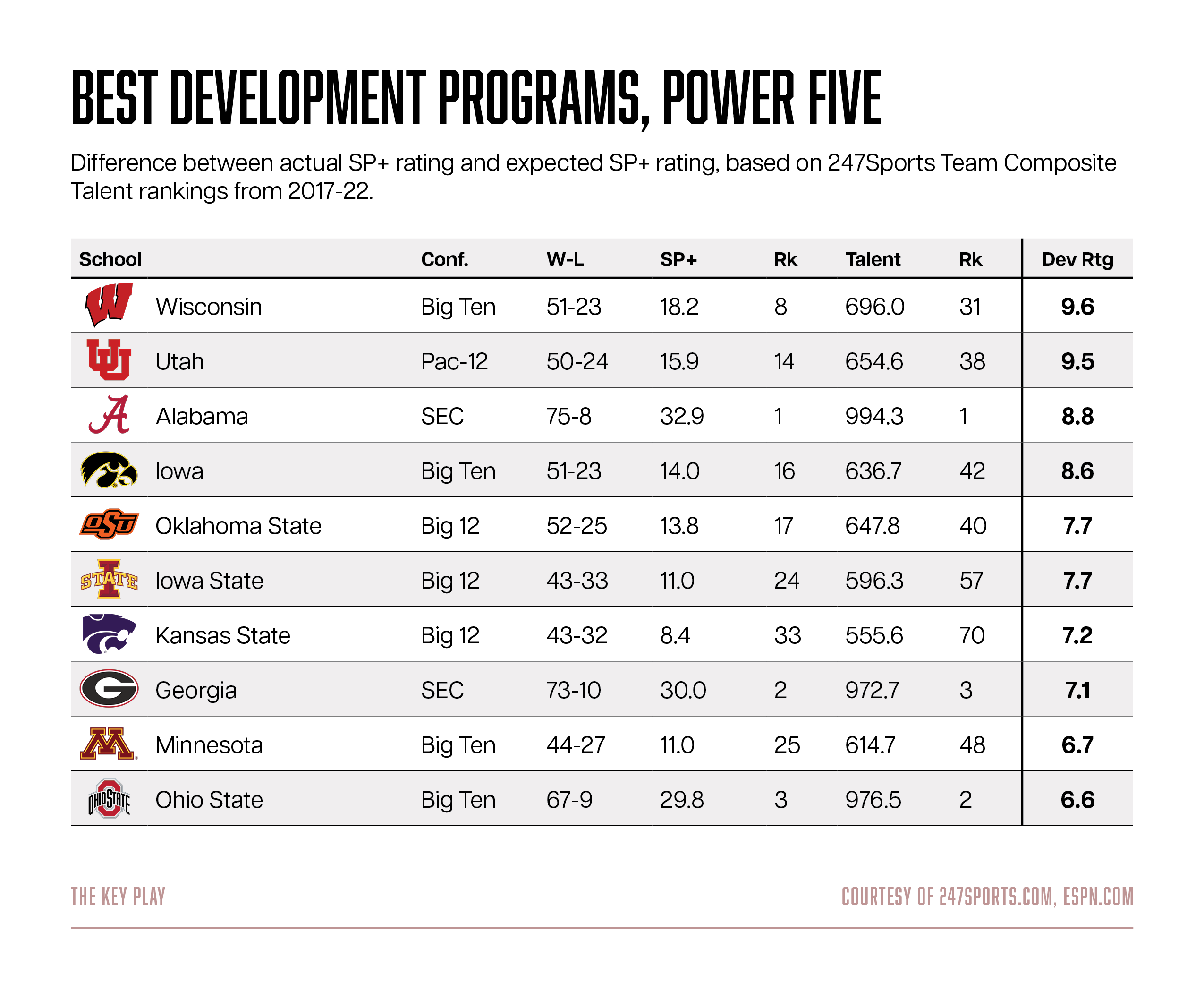
To no surprise, Wisconsin gets the most out of their talent, followed by Utah, Alabama, and Iowa. As with any metric, it's not perfect, but it does give you a good feel for who the biggest overachievers are.
What are the key ingredients to being a good developmental program? First, let's be clear: every program's success starts and ends with the head coach. If you do not get the head coaching hire right, nothing else matters. But beyond that, I identified three major factors.
1. Coaching continuity
The average tenure for each head coach on this list is 10 years. Kirk Ferentz (24 years) and Mike Gundy (17) are the two longest-tenured head coaches in the FBS. Continuity on the assistant staff is just as important: at Iowa, defensive coordinator Phil Parker has been on board just as long as Ferentz, and both Oklahoma State and Utah have veteran strength coaches that have become synonymous with their respective programs.
The longer a coach has been at a school, the more time they have to establish relationships with high school coaches in their state. Longevity, combined with success, is a huge selling point on the recruiting trail.
2. Recruiting Identity
"Identity" is a chalkboard slogan that every coach will preach, but what it looks like in practice is harder to picture.
Utah might be the best example of having a clear recruiting identity that translates to success. In any given year, their roster is composed of roughly one-third Polynesian players, who happen to be the most overrepresented ethnic group in the NFL. (By one account, Samoans boys are 56 times more likely to play pro football than their American-born counterparts).
That pipeline has forged Utah's identity of physical, smash-mouth football teams that win games by dominating the line of scrimmage. It's also created a tight-knit cross-cultural bond that few other programs can rival.
3. Institutional Alignment
Institutional alignment means having your school administration, athletic department, and coaching staff be on the same page with regards to what the program needs to be successful. It is perhaps the most overlooked component to winning. So again we should ask: what does it look like in practice?
To give one example, I recently read an article that delved into how UCF — the newest member of the Big 12 — elevated their football program over the past decade to earn a bid to a Power Five conference. As UCF moved up, their rival South Florida was left stranded in a watered-down American Athletic Conference.
It wasn't always this way. South Florida used to be the preeminent program in the rivalry, and would've been far more attractive to a Power Five conference even 15 years ago. What changed?
Across the board, UCF invested in facilities, bumped up coaching salaries, and created a direct-support organization to streamline athletics. There was a clear emphasis on football from both the athletic department and university president.
At South Florida, coaches had to beg for many of those infrastructure upgrades.
UCF also made consistent coaching hires, tabbing coaches like Scott Frost, Josh Huepel and Gus Malzahn — all offensive minds with up-tempo systems. That allowed them to maintain stability in coaching transitions and avoid prolonged rebuilds. In contrast, South Florida's coaching hires were fairly incongruent in terms of scheme — from the Gulf Coast offense of Willie Taggart to an old-school defensive mind in Charlie Strong to a first-year head whistle in Jeff Scott — which necessitated a large-scale rebuilding project from Day One.
Thus, when assessing the growth of UCF, we would be wise to look beyond just the head coaching hires. Sure, the Knights hired great coaches who won them a lot of games. But they hired coaches who fit a specific identity, allowing them to maintain success across hires, while their athletic administration supported football from the top down.
(For the record, UCF would've finished 10th on this list if I had included Group of Five programs. Among that top-10, only one other program — Appalachian State — did so across three different coaching staffs.)
Finally, there are three teams on this list that might seem a little surprising: Alabama, Georgia, and Ohio State. What gives? Simple: they are just that good. Bear in mind that just because you recruit elite talent doesn't mean you can't also be elite at developing said talent. After all, Georgia won back-to-back national championships with a former walk-on quarterback. When you combine great players with great coaching, dynasties are usually the end-result.
If you take away anything from this piece, it should be how coaches like Nick Saban and Kirby Smart make winning look way easier than it actually is. It's never that easy — at least it shouldn't be.
What's the Plan For Brent Pry?
Since this is indeed a Virginia Tech blog, I thought it might be worthwhile to discuss how the lessons learned from this study apply to the Hokies. First, let's take a step back in time.
In 2001, Virginia Tech had the third-highest paid coaching staff in the country. Former Virginia Tech athletics director Jim Weaver greatly enhanced the school's facilities, overseeing a new football locker room and a massive expansion of Lane Stadium. During the early 2000s, there were few programs in America more committed to investing in football than Virginia Tech.
As for Beamer, he won so many games because he surrounded himself with an excellent staff. Take a gander at the 2004 Virginia Tech football media guide. The average tenure for Beamer's assistants that season was 10 years. Half of those assistants had previous Power Five experience. On the recruiting front, Jim Cavanaugh and Bryan Stinespring were arguably the two best recruiters in program history, locking down Richmond and Hampton Roads. They helped Virginia Tech dominate in-state recruiting: in 2005, 20 of the Hokies' 22 starters were from the Commonwealth.
Beamer's heyday checked every box on our list: coaching continuity, recruiting identity, and institutional alignment.
Fast forward to today. How are things going? Not as great as they once were, but a lot better than they used to be.
Let's start with recruiting. It has been written before that Brent Pry wants to recruit the state of Virginia, as well as a six-hour radius from Blacksburg. I think it would be more prudent to focus on the "six-hour radius" part than the Virginia part. Over the last few years, the state of North Carolina has actually outpaced Virginia in population growth, as parts of NOVA and the 757 have stagnated. This partly explains why, since 2020, the Tar Heel state has produced almost twice as many NFL Draft picks as Virginia has. Among four key mid-atlantic recruiting states — Virginia, North Carolina, Tennessee, and Maryland — Virginia has produced the fewest draft picks.
So recruiting the Commonwealth matters, but it can't be everything, like it was in 2005. Pry is surely aware of this, which is why his 2024 recruiting class features marquee commitments from each of those states listed.
As for institutional alignment, this is an area where Virginia Tech is in a far better spot than they were at any point during the 2010s, making upgrades to their support staff, coaching salaries, and facilities. Granted, in the age of NIL, it's hard to say how much these things matter; there is certainly a point of diminishing returns with support staff, and facilities upgrades can only go so far. But they aren't playing catch-up like they once were.
But to demonstrate how Pry has assimilated to Virginia Tech as an institution, I can offer one anecdote. In January, the Virginia Tech coaching staff went all-out on Signing Day, staging a mock draft where they brought in every signee and their family onto a Zoom call to be recognized by the staff. The social media team did a fantastic job marketing the event. For Pry, it showed how much he was invested in the relationship aspect of recruiting.
Pry's predecessor, in contrast, could not have cared less about Signing Day. For him, it was just another Wednesday. His only comments on the players came in routine press conferences. In fact, a former Tech worker once told me how deflating it was to spend an entire year working on a recruiting class, only to see the head coach give almost zero public recognition to the efforts by everyone involved.
I'm not here to give a lovey-dovey treatise about how Pry's affability and southern charm is going to win football games (we saw last year how quickly the "new coach" smell can turn rancid). But Pry has now checked two of our boxes for program success, and with time he can check a third. He fits the culture. He has an identifiable recruiting strategy. The administration is investing in the places where it needs to.
In other words, Pry is winning off the field. The hope is that he can start winning on it, too.

Comments
Well done Shelton - Great Article!
Great stuff Shelton. Very interesting that there isn't a single ACC school on the list, and surprising to see the Big 12 so well represented. For your extended list, where exactly would the first ACC school appear?
Glad you asked! Here are the top three ACC teams and where they rank among the Power 5 programs:
12 - Clemson
16 - Wake Forest
23 - Pitt
Virginia Tech comes in at 39th.
The only ACC school currently listed that surprised me on first reading was Pitt. Clemson has a great staff, and Wake has always done a good job coaching up. As much as we love to hate on Narduzzi, he is a good defensive mind. They also play better than their rankings.
Nard Dogg and his staff are really, really good at putting players into the NFL on first string squads, and not just on defense.
interesting, but not surprising
Great writeup.
Alabama? Georgia? Ohio State? So if you throw money at coaches and administrative staff, recruit superstars, and back them up with superstars, you get superstars, so no surprises there. I guess to their credit they do more with more. You don't see coaches like Saban resting on their laurels.
The teams on that list are certainly excellent models.
Having a team identity, a team goal, and coaches who work tirelessly to recruit and develop talent are certainly going to be components of success, and it seems as if Pry is on top of all of those. His work is cut out for him, though, as it's pretty competitive at the top, with Miami and Florida State coming on like gangbusters, and Clemson and Notre Dame are not slouching, either. Miami has 20 four star recruits, and two five stars. For VT, the wins and the need for high-level recruiting start snow.
Fuente squandered an opportunity. Early career success came too easily for him, and he didn't know what he didn't know. Many fans were lulled into a false sense that the short term failures might be overcome eventually. Turned out a cigar was just a cigar, and the apparent failures were representative of the true state of the program.
Pry seems to intuitively understand that he's got to be "on" all the time and in every capacity. He hit the ground running, and I'm both impressed and optimistic for his chances. He's going to need some unexpected wins at some point, and he'll likely have to fight for every win.
We, as fans, are going to need a lot of patience. The road is going to be long, and won't be for the faint of heart. VT lives somewhere in the middle of the ACC, and will have to fight like hell to win there.
Gotta hand it to Pry, he has a plan and he is trying really hard. He will never be credibly knocked for lack in those 2 areas.
Is there any correlation between student body size, alumni size and long term success in recruiting there? You mention UCF (who seems to be doing well recruiting Florida this year) who has arguably the largest student body in P5 football, Ohio State is a huge school with an equally large alumni base. Does having alums and lots of students that get the name spread out there along with obvious monetary benefits help?
This comes to mind as a basic assumed tenet...
Probably depends on the school. Having a larger alumni/donor base definitely helps in terms of funding the necessary infrastructure for football.
You've also got schools like Oklahoma State, which have gotten something like $260M in athletic donations from a single donor, Boone Pickens. One of the problems for VT is that they don't have those uber-rich donors that can drop "F-U" money on a dime like that. So everything has to come from the ground up, little by little. That's what Clemson has done so well with their IPTAY program.
So yeah, larger alumni base matters, but there are ways to get around that. All gets back to having the right people in place!
So my takeaway is that we also need a really good pig latin program too.
IPTAY in pig latin would, if I'm not mistaken, translate to TIP
that checks out, I guess
Sometimes a large student body/alumni base does nothing for you. Take North Texas for example, one of the largest schools in Texas I believe, but since it is a "commuter school" the sports programs are not as big.
Other side of that coin is the University of Houston. Another massive commuter school but clearly cares about athletics.
obligatory:

Students with bigger bodies are typically better at football /s
Is that why there are so many Samoans playing football?
Why yes, yes it is.
This is excellent Shelton: A relatively simple way to figure out whose on-field performance is outpacing talent, without penalizing teams for having too much or too little talent.
It seems simple, but I haven't seen anyone come up with this idea until now, and that's with various development rankings sending the cfb online discourse into a frenzy every year.
Thank you for the post Shelton.
Somehow, I'm not surprised to see Wisconsin on top. Glad to see Iowa State there, and not too surprised either since Matt C. got there. Would have guessed TCU was up real high, but they are not. Guessing they are close to the top 10. Those were the 3 that popped into my head before opening the article. Should have guessed Kansas State too, but had not thought of them.
Anyway, it can be done. Let's hope Pry and Company can keep the recruitment uptrend and get them coached up.
Curious to see what the bottom looks like. Texas has got to be real low. Miami and FSU should not be great.
TCU was weighed down by the last 3-4 Patterson years, which were pretty rough. But from 2015-17 they were up around the top 10.
Dykes should have them back soon (in my rankings, that is).
They already have 2 of top 60 players in the country in next year's class so Dykes is on the right track
The coaching up and on field decision making aspect is the next step for Pry and his staff to prove themselves. They have the recruiting down, they have team building down from all reports, they have the conditioning improving (again reports). Now the coaches have to prove themselves as Coaches not recruiters.
An interesting proposal but I don't see the link between the three important factors in development to the ratings, i.e. the factors are not included in the ratings.
The assumption is that developing talent is the magic formula to success.
I don't see the path to getting into the elite 5 based on an argument that "if only we did a better job developing talent ".
I would like to see more success on the field and development can't hurt. I just think the metric does not quantify it correctly. Does talent ranking consider the transfer portal impacts? Maybe talent gained through the portal is more important now. Also, what impact does NIL money have?
Maybe I'm wrong, but I don't think that's the argument at all. My interpretation is Shelton is looking for trends behind teams outperforming their talent level. Wisconsin isn't a top 5 program, but from 2017 to 2022 they were the best at outperforming relative to the talent they acquired. And trying to learn what is unique about them or Kansas State (or why Alabama is so much better at this than another elite recruiter) is very worthwhile.
Also, 247 has a team talent ranking that includes the ranking of every player on the roster. It includes transfer players, though their ratings are from high school. This is what Shelton used to compare a team's talent and their performance for a given year.
Good points. What I am trying to say is the connection between outperforming talent level is not an indicator that proves the importance of the three factors. There is an inference that is what is going on but no correlation is shown.
I think I get what you're saying? For example:
Good points all around from both of you. I think we can qualitatively pick out a weak correlation between a few of these concepts and quality development, but it'd be inappropriate to claim any causation
Yeah my read on this article was two-parts:
part 1 - quantitative analysis to identify 10 programs whose on-field performance exceeds expectations, controlled for talent level.
part 2 - qualitative assessment of some shared qualities between those 10 programs.
I didn't read it as an attempt at a causal argument.
The fun dark mirror of this list is, who does less with more? Always fun to see Notre Dame top the list...
My pick is Texas.
Tha "U"?
Yea we need this list.
Yesss...
I'm curious as to who does poorly as well.
Depends on the time frame but USC, Michigan (prior to two years ago), Penn State, FSU, A&M and really most of the SEC.
Now here is the Dark Horse ... Stanford. They have two top 25 classes on the last 4 years. Their other years were ~40th but had higher per recruit ratings that many of the teams above them. And they are currently 15th for 2024 class. They are 10-28 the last 4 years.
Notre Dame won't top the list because they do "pretty good" with more.
Miami strikes me as a leader in doing less with more.
Florida State has had a pretty good recent streak of doing less with more, but they may have turned a corner.
pre-HH Tennessee comes to mind first
I was going to say the same thing. Post Fulmer / pre-Heupel Tennessee got some good recruits and lost a metric shit ton of games.
I had to read that a few times...I know after the UNC flirtation, Frank had some demands, but damn!
I still haven't see data on this but I keep hearing it.
Source: WaPo in 2000
Thank you, I still wonder if it was truly 3rd because the private schools don't always report, however that really only means it was top 6-7 at worse which is still great and a long ways from where we are at.
In 2001 we added $100k to each coaches salary per the article. In 2021 our LB coach made, $150k. We really fucked up along the way. I knew it was bad because Wiles got a huge pay increase to go to NC State. But to pay a coach 2001 pay in 2021.
Since some folks asked: yes, I do have a graphic for the 10 worst player development programs in Power Five!
You see a lot of teams that recruit very poorly here, but (in the invert of Alabama and UGA) are also really bad at maximizing the talent they do have. I believe Kansas and Georgia Tech are the only Power Five programs that have a losing record vs. G5 schools since 2010.
I know Texas would've been a popular choice. They've definitely underachieved relative to talent level, but the Tom Herman years prop them up a little bit. Same boat with UNC: pretty average overall but with a couple decent seasons (Orange Bowl in '20) to make it seem not as bad.
If anything my formula might over-weight teams that are really really bad or really really good. There's obviously some degree of subjectivity in terms of who should be performing better with the talent they have.
Miami also got a boost from a couple decent years in there but I imagine are in the top 20 for doing the least.
I wonder how much of the GT is still wreckage from CPJ?
I'm sad that Maryland isn't on that list.
Great read, but I'll disagree with the first part:
That number is highly skewed due the dominance of Alabama and Clemson in the playoff era. These two teams accounted for 13 of the 36 playoff spots available in the 9 year period. The remaining 23 playoff spots were split between 11 just teams.
For comparison, Miami and FSU finished in the top 4 (of the AP) every year from 1987 to 1992. At least one of them was in the top 4 every year from 1986 to 2002. In fact, if we look at the 9 year period from '86 to '94, and assume that the AP season end top 4 would have qualified for a playoff, then these two schools would have counted for 15 of the 36 hypothetical playoff spots, with the other 21 spots being split by just 11 teams.
In fact, in this 9 year from '86 to '94, we had just 6 different teams finish AP #1. From 2014 through 2022, we've had 5 national champions (I suppose 6 if you count UCF).
I share this because I strongly believe that CFB goes in cycles, and that the lack of parity we are seeing right now is not dissimilar to past periods. The difference, in my opinion, is how the sport is covered and consumed. National coverage on the playoff race trumps local coverage on your team, so fans really have no choice but to view the season through the lens of finding a national champion (something that never really existed in the sport until 20-30 years ago).
You are correct that CFB goes in cycles. My main point is that high-level success is much more attainable for a larger number of college basketball programs than football programs, which is a trend that goes back at least a couple decades now.
In college basketball, the equivalent to a CFP berth would be a 1-seed in the NCAA Tournament. Since the CFP has been in place (minus one year to make up for 2020), the top five CBB programs, in terms of getting 1-seeds, account for only 56% of all 1-seeds. Kansas, Gonzaga, and UVA lead the way with four each; in football, Alabama, Clemson, and Ohio State have at least five.
In basketball, you don't see programs hogging those spots as consistently from year to year. And to the extent that they do, it's not predetermined based on recruiting rankings. Any CBB program could theoretically get a 1-seed and win a title if they get the right coach in place. That isn't true for football because the vast majority of CFB programs will never recruit at the level required to get there.
It's interesting that you chose 2017-2022 - any reason for this other than the fact that 5 years is a nice round number?
I've heard people consider 2011 onward to be the 'modern recruiting era' (not sure why, but let's go with it) - in that time period, I believe (going from memory) that 7 of these 10 teams have had 2 coaches or less (excluding interims) in that time (Minnesota, Wiscy and OSU being the exception, with all three having continuity between hires) - anyways, if possible, would love to see these numbers for 2011 through today.
I can give you the numbers back to 2015 -- that is when 247 first started tracking composite team talent, which takes into account every player on the roster. (You could go back further, but you'd have to combine recruiting classes from the previous 4 years for each season which throws it off a little due to natural roster attrition.)
2015-22
1. Wisconsin
2. Utah
3. Iowa
4. Alabama
5. Minnesota
6. Oklahoma State
7. Kansas State
8. Clemson
9. Oklahoma
10. Ohio State
Interesting, thanks for computing!
This should be a friendly reminder that we all need to be jumping on board here.... Even an annual donation to the Hokie Scholarship Fund AND Triumph NIL (even just a total of $50/year) will go a long way. Imagine if the thousands of Hokies who aren't sure how to donate could figure out how to just give a few $$.
I don't know if Triumph has a $50 option. I think the lowest option is $10/month or $99/year
You may be right... I haven't logged on yet as I've been donating to the scholarship fund. I anticipated adjusting my investment between both. Thanks for clarifying!
Yea when I signed up for triumph, I just signed up for a yearly subscription. You can buy additional points too, but Im not sure you can do that without a subscription. I bet you could if you signed up but didn't purchase a subscription.
Anyone here involved with triumph? If so, my suggestion is to sell gameday experiences with membership. I.e. tailgating spot for all members close to the stadium, roped off with community drinks and food. Don't really care about shout outs or meet ups tbh but would love a cool spot to tailgate and drink some beers with other fans on gameday (don't have my own parking pass or enough friends in town regularly to host a tailgate myself)
That's not really how NIL works... The athletic department could sell this to you. NIL is an endorsement for the player, the player needs to sell something related to their name, image, or likeness.
Perhaps a player could make an appearance at this tailgate - then it would be NIL
I think this stuff is actually pretty cool. I wouldn't want a shout out for myself, but I'll probably get a shout for a friend having a baby or as a holiday gift or something. It's just like Cameo. You can also some of the athletes to create workouts for you, which I think is really cool.
Edit: autocorrect
Ah ok I see I see. Thanks for clarification
In theory, they can fundraise any way they want (without getting/giving impermissible benefits), and a tailgate is a potential way to further promote the players' NIL and get more members signed up, then why not. They could charge for non-members or members of a certain donation range get in free. They could have non-football players attend or show up, etc. as an attendee perk and NIL payment to the player. You could promote football players' NIL in other ways (e.g., merchandise tent).
I would have to imagine they would need to pay a fair price to use university grounds so that it's not an impermissible gift from the University, but in my opinion, this seems like a legit NIL opportunity that at a minimum would be a perk for donors and potentially a way to further NIL fundraising and to compensate VT athletes.
...ahem...
The Hokie Way lets you do a one time donation any amount you want.
https://www.thehokieway.org/
Duke and Wake have done as good of a job with development as anyone in recent years