
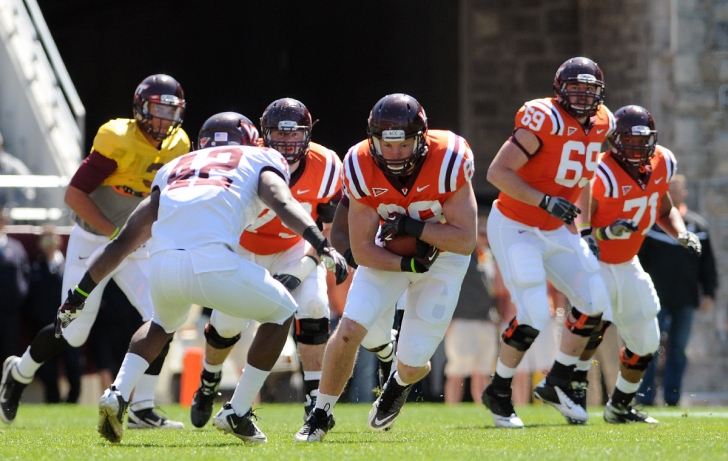
Run the football. Those three words will define the 2013 Virginia Tech season. The Hokies will win if they can run the ball effectively over 30 times a game. Running the football will set up play action, and play action will give the Hokies the opportunity for big gains. Running the football will allow the defense to be aggressive on limited snaps, rather than being forced to stay on the field for long stretches. Running the football will lead to victories. I made the trek down interstate 81 for one reason. I wanted to see the Hokies run the football.
Perhaps for me, nothing was more disappointing than the inability of the offense to run the football against the second- and third-team defensive groupings. I didn't expect them to be a well-oiled machine. It requires strict adherence to simple blocking rules, but with that simplicity comes a feel that can only be developed through experience. What is the precise moment when you should peel off a down linemen to go to the second level? These things take time. Nevertheless, when your top five offensive linemen go against your 6th-12th best defensive linemen, you expect the top offensive line to win those battles. Why didn't it happen on Saturday?
I went to the film trying to figure out what exactly went wrong up front. The film shows a work in progress. Dominance was hard to fine, but the first offensive line group was relatively solid in picking up their assignments. Some of the problems stemmed from a lack of timing on when to release a double team. Other unsuccessful plays were the result of poor blocking by fullbacks and tight ends. Some were missed assignments, and then finally, there were a handful of plays where the defenders were just better. Perhaps it bodes well that those plays where the defenders were better were few and far between.
Examining the Basics of Zone Blocking
The zone is a play where the offensive line takes an initial step to key the defenders that a run is going outside, and then as gaps develop on the inside, the running back plants and cuts through the soft spot in the defense. Though inside zones are designed to run inside the tackles, they can break open anywhere depending on how the defense attacks. Outside zones require the running back to take an initial east-west route to get to the edge of the defense. It is an ideal play for Trey Edmunds, as he is a patient runner who is decisive, gets downhill quickly after his initial cut, and gets yards after contact in small seams. The inside zone is difficult to diagram because blockers engage based on the pursuit of the defense, but here is an example from the "A" formation that the Hokies have run extensively in early spring practices.

On the inside zone play, the offensive line will all take an initial step to the play side. Linemen who are "covered" (meaning that a defender is on the line of scrimmage directly across or on the play side shoulder of the blocker) will take a short, almost horizontal step to the play side. The defender will read this as an outside run, and attempt to gain leverage on the outside shoulder. This causes the defender to "widen" as he moves to the sideline, creating additional space. The blocker engages the defender immediately and continues to take him to the outside, but the blocker can't allow the defender to cross his face back to the inside. The aiming point for the covered blocker is the outside hip or shoulder of the defender to prevent initial penetration, then adjust pressure to the inside shoulder of the defender (usually through a hard punch or thrust with the inside arm) to prevent him from coming back to the inside.
The "uncovered lineman" (who does not have a defender on the line of scrimmage in front of him) will also take a flat lateral step to influence the linebacker, and then he will double team the inside shoulder of the defender engaged with the blocker to the play side. This helps prevent the defender from crossing the face of the covered lineman.
At this critical moment in the double team, both the play side offensive blockers are engaged with a defender. This means both blockers are engaged with the defensive lineman while both blockers are watching the play side linebacker. When the linebacker attacks the line of scrimmage, one of the linemen releases the double team and blocks him. If the linebacker goes inside, the inside blocker takes him. If the linebacker goes outside, the outside blocker takes him. The other blocker stays with the defensive lineman, maintaining leverage and leg drive.
On the back side of the play, each blocker steps to the play side and engages the defender. The same rules apply. The uncovered lineman will double to the play side, and the covered lineman must not allow initial penetration. The toughest block on the play is the responsibility of the backside covered lineman, who must block a defender lined up inside himself, where the defender has a better angle to the football than the he. Often, you will see the Hokies backside tackle, guard, or tight end struggle with this block in scrimmages and early games as they grow accustomed to the offense.
The Hokies will often utilize a fullback lead blocking on the play. The fullback has the same rule as the uncovered lineman. He moves to the play side, attacks the line of scrimmage when the linebacker commits, and takes him where he wants to go laterally. The Hokies will often use a full house backfield, with the H-Back / D.J. Coles flexed in a fullback position on the back side of the play. He will take a step play side to help the back side scoop block with penetration, and then go hard to the flat away from the play. The quarterback will bootleg hard after either handing the ball off or faking the handoff. If the defense respects the H-Back going to the flat, then it pulls an additional defender away from pursuing the run. If the defense collapses hard on the zone run, a bootleg leaves the H-Back wide open, or Logan can run the ball.
The tailback takes an initial lateral step to the play side, and then attacks the line of scrimmage two hard steps. When he gets close to the line of scrimmage, the back will plant his outside leg and make a decisive cut. The critical components for success are a running back who can get downhill quickly after making a decisive cut, and offensive linemen athletic enough to cut off initial penetration and maintain their block for a much longer time period than traditional "straight-ahead" schemes require. While being athletic and quick, they also must be strong enough to not be driven into the backfield before the back can make his primary cut. The Hokies attempted to implement zone blocking under Newsome, but in an effort to become more athletic, their linemen were not strong enough to prevent initial penetration.
This play is very flexible and can be run from almost any formation, and it is impossible to defend because the hole develops where the defender either gets cut off or over pursues the play. If the defense squeezes inside to prevent the inside zone, the outside zone stretch suddenly becomes a much more effective play and looks almost identical from a blocking perspective except the blockers must seal the defenders inside.
The Film
Scot Loeffler tried to establish the zone play immediately on the first drive. Things started out promising. On a second and short, the Hokies ran an inside zone left from a deep I-formation with D.J. Coles lined up offset like a fullback away from the direction of the play.
0:55–1:02
As discussed above, each lineman takes a flat step to the left side. Edmunds attacks the line of scrimmage. If you freeze the film at the 57 second mark, you will see Edmunds plant his outside foot.

Each blocker on the play side is driving their assignment laterally. On the back side, Zach McCray (who initially lines up as a fullback to the weak side) fills the cutback lane and engages a double team on the three technique defensive tackle. Edmunds plants and makes the correct cut, following McCray into the bubble. Both Gibson and McCray are engaged with the defensive tackle, but Gibson should peel off to either the linebacker or Ekanem crashing in from the backside. Edmunds finishes the run with a burst. This play gets five and a half yards, but should have gotten around seven. Those inches and yards matter as we see shortly.
Following the long run after catch by Stanford, Loeffler calls the zone play to the left three straight times on the goal line. He doesn't turn to a full jumbo formation and essentially has 8 blockers to block 10 defenders. On first down, there are no busted assignments.
1:15–1:20
Edmunds picked the correct hole, but Brandon Facyson steps into the hole and sticks him. It is a terrific individual play by Facyson. In a game situation, the staff would expect Edmunds wins that physical battle.
On second and goal, Loeffler comes back with the same play.
1:21–1:29
Again, Edmunds makes the correct cut. This time, the play side fullback (#36) dives headlong into the hole, throws a shoulder at Clarke and misses, then goes to Faycson and misses him. If he blocks one, Edmunds has to beat the other. Edmunds makes a breathless cut, and almost beats both to the end zone. Again, the offensive line completes all assignments, and Jonathan McLaughlin has a terrific drive block that almost springs Edmunds.
On third and goal, Loeffler again calls the zone left, but the defense blitzes the middle linebacker through the center-right guard gap.
1:29–1:36
Devin Vandyke hammers between Farris and Miller. Zone blocking rules mean that Andrew Miller (at guard) absolutely has to cut block that blitzer, or the fullback has to bend back. My guess is that was a bust by Miller on the play.
The failure to pound the ball into the endzone, and the subsequent interceptions seemed to derail any confidence that the offense had developed over the past couple of weeks. Here, J.C. Coleman runs an inside zone.
2:34–2:39
Again, the interior of the line struggles to pick up a middle linebacker blitz through the center-guard gap. This time, Farris is assigned to pick up that gap. He doesn't get a great first step off the ball, and Vandyke's movement turns Farris' shoulders facing the sideline. If there was not a blitz, McCray from the H-Back spot would double the three technique (Alston Smith) with Farris. Since Farris has to deal with Vandyke, McCray should fill on Smith, but overruns him. Smith and Vandyke arrive and Coleman falls down. Again, at the other spots all assignments are completed.
Sometimes, the running back has to make the correct read, and Michael Holmes sometimes made his offensive line look bad by making the wrong cut. Here, Loeffler runs a zone away from the strength of the formation.
3:23–3:30
Again, Miller and Farris have difficult reach blocks on the interior. Freeze at 3:27: Holmes has to plant and cut outside Miller, who also has to be athletic enough to adjust and get enough of Vandyke to seal him inside.

A huge hole forms just outside of Miller if Holmes can bounce it, but he attacks the line and gets eaten up. Again, if Miller can just get a piece of the blitz, or if Holmes makes the correct cut, this is a huge play.
Individual Performances
It is surreal to see how similar things played out between last season and the Spring Game. Time and again they were one block (no pun intended) from bad plays being average, and good plays being great. How did each player stack up individually, despite the performance of the full unit?
Jonathan McLaughlin was the surprise of spring practice. He quickly moved from right tackle to left tackle, and then supplanted Mark Shuman as the starting left tackle. I suspected that McLaughlin may have been used as a bit of a motivational ploy by Jeff Grimes to get Shuman to improve his run blocking, but McLaughlin wowed me with his play on Saturday. Based on my review, he was blocked the correct assignment on every play, and at times was physically dominant. His feet don't look particularly quick, yet he gets where he needs to go. His feet continue to chop at contact. He has low pad level, and when he makes contact, defenders just can't get seem to shed him.
I still have some concerns about his pass blocking. He was excellent on Saturday, but the Hokies play their best pass rushers over the right tackle. Loeffler also occasionally kept a tight end or back in to help McLaughlin. He was outstanding for a freshman, and hopefully he will continue to improve.
Mark Shuman lost the starting job at left tackle. On the limited tape we got to see from earlier scrimmages, he appeared to struggle run reach block the back side defenders effectively. When I learned he was starting at left guard, I had deep concerns about how those limitations would translate to the position. However, it appears that Grimes made the right move. Shuman was also sharp with his assignments (I did not find a complete bust.) He isn't a dominant run blocker, but kept defenders moving laterally and maintained contact and foot drive. He was excellent in pass protection. Shuman took two penalties at the guard position, a hold and a false start on back to back plays. The hold appeared to be a phantom call. I did not see his hands reach outside the shoulders, and there didn't appear to be any strange change of direction from a hold. The odd call seemed to rattle him, and he flinched in his stance on the next play.
Laurence Gibson was one of the guys who I was very critical of in my live game review. However, the film told a bit of a different story. He suffered a major lapse towards the end of the half where he was getting beaten in pass protection, and the significant penetration that came from the left side on the goal line (and Jeff Grimes resulting butt chewing of Gibson) suggested that he was struggling. Also, he was called for holding on Trey Edmunds long run, which negated perhaps the best offensive play of the day. His hands were outside of the shoulders, but he wasn't grabbing jersey and the defender did not have his direction changed because of the hand position. That hold will not be called very often in a live game situation.
The Hokies did not run left as much as I would have expected, but when they did, he was solid on the reach technique that forces the defensive end to widen out on the zone play. He had two plays where he struggled to scoop a three technique on the back side, but neither really impacted the play. However, when things really started to turn negative towards the end of the half, his level of play dropped. He was close to being beaten on several pass rushes and ultimately gave up a sack to Matt Roth, who I do not expect to ever be a contributor at Virginia Tech. In the second half, the Hokies almost completely abandoned the run. Gibson, who was facing Ken Ekanem most of the game, was relatively solid.
Brent Benedict had the challenge of facing the number one defensive unit while working with an inexperienced group of underclassmen. He had a very solid game run blocking, and got a couple of pancake blocks (one on Jack Tyler and one on Kris Harley).
His mobility, especially taking on stunts on passing situations, continues to be a problem. Too often I saw the defensive ends perform an X stunt with the tackles and crash hard through Benedict's inside shoulder. Benedict lost leverage on his inside shoulder (a cardinal sin for a guard because it collapses the pocket for the quarterback and takes away the lane for follow through on his throws.) Benedict gets points for performing at a high level against the higher level of competition, but, I continue to be alarmed that he wasn't getting work with the first team.
Farris had an opportunity to get work as the number one center, while Andrew Miller worked at right guard. Early in the game, he had a poor low snap on the long completion to Stanford. Later, Devin Vandyke beat Farris to the point of attack on two zone plays. For a center, this is one of the toughest blocks to make (look back at how many tackles for a loss Jack Tyler has made blowing through the center-guard play side gap against the run). It is made even tougher by the need to have a sharp center-quarterback exchange while taking a fundamentally sound step to the play side. Farris sometimes does not get a sharp step, allowing the defender to turn his shoulder pads to the sideline.
To his credit, Farris had the work ethic to get himself back into the play on several of those miscues. His second and third steps are excellent, allowing him to recover and at least continue to occupy the defender. On several plays, I saw Farris get pushed backwards a little more than I would like to see, but he would turn it into a higher gear, get underneath the pads, and get a draw on the play. In pass protection he looks a little awkward sometimes, but he did not give up any sacks or significant pressure. Over the summer, snapping and his first step will be critical areas of improvement.
It is certainly possible that Miller is still not 100% from his season-ending ankle surgery, or he's out of position at guard, and if so, hopefully he can be better during the fall, but he was the least impressive of all the orange linemen. He looked to be labored just walking out to the field, and once live action started he seemed to be a step behind, especially handling those same interior blitzes that Farris struggled with. However, Miller wasn't burdened with the additional challenge of getting the snap off. He struggled scooping the one technique defensive tackles on the back side of the zone play. He had the same issues on some of the film from prior practices, as Kris Harley gave him fits on numerous plays. Alston Smith also toasted Miller on a swim move on the last series of the game. That just isn't good enough.
Where Does This Leave Us?
I walked away from this film scratching my head a bit. The offensive line didn't perform as poorly as they looked, and most of the mistakes came more from things that will be learned through experience, especially the nuance of following zone blocking rules and getting a feel for the leverage needed to release double teams and go to the second level. At the same time, you expect your experienced top guys to be dominant against your second and third team defensive groupings. As I told people at the game, the Hokies could go 11-1, and I would still regard it as a rebuilding season, because Grimes doesn't have the length and athleticism at every position on the line that he wants and the cupboard is bare behind the two deep, with only Pfaff and Osterloh on scholarship. Adam Taraschke and Augie Conte have bright futures, but the six players listed above, if healthy, will be the rotation this year along with David Wang.
So, where do things shake out? I feel pretty good that McLaughlin and Gibson are locked into starting jobs and they deserve them. Mark Shuman looked much better than I expected him to look at left guard and may have found the correct role after bouncing around the depth chart. I still think Benedict is the correct play at right guard. Center should be the heaviest competition, with Farris, Wang, and Miller all competing for repetitions there and at the guard spot. To me, that is a complete toss-up.
How will this group perform against Alabama? That is a more difficult question to answer at this stage. Foster's defense is a unique animal. I have compared playing against it, to playing the Georgia Tech spread option. There were eight men in the box on most plays, and even with perfect blocking, one man was unblocked every play. The stunting and slanting front, with linebackers crashing through the interior gaps, was designed specifically to stop zone blocking systems. Pass protections are also very different, as the Hokies best pass rushers were lining up over Gibson at right tackle, where McLaughlin will face outstanding edge rushes from outside linebackers who are lined up wider than a traditional defensive end against Alabama. On the inside, Farris, Miller, and Wang won't be faced with slanting tackles and blitzing linebackers. Instead, their challenge is moving a massive nose tackle and timing the release of the double team so one blocker can pick up the scraping inside backers. The 3-4 is a wildly different look, and we know that the athletes playing it for Alabama are elite. If the Virginia Tech offensive line wants to control the game and power the football, it will be critical to develop that cohesion and feel for the offense through voluntary work over the summer. The longer position battles are unsettled going into fall camp, the more problematic it will be to develop that cohesion. I expect Jeff Grimes to take a long look at the film, and make some tough decisions about the opening depth chart for fall camp over the next couple of weeks.
Next week, I will drill down on the quarterback performance in the spring game, and break down the bootleg series that compliments the zone running game.

Comments
Is anyone really surprised that the offense hasn't immediately turned a corner? Good things take time.
The defense will be our crutch, what else is new? Fortunately, we also have a proven kicker (Journell) and punter (Hughes), and we saw last year how those can save a game.
and as French said to me during the game, "at least he's not Scot Demler"
Hearing Demler's name gave me the jibblies...in fact it gave me the jibbly jibblies
Strongbad reminds me of VT days circa 2005. You get a turkey leg
+1 for Strongbad
When you e-mail Strongbad/stare-down Bud Foster: you "get a world of hurt!"
+1 for that throwback...
Dude...great analysis!
I thought you might be slightly less dejected after looking at the film. I've just made it through the first quarter so far, so can't speak to the whole game, but I saw some good things along with the not-so-good things. This is a snapshot on the way to being where the team will be on Aug 31. Let's hope the bumps in the road aren't insurmountable.
So I've seen people say that the defense wasn't allowed to blitz in the spring game, but you pointed out some fairly clear blitzing linebackers. Is that just the nature of Foster's defense? Was the defense in fact allowed to blitz as long as it wasn't anything too exotic? Did Frank just allow it to force Loeffler to react to blitzes he wasn't expecting? Just a question that popped up as I was reading. I don't know enough about football terminology to know what would constitute our "base defense", and what would be something extra Bud dialed in.
As always, thanks French for the effort you put into these. Looking forward to the summer of knowledge.
Blitzing allowed on short yardage situations. Might have even been just on 3rd and short.
That's why the rules (basic offensive plays, "base defense") so heavily favored the defense.
The defenders knew what plays were coming and could react very quickly, much quicker then a real game where they'd have to worry about counters. Those blitzes by the LB's in the interior gaps are part of the base defense. When given a certain formation and when seeing certain keys (like Linemen stepping parallel to the LOS) the interior LB crashes the playside A gap.
If Loeffler had his whole offense, he could have attacked that rule with more play action plays, or switch up blocking assignments, or throw some counters (like traps and cut-back runs). But with only a handful of plays, there wasn't much he could do but continue to run right at the teeth of the defense.
Still disappointing how little push the Oline had. It's one thing to hit all your assignments, it's another to dominate your man once you reach them. Don't be surprised this season if the Hokie offensive line struggles often to get vertical movement up front.
I feel smarter every time I read one of French's video breakdowns. Excellent work as always, and it lifted my mood to see that perhaps we just need some refinement to really start seeing some consistency. The guys will have to work hard over the summer, but I feel a bit more optimistic than I did when leaving the stadium on Saturday.
French, how different is the zone blocking scheme we want to run compared with Mike Shanahan's stretch? I understand Shanahan wants the back to get a little further out before cutting it up, but are the two formations similar in other regards? The reason I ask is because talking with a coach or two up in DC might be beneficial for our O-linemen, considering Alfredo (Morris) proved how effective their scheme can be.
As always, tits write-up French!
Let's hope we can turn a corner this summer and play like a team.
I will upvote anyone who uses "tits" as an adjective
French - I have an overall question for you (since you are...by far...the best expert in this arena): Given VT's current roster and recruiting base, what kind of offensive scheme would we be best suited to run? Just seems like year-after-year (and yes, this is a new regeme) we are looking at a system that just isn't "comfortable" (blocking is awkward, passing isn't smooth and refined, running is too reliant on "perfect" blocking). I've posted this in other areas, and maybe it's a bigger question than a reply.
It seems to generate the most interest when talking about LT. He's not a classic drop back, accurate passer...his strength is running over people (i.e. read option) and being able to throw (effectively) after the run threat is there (more like the Tim Tebow system). Is our system best designed for his strengths? Don Shula was a Hall of Fame coach because he adjusted his system to the players he had around him.
Our best offense is punting.
BEAMERBALL
Arm punting FTW?
In that case, the arm pride and joy gave up two returns for touchdowns and the arm punter injured himself trying to tackle the return man
Somewhere in the world, Marcus Davis is reading this and chuckling at the thought of blocking.
I was late into the game so I missed the play but that pass play to Stanford in orange's opening drive was placed perfectly.
that pass was actually thrown into an ultra tight window. yeah it was placed well, but it was a couple inches away from being the first pick six.
If he made the throw he made the throw. That's all there is to it. You can't get mad at a player for making too good a play.
The fact that it was a completion (regardless of how close it was) shows that he made the right decision.
i wasnt mad about it, i jumped up and yelled and annoyed the people in front of me. it was a hell of a catch and run by stanford. i was just saying it was an extremely small opening. just a habit lt may not want to get too comfortable with.
you can get upset with a player for making the wrong decision, whether it ends up working out or not. Props to LT for a beautiful throw, but he needs to make a better decision and not throw that next time.
If he saw the window, thought he could make it through, and does... it's the right decision.
I haven't had a chance to look at the video for evidence or a reason why, but the blocking by the line on punts looked awful. I thought 3 punts had a good chance of being blocked, but it looked like we had guys holding back as to not hurt Hughes. Anyone have any theories why that was so bad. Also am I the only one who can't stand having two returners on punts? I mean all it does it give Holmes a chance at return instead of having Kyshoen Jarrett return, and you lose a better blocker for Kyshoen or someone to block the punt (the return of Beamerball Would be nice).
French, let's suppose that Benedict does end up as our starting RG. You've said it before that Miller struggles against good NG's like the one we will face against Alabama (Brandon Ivory?). Wang doesn't seem like he has the size or strength to handle the Bama front, so doesn't Farris give us the best option at C for the opener?
I'm starting to think that Beamer needs to quit spotting the starters points and see if they fight back. Gayle's comment in Bitter's blog, "I thought it would be a cake work [cake walk, he meant]..." was very telling. That is the wrong mindset in the first place.
When Logan first took the snap in the first spring game as the full-time starter, I was watching him because I had my doubt, but once he hit Marcus Davis in stride, my doubt vanished. The difference between that spring game and the Saturday ones? They mixed and matched the 1st and 2nd unit guys to see what happens. The result? Maroon dominated the White team with Danny Coale on the White team, if I remember right.
I didn't liked the format. I didn't liked the introduction to all the players, taking up needless times, and the only highlight I had was "Enter Sandman." That was all before the first snap.
I think the team would be better served next year to just slug it out like always, earn the points and the win. Maybe, just maybe we can get better sense than Saturday where everybody were going, "WTF?"
You make a good point with the Gayle comment. If I was a starter on this team, returning from last year's 7-6 team (Thank God for UVa and Duke), I believe I would have a different attitude about my "cake walk".
Instead of moseying around until the music stops, I would have wanted to come out on Sat in front of the fans and stomp that mother trucking cake into the ground.
I hate to say it, but I think these "tip of the spear" and "T-Time" antics indicate that these coaches are worried that this team is soft. And...I think they are dead on. Beamer needs to go to Merryman and cut the cords on the Playstations and just play John Wayne movies on a 24/7 loop or something.
There is such a thing as practice overload, too. Sometimes, it's all about playing smarter, not harder. I have no problem with the players gaming in their off-time.
Sad part is, they really don't even get to use the lounge that much. If it wasn't in such a vulnerable spot, I'd say it should be open to the public on weekends or something similar. Otherwise that is a lot of wasted money (although not from a recruiting stand point) to have 6+ flat screens and PS3/XBOX 360s and two really nice pool tables. Of course they could just rent it out for parties (TKP party anyone?) and use that money for something useful.
Wise,
I really don't have a specific issue with the players gaming in their spare time. I just get the feeling that the entitlement attitude of a few players in this current crop has spilled over to this year. I'd just like to see the 1st stringers as hungry on the field as the 3rd stringers.
I'd prefer gaming to, oh, say getting into fights at 1:50 in the morning.
Needless to say, many of us will be following updates and reports from the summer very closely. I for one think that although the offense had a poor showing, at least there was a spring game this year to begin with. That's one more major practice, all squads got in. Having it cancelled last year, didn't help matters at all. Just like the Russell Athletic Bowl helped the team have more time to practice.
Great job as usual French and thank-you. Ultimately when recruiting begins to bring in the right linemen and personnel then we will see a big difference in the personality of the running game. We can move away from the split personality with the Jekyll and Hyde performances. Has anyone checked out Alabama's scrimmage from last Saturday? It seems as if it didn't go so smoothly either. The Alabama offenses combined for six interceptions and three lost fumbles. AJ McCarron threw 2 interceptions himself and completed 19 of 30 passes for 223 yards. Take a look at the whole story yourself at :
http://espn.go.com/college-football/story/_/id/9194533/nick-saban-says-s...
French,
Always look forward to your breakdown of individual play, I think it shows the everyone how complex D1 football is.
I re-watched the '07 Clemson game last night, and thought about how much we all miss true BeamerBall.
Also, I cursed loudly at Dabo Swinney, every time the then-WR coach was shown.